Key Laboratory of Pathobiology, Ministry of Education, Jilin University, Changchun, China.
Department of Radiation Oncology, The First Hospital of Jilin University, Changchun, China.
Oxid Med Cell Longev. 2018 Jun 6;2018:5438179. doi: 10.1155/2018/5438179. eCollection 2018.
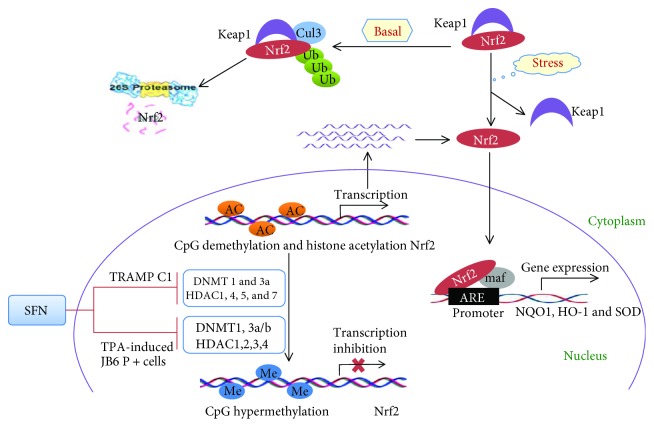
Sulforaphane (SFN), a compound derived from cruciferous vegetables that has been shown to be safe and nontoxic, with minimal/no side effects, has been extensively studied due to its numerous bioactivities, such as anticancer and antioxidant activities. SFN exerts its anticancer effects by modulating key signaling pathways and genes involved in the induction of apoptosis, cell cycle arrest, and inhibition of angiogenesis. SFN also upregulates a series of cytoprotective genes by activating nuclear factor erythroid-2- (NF-E2-) related factor 2 (Nrf2), a critical transcription factor activated in response to oxidative stress; Nrf2 activation is also involved in the cancer-preventive effects of SFN. Accumulating evidence supports that epigenetic modification is an important factor in carcinogenesis and cancer progression, as epigenetic alterations often contribute to the inhibition of tumor-suppressor genes and the activation of oncogenes, which enables cells to acquire cancer-promoting properties. Studies on the mechanisms underlying the anticancer effects of SFN have shown that SFN can reverse such epigenetic alterations in cancers by targeting DNA methyltransferases (DNMTs), histone deacetyltransferases (HDACs), and noncoding RNAs. Therefore, in this review, we will discuss the anticancer activities of SFN and its mechanisms, with a particular emphasis on epigenetic modifications, including epigenetic reactivation of Nrf2.
萝卜硫素(SFN)是一种从十字花科蔬菜中提取的化合物,已被证明安全无毒,副作用极小/无,由于其众多的生物活性,如抗癌和抗氧化活性,已经得到了广泛的研究。SFN 通过调节与细胞凋亡、细胞周期停滞和血管生成抑制相关的关键信号通路和基因发挥抗癌作用。SFN 还通过激活核因子红细胞 2-(NF-E2-)相关因子 2(Nrf2)来上调一系列细胞保护基因,Nrf2 是一种对氧化应激反应激活的关键转录因子;Nrf2 的激活也参与了 SFN 的抗癌作用。越来越多的证据支持表观遗传修饰是致癌和癌症进展的一个重要因素,因为表观遗传改变通常导致肿瘤抑制基因的抑制和癌基因的激活,这使细胞获得促进癌症的特性。SFN 抗癌作用机制的研究表明,SFN 可以通过靶向 DNA 甲基转移酶(DNMTs)、组蛋白去乙酰化酶(HDACs)和非编码 RNA 来逆转癌症中的这种表观遗传改变。因此,在这篇综述中,我们将讨论 SFN 的抗癌活性及其机制,特别强调表观遗传修饰,包括 Nrf2 的表观遗传再激活。