Jung Jaehyuk, Jeong Inchul, Lee Kyung-Jong, Won Guyeon, Park Jae Bum
1Department of Occupational and Environmental Medicine, Ajou University Hospital, Suwon, South Korea.
2Department of Occupational and Environmental Medicine, Ajou University School of Medicine, 164 World cup-ro, Yeongtong-gu, Suwon, 16499 South Korea.
Ann Occup Environ Med. 2018 Jun 8;30:39. doi: 10.1186/s40557-018-0249-5. eCollection 2018.
Prospective studies on occupational stress and depression among Korean workers are scarce. This study aimed to investigate the causal relationship between changes in occupational stress and the presence of depression.
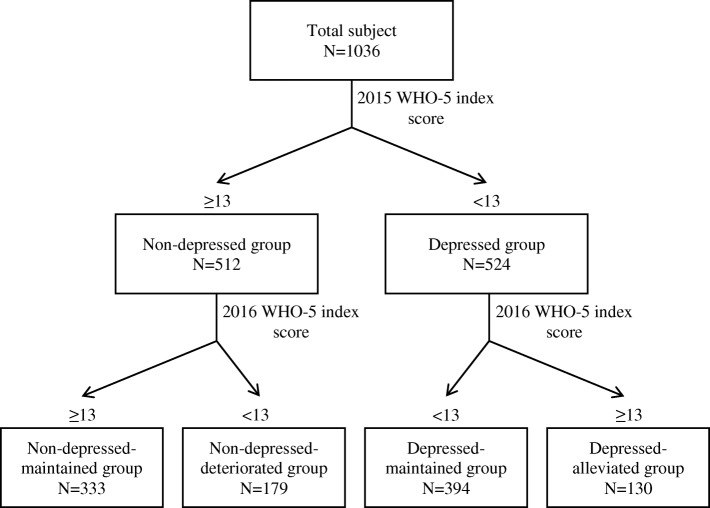
This study analyzed data from a survey conducted with workers in a large Korean company (2015-2016). Occupational stress was measured using the Korean Occupational Stress Scale, and depression was screened using the WHO-5 Well-being Index. The levels of occupational stress were grouped in quartiles based on subjects' occupational stress scores in 2015, and changes in occupational stress were measured using the score changes between the 2015 and 2016 surveys. Subjects were divided into four groups according to the presence or absence of depression in 2015 and 2016: a non-depressed group whose mental health did not change, a non-depressed group whose mental health deteriorated, a depressed group that continued to be depressed, and a depressed group whose symptoms of depression were alleviated. Logistic regression analysis was used to calculate the odds ratios (ORs) and confidence intervals (CIs) of the subjects' deterioration in mood or alleviation of depression by occupational stress levels and changes.
The OR for developing depressive symptoms was 2.51 (95% CI 1.46-4.33) and 2.73 (95% CI 1.39-5.36) in the third and the fourth quartiles of occupational stress, respectively, compared to the first quartile. When the occupational stress score increased by 1 point, the OR for increasing depressive symptoms was 1.07 (95% CI 1.04-1.10). There was no significant difference in the alleviation of depressive symptoms between the groups by level of occupational stress. However, when the occupational stress score decreased by 1 point, the OR for alleviating depressive symptoms was 1.08 (95% CI 1.05-1.11).
The results showed that increased occupational stress increased the presence of depressive symptoms, and that reduced occupational stress suppressed the development of depressive symptoms. More attention should be paid to stress management among workers.
关于韩国工人职业压力与抑郁症的前瞻性研究较少。本研究旨在调查职业压力变化与抑郁症存在之间的因果关系。
本研究分析了对一家大型韩国公司员工进行的一项调查(2015 - 2016年)的数据。使用韩国职业压力量表测量职业压力,使用世界卫生组织-5幸福指数筛查抑郁症。根据2015年受试者的职业压力得分将职业压力水平分为四分位数,并使用2015年和2016年调查之间的得分变化来衡量职业压力的变化。根据2015年和2016年是否存在抑郁症将受试者分为四组:心理健康未改变的非抑郁组、心理健康恶化的非抑郁组、持续抑郁的抑郁组以及抑郁症症状得到缓解的抑郁组。使用逻辑回归分析来计算受试者因职业压力水平和变化而出现情绪恶化或抑郁症缓解的优势比(OR)和置信区间(CI)。
与第一四分位数相比,职业压力第三和第四四分位数中出现抑郁症状的OR分别为2.51(95%CI 1.46 - 4.33)和2.73(95%CI 1.39 - 5.·36)。当职业压力得分增加1分时,抑郁症状增加的OR为1.07(95%CI 1.04 - 1.10)。按职业压力水平分组,各组在抑郁症状缓解方面无显著差异。然而,当职业压力得分降低1分时,缓解抑郁症状的OR为1.08(95%CI 1.05 - 1.11)。
结果表明,职业压力增加会增加抑郁症状的出现,而职业压力降低会抑制抑郁症状的发展。应更加关注工人的压力管理。