Chen Yen-I, Khashab Mouen A, Adam Viviane, Bai Ge, Singh Vikesh K, Bukhari Majidah, Brewer Gutierrez Olaya, Elmunzer B Joseph, Moran Robert A, Fayad Lea, El Zein Mohamad, Kumbhari Vivek, Repici Alessandro, Barkun Alan N
Division of Gastroenterology and Hepatology, Johns Hopkins Medical Institutions, Baltimore, Maryland, United States.
Division of Gastroenterology and Hepatology, The McGill University Health Center, Montreal, Quebec, Canada.
Endosc Int Open. 2018 Jul;6(7):E780-E788. doi: 10.1055/a-0611-5082. Epub 2018 Jul 4.
Endoscopic ultrasound-guided drainage is an effective and accepted primary modality for management of pancreatic pseudocyst (PP). A lumen-apposing metal stent (LAMS) has recently been developed specifically for drainage of pancreatic fluid collections which may be superior to using traditional plastic stents (PS) but is more expensive. Because use of a stent involves a risk of unplanned endoscopy, percutaneous drainage (PCD) and surgery, their costs should also be included in the comparison and a cost-effectiveness analysis of LAMS and PS should therefore be performed.
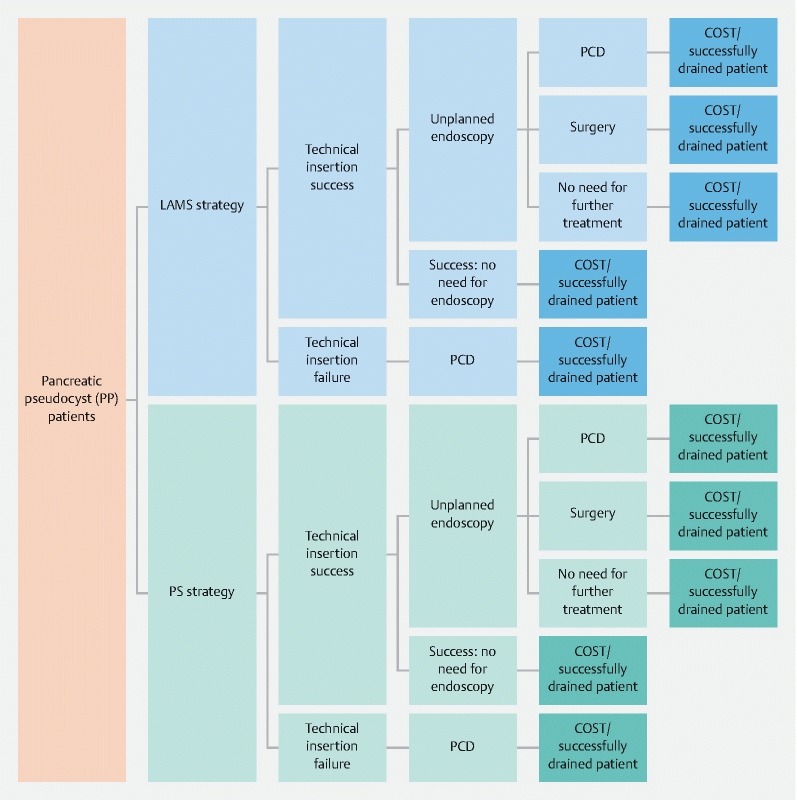
A decision tree was developed assessing both endoscopic drainage strategies for patients with PP: LAMS and PS over a 6-month time horizon. For each strategy, inpatients received a stent and were followed for subsequent need for direct further interventions or adverse events leading to unplanned endoscopy, PCD, surgery, or successful endoscopic drainage using probabilities obtained from the literature. The unit of effectiveness was successful endoscopic drainage without need for PCD or surgery. Sensitivity analyses were performed.
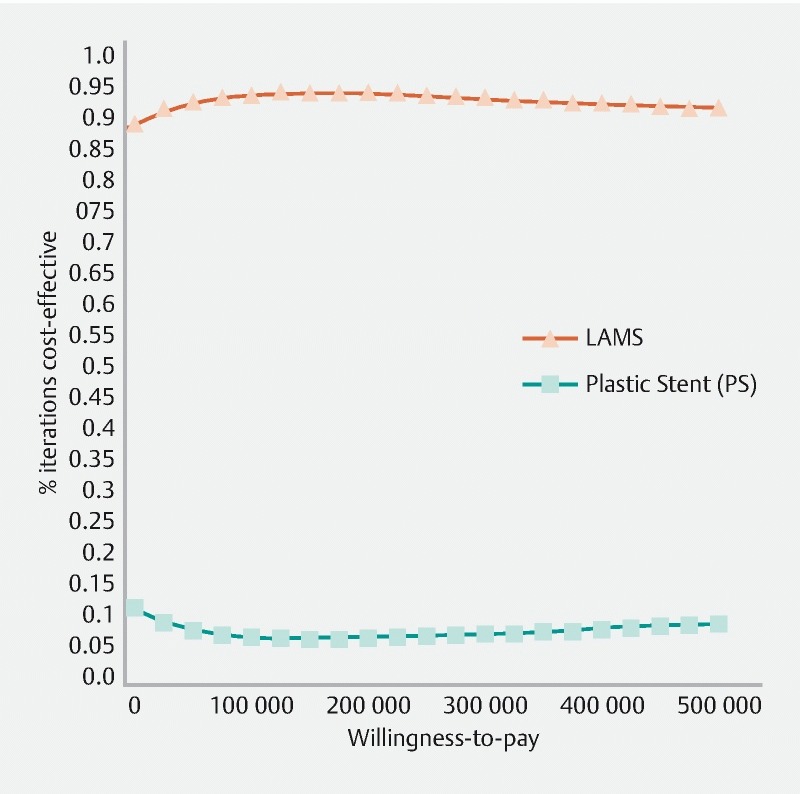
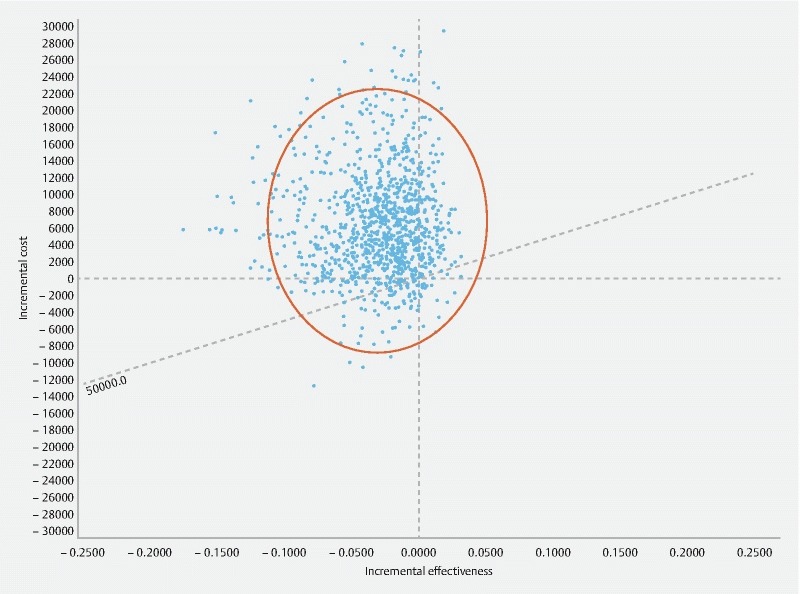
Success rates were 93.9 % for LAMS and 96.96 % for PS. Respective costs per successful drainage were US $ 18,129 (LAMS) and US $ 10,403 (PS). The LAMS strategy was thus characterized as dominated by the PS approach because it was costlier and less effective than PS. Both deterministic and probabilistic sensitivity analyses confirmed the robustness of these findings.
Use of LAMS is not less effective and more costly than PS in management of patients with PP. As such, PS should be preferred over LAMS as initial management of these patients.
内镜超声引导下引流是治疗胰腺假性囊肿(PP)的一种有效且被认可的主要方式。一种管腔贴壁金属支架(LAMS)最近专门被研发用于胰腺液体积聚的引流,它可能优于传统塑料支架(PS),但成本更高。由于使用支架存在计划外内镜检查、经皮引流(PCD)和手术的风险,其成本也应纳入比较,因此应进行LAMS和PS的成本效益分析。
构建了一个决策树,评估PP患者的两种内镜引流策略:LAMS和PS,时间跨度为6个月。对于每种策略,住院患者接受一个支架,并根据从文献中获得的概率跟踪后续是否需要直接进一步干预或导致计划外内镜检查、PCD、手术或成功内镜引流的不良事件。有效性的单位是无需PCD或手术的成功内镜引流。进行了敏感性分析。
LAMS的成功率为93.9%,PS的成功率为96.96%。每次成功引流的成本分别为18,129美元(LAMS)和10,403美元(PS)。因此,LAMS策略的特点是被PS方法主导,因为它比PS成本更高且效果更差。确定性和概率性敏感性分析均证实了这些结果的稳健性。
在PP患者的管理中,使用LAMS并不比PS效果更好且成本更高。因此,作为这些患者的初始管理,应首选PS而非LAMS。