Beverly Chloe M, Naughton Michelle J, Pennell Michael L, Foraker Randi E, Young Gregory, Hale Lauren, Feliciano Elizabeth M Cespedes, Pan Kathy, Crane Tracy E, Danhauer Suzanne C, Paskett Electra D
1Division of Epidemiology, College of Public Health, The Ohio State University, Columbus, OH 43210 USA.
2Division of Population Sciences, Department of Internal Medicine, College of Medicine, The Ohio State University, Columbus, OH 43210 USA.
NPJ Breast Cancer. 2018 Jun 29;4:15. doi: 10.1038/s41523-018-0065-7. eCollection 2018.
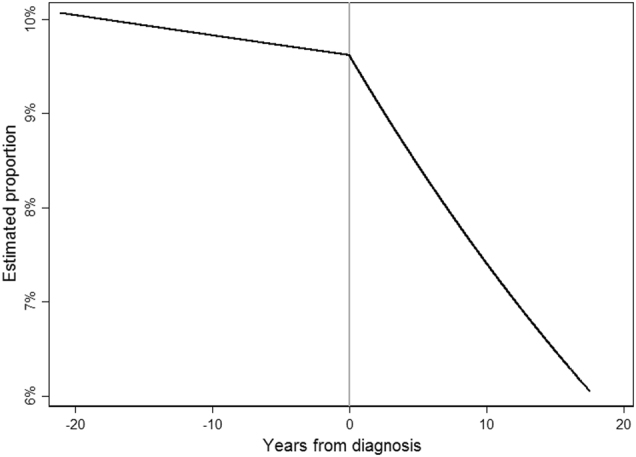
Breast cancer survivors frequently report sleep problems, but little research has studied sleep patterns longitudinally. We examined trends in sleep quality and duration up to 15 years before and 20 years after a diagnosis of breast cancer, over time among postmenopausal women participating in the Women's Health Initiative (WHI). We included 12,098 participants who developed invasive breast cancer after study enrollment. A linear mixed-effects model was used to determine whether the time trend in sleep quality, as measured by the WHI Insomnia Rating Scale (WHIIRS), a measure of perceived insomnia symptoms from the past 4 weeks, changed following a cancer diagnosis. To examine sleep duration, we fit a logistic regression model with random effects for both short (<6 h) and long (≥9 h) sleep. In addition, we studied the association between depressive symptoms and changes in WHIIRS and sleep duration. There was a significantly slower increase in the trend of WHIIRS after diagnosis ( = 0.06; = 0.03), but there were non-significant increases in the trend of the probability of short or long sleep after diagnosis. The probability of depressive symptoms significantly decreased, though the decrease was more pronounced after diagnosis ( < 0.01). Trends in WHIIRS worsened at a relatively slower rate following diagnosis and lower depression rates may explain the slower worsening in WHIIRS. Our findings suggest that over a long period of time, breast cancer diagnosis does not adversely affect sleep quality and duration in postmenopausal women compared to sleep pre-diagnosis, yet both sleep quality and duration continue to worsen over time.
乳腺癌幸存者经常报告存在睡眠问题,但很少有研究对睡眠模式进行纵向研究。我们在参与女性健康倡议(WHI)的绝经后女性中,研究了乳腺癌诊断前15年及诊断后20年期间睡眠质量和时长的变化趋势。我们纳入了12098名在研究入组后患上浸润性乳腺癌的参与者。使用线性混合效应模型来确定,根据女性健康倡议失眠评定量表(WHIIRS)(一种衡量过去4周内感知到的失眠症状的量表)所测量的睡眠质量的时间趋势,在癌症诊断后是否发生了变化。为了研究睡眠时间,我们拟合了一个逻辑回归模型,该模型对短睡眠(<6小时)和长睡眠(≥9小时)都有随机效应。此外,我们研究了抑郁症状与WHIIRS及睡眠时间变化之间的关联。诊断后WHIIRS趋势的增加明显放缓(β = 0.06;P = 0.03),但诊断后短睡眠或长睡眠概率的趋势有不显著的增加。抑郁症状的概率显著降低,尽管诊断后降低更为明显(P < 0.01)。诊断后WHIIRS趋势以相对较慢的速度恶化,较低的抑郁率可能解释了WHIIRS恶化较慢的原因。我们的研究结果表明,在很长一段时间内,与诊断前的睡眠相比,乳腺癌诊断对绝经后女性的睡眠质量和时长没有不利影响,但睡眠质量和时长都会随着时间的推移而继续恶化。