Drozd Łukasz, Ziomek Monika, Szkucik Krzysztof, Paszkiewicz Waldemar, Maćkowiak-Dryka Monika, Bełkot Zbigniew, Gondek Michał
Department of Food Hygiene of Animal Origin, Faculty of Veterinary Medicine, University of Life Sciences in Lublin, 20-950 Lublin, Poland.
J Vet Res. 2017 Sep 19;61(3):293-298. doi: 10.1515/jvetres-2017-0039. eCollection 2017 Sep.
The objective of the present research was to carry out a comparative assessment of copper, zinc, and selenium concentrations in the meat of edible land snails collected in Poland (, and ), as well as to determine the effect of preliminary processing of Roman snails () on the content of the aforementioned elements.
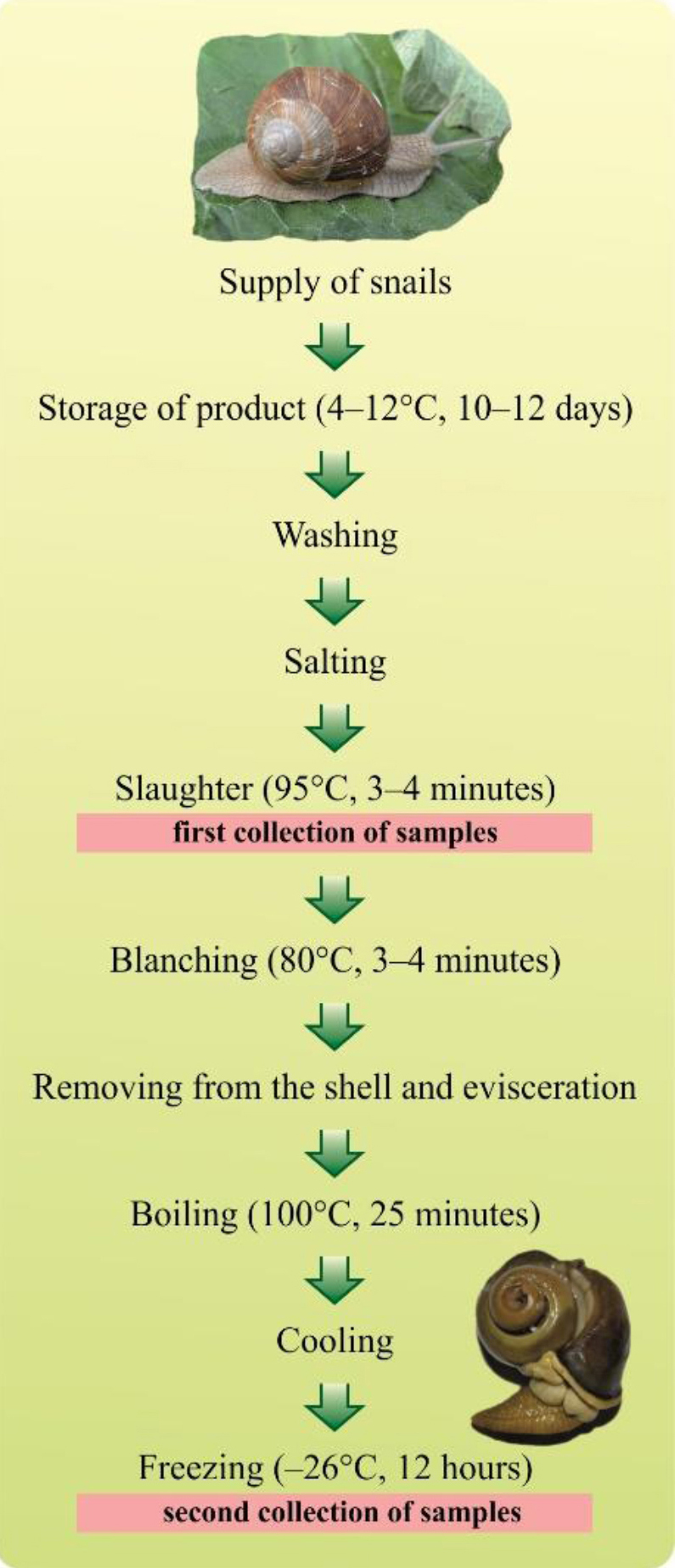
In the first stage, determinations were made on unprocessed snail meat. In the second stage, the study focused on Roman snails and consisted in an additional evaluation of frozen meat after full processing. Zinc and copper contents were determined by flame atomic absorption spectrometry and the selenium content was established by graphite furnace atomic absorption spectrometry.
The selenium content differed significantly among all three species. The copper content in Roman snails differed significantly from that in farmed snails. No significant difference in the zinc level was noted among the three snail species. The selenium content in raw and processed meat of Roman snails did not show any significant difference while the copper and zinc level was significantly higher in processed meat samples.
The present research on the meat of edible snails showed different levels of selenium, copper, and zinc, depending on the species, collection site, and subjection to processing.
本研究的目的是对在波兰采集的食用陆生蜗牛( 、 和 )肉中的铜、锌和硒浓度进行比较评估,并确定罗马蜗牛( )的初步加工对上述元素含量的影响。
第一阶段,对未加工的蜗牛肉进行测定。第二阶段,研究聚焦于罗马蜗牛,包括对完全加工后的冷冻肉进行额外评估。锌和铜含量通过火焰原子吸收光谱法测定,硒含量通过石墨炉原子吸收光谱法测定。
所有三种蜗牛的硒含量差异显著。罗马蜗牛中的铜含量与养殖蜗牛中的铜含量差异显著。三种蜗牛的锌含量未发现显著差异。罗马蜗牛生肉和加工肉中的硒含量没有显著差异,而加工肉样品中的铜和锌含量显著更高。
目前对食用蜗牛肉的研究表明,硒、铜和锌的含量因物种、采集地点和加工情况而异。