Koch R M, Diavatopoulos D A, Ferwerda G, Pickkers P, de Jonge M I, Kox M
Department of Intensive Care Medicine, Radboud university medical centre, Nijmegen, The Netherlands.
Radboud Center for Infectious Diseases (RCI), Radboud university medical centre, Nijmegen, The Netherlands.
Intensive Care Med Exp. 2018 Jul 5;6(1):15. doi: 10.1186/s40635-018-0182-5.
Influenza infections are often complicated by secondary infections, which are associated with high morbidity and mortality, suggesting that influenza profoundly influences the immune response towards a subsequent pathogenic challenge. However, data on the immunological interplay between influenza and secondary infections are equivocal, with some studies reporting influenza-induced augmentation of the immune response, whereas others demonstrate that influenza suppresses the immune response towards a subsequent challenge. These contrasting results may be due to the use of various types of live bacteria as secondary challenges, which impedes clear interpretation of causal relations, and to differences in timing of the secondary challenge relative to influenza infection. Herein, we investigated whether influenza infection results in an enhanced or suppressed innate immune response upon a secondary challenge with bacterial lipopolysaccharide (LPS) in either the acute or the recovery phase of infection.
Male C57BL/6J mice were intranasally inoculated with 5 × 10 PFU influenza virus (pH1N1, strain A/Netherlands/602/2009) or mock treated. After 4 (acute phase) or 10 (recovery phase) days, 5 mg/kg LPS or saline was administered intravenously, and mice were sacrificed 90 min later. Cytokine levels in plasma and lung tissue, and lung myeloperoxidase (MPO) content were determined.
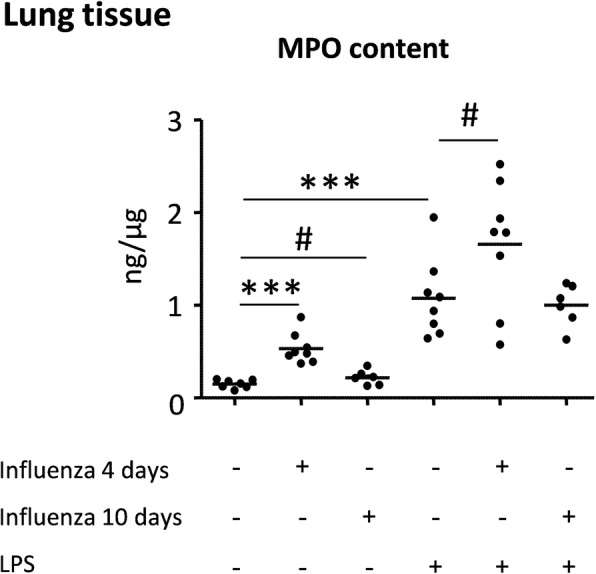
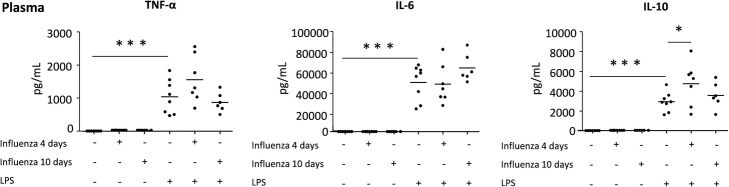
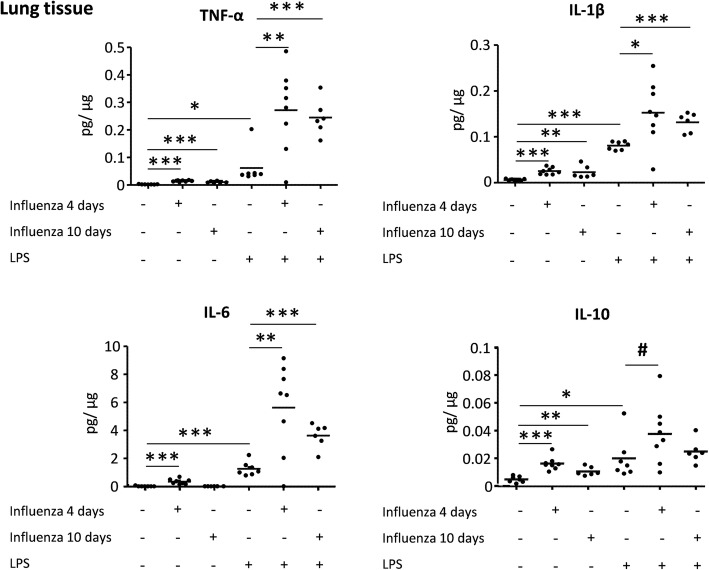
LPS administration 4 days after influenza infection resulted in a synergistic increase in TNF-α, IL-1β, and IL-6 concentrations in lung tissue, but not in plasma. This effect was also observed 10 days after influenza infection, albeit to a lesser extent. LPS-induced plasma levels of the anti-inflammatory cytokine IL-10 were enhanced 4 days after influenza infection, whereas a trend towards increased pulmonary IL-10 concentrations was found. LPS-induced increases in pulmonary MPO content tended to be enhanced as well, but only at 4 days post-infection.
An LPS challenge in the acute phase of influenza infection results in an enhanced pulmonary pro-inflammatory innate immune response. These data increase our insight on influenza-bacterial interplay. Combing data of the present study with previous findings, it appears that this enhanced response is not beneficial in terms of protection against secondary infections, but rather damaging by increasing immunopathology.
流感感染常伴有继发性感染,后者与高发病率和死亡率相关,这表明流感会深刻影响机体对后续病原体攻击的免疫反应。然而,关于流感与继发性感染之间免疫相互作用的数据并不明确,一些研究报告称流感会增强免疫反应,而另一些研究则表明流感会抑制对后续攻击的免疫反应。这些相互矛盾的结果可能是由于使用了各种类型的活细菌作为继发性攻击,这妨碍了对因果关系的清晰解读,也可能是由于继发性攻击相对于流感感染的时间差异。在此,我们研究了流感感染在感染的急性期或恢复期用细菌脂多糖(LPS)进行继发性攻击后,是否会导致先天性免疫反应增强或受到抑制。
将雄性C57BL/6J小鼠经鼻接种5×10 PFU流感病毒(pH1N1,A/Netherlands/602/2009株)或进行模拟处理。4天(急性期)或10天(恢复期)后,静脉注射5 mg/kg LPS或生理盐水,90分钟后处死小鼠。测定血浆和肺组织中的细胞因子水平以及肺髓过氧化物酶(MPO)含量。
流感感染4天后给予LPS导致肺组织中TNF-α、IL-1β和IL-6浓度协同增加,但血浆中未增加。流感感染10天后也观察到了这种效应,尽管程度较轻。LPS诱导的抗炎细胞因子IL-10的血浆水平在流感感染4天后升高,而肺组织中IL-10浓度有增加的趋势。LPS诱导的肺组织MPO含量增加也有增强的趋势,但仅在感染后4天出现。
流感感染急性期的LPS攻击会导致肺部促炎先天性免疫反应增强。这些数据增加了我们对流感与细菌相互作用的认识。将本研究的数据与先前的发现相结合,似乎这种增强的反应在预防继发性感染方面并无益处,反而会因增加免疫病理学损伤而造成损害。