Lin Hua, Li Wenjuan, Ni Jiaxiang, Wang Yuping
Department of Neurology Department of Pain, XuanWu Hospital, Capital Medical University, Beijing, China.
Medicine (Baltimore). 2018 Jul;97(27):e11235. doi: 10.1097/MD.0000000000011235.
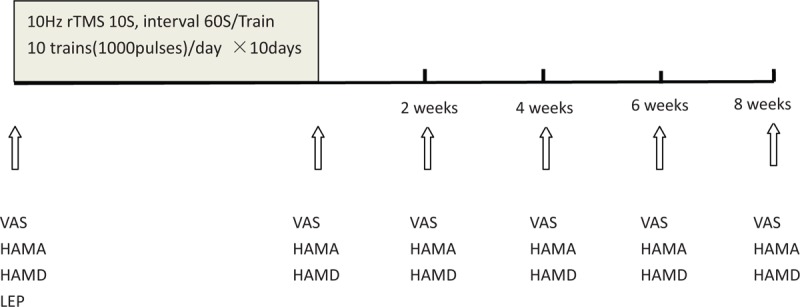
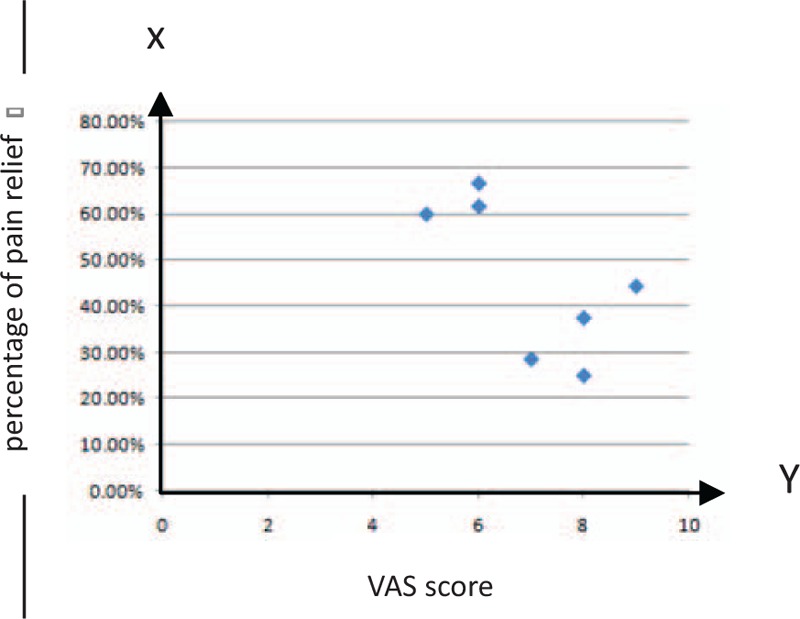
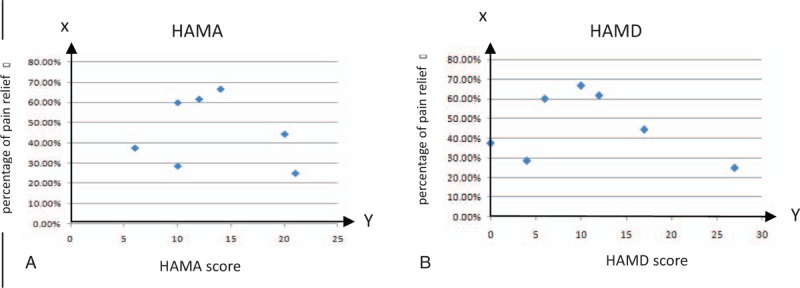
Thalamic pain is a severe pain that is often unresponsive to medical therapy. Repetitive transcranial magnetic stimulation (rTMS) entirely non-invasively modulates neuronal plasticity to produce therapeutic benefit. Since the rTMS stimulation parameters varied, it is difficult to determine which specific parameters are best for clinical use. The aim of this study was to evaluate the analgesic lasting effect of 10-Hz rTMS over the motor cortex (M1) for 10 consecutive days to treat thalamic pain.Patients were treated with daily 10-Hz rTMS sessions for 1000 pulses applied over the M1 for 10 consecutive days. Pain severity and mood were assessed at baseline, immediately after, 2 weeks, 4 weeks, 6 weeks, 8 weeks after rTMS. Pain severity was measured by the visual analogue scale (VAS) and the percentage of pain relief on VAS score was calculated between baseline and final examination. Mood was monitored using the Hamilton Anxiety Scale (HAMA) and Hamilton Depression Scale (HAMD).Seven patients with thalamic pain were enrolled. VAS score was significantly decreased after rTMS. Mean VAS scores were 7 at baseline and decreased to 5.6 at 2 weeks after rTMS and then decreased to 3.9 at 8 weeks after rTMS. The analgesic effect of rTMS can last up to 8 weeks. The percentage of pain relief ranges from 25.0% to 66.7% at the 8th week. Four patients (3 moderate pain and 1 severe pain) achieved satisfactory relief (pain relief ≥40-69%).Although this was an open-label study without a control group, our findings show that 10 Hz rTMS over the M1 for 10 consecutive days can produce satisfactory or partial antalgic effect on patients with thalamic pain.
丘脑痛是一种严重的疼痛,通常对药物治疗无反应。重复经颅磁刺激(rTMS)完全以非侵入性方式调节神经元可塑性以产生治疗益处。由于rTMS刺激参数各不相同,因此难以确定哪些特定参数最适合临床应用。本研究的目的是评估连续10天对运动皮层(M1)进行10赫兹rTMS的镇痛持续效果,以治疗丘脑痛。
患者连续10天每天接受10赫兹rTMS治疗,在M1上施加1000个脉冲。在rTMS治疗前基线、治疗后即刻、2周、4周、6周、8周时评估疼痛严重程度和情绪。疼痛严重程度通过视觉模拟量表(VAS)测量,并计算基线与最终检查之间VAS评分的疼痛缓解百分比。使用汉密尔顿焦虑量表(HAMA)和汉密尔顿抑郁量表(HAMD)监测情绪。
纳入7例丘脑痛患者。rTMS治疗后VAS评分显著降低。基线时平均VAS评分为7分,rTMS治疗后2周降至5.6分,rTMS治疗后8周降至3.9分。rTMS的镇痛效果可持续长达8周。第8周时疼痛缓解百分比在25.0%至66.7%之间。4例患者(3例中度疼痛和1例重度疼痛)获得满意缓解(疼痛缓解≥40 - 69%)。
尽管这是一项无对照组的开放标签研究,但我们的研究结果表明,连续10天对M1进行10赫兹rTMS可对丘脑痛患者产生满意或部分镇痛效果。