Department of Animal Medicine, Production and Health, University of Padua, Legnaro, Italy.
PLoS One. 2018 Jul 6;13(7):e0200439. doi: 10.1371/journal.pone.0200439. eCollection 2018.
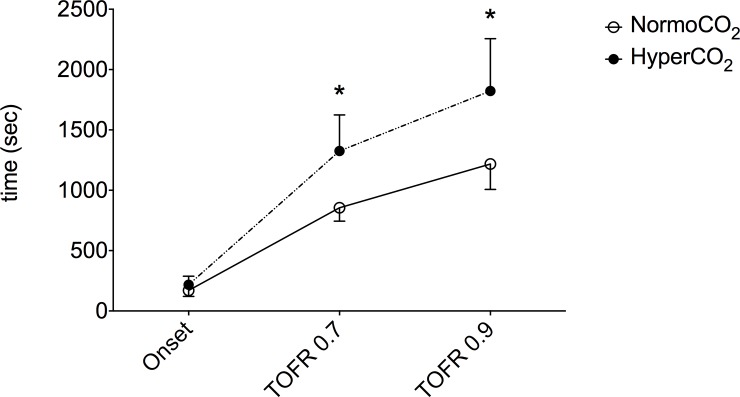
Neuromuscular blocking agents (NMBAs) are commonly used in experimental laparoscopy in swine undergoing carbon dioxide pneumoperitoneum. Hypercapnia may be present and may prolong NMBAs' pharmacologic activity. The aim of this study is to evaluate the effect of permissive hypercapnia on the neuromuscular blockade of atracurium in swine. Six Large White swine weighing 30.5 ± 1.6 kg were sedated with intramuscular ketamine and medetomidine, after which anaesthesia was induced with propofol and maintained with sevoflurane. Atracurium 0.4 mg/kg was administered intravenously and the neuromuscular block monitored by acceleromyography during normocapnic and hypercapnic conditions (PaCO2 range 35-45 mmHg and 60-70 mmHg, respectively). Onset time and time to reach a train of four ratio (TOFR) of 0.7 and 0.9 were recorded. Cardiorespiratory parameters, electrolytes and acid-base status were measured under both conditions. Onset time was similar between the two conditions. Time to reach a TOFR of 0.7 and 0.9 (duration of the neuromuscular block) was longer in hypercapnic compared to normocapnic animals being 1325 ± 300 vs 855 ±111 (p = 0.002) and 1823 ± 434 vs 1218 ± 210 seconds (p = 0.005), respectively. Three hypercapnic swine had a TOF count of 2 and 1 instead of a count of 4 with fade. Permissive hypercapnia was associated with a decrease in pH from 7.444 ± 0.039 to 7.257 ± 0.025 (p < 0.001). No differences were observed for heart rate, end-tidal concentration of sevoflurane, body temperature and arterial haemoglobin saturation. Nonetheless, hypercapnic swine had a statistically significant increase in mean arterial pressure (p = 0.020) and plasma potassium concentration (p = 0.003). The values of PaCO2 achieved during hypercapnia were well tolerated in swine undergoing CO2 pneumoperitoneum for laparoscopy. Permissive hypercapnia increased the duration of the atracurium effect and caused an increase in the intensity of the neuromuscular block in few swine.
肌松药(NMBAs)在接受二氧化碳气腹的猪进行实验性腹腔镜检查中通常被使用。高碳酸血症可能存在,并可能延长 NMBA 的药理活性。本研究的目的是评估允许性高碳酸血症对猪阿曲库铵神经肌肉阻滞的影响。六头重 30.5±1.6kg 的大白猪接受肌肉内氯胺酮和右美托咪定镇静,然后接受异丙酚诱导麻醉,并以七氟醚维持麻醉。静脉给予阿曲库铵 0.4mg/kg,并在正常碳酸血症和高碳酸血症条件下(PaCO2 分别为 35-45mmHg 和 60-70mmHg)通过加速肌电图监测神经肌肉阻滞。记录起效时间和达到四个成串刺激(TOFR)0.7 和 0.9 的时间。在两种情况下测量心肺参数、电解质和酸碱状态。两种情况下的起效时间相似。达到 TOFR 0.7 和 0.9(神经肌肉阻滞持续时间)的时间在高碳酸血症动物中比在正常碳酸血症动物中更长,分别为 1325±300 秒与 855±111 秒(p=0.002)和 1823±434 秒与 1218±210 秒(p=0.005)。3 头高碳酸血症猪的 TOF 计数为 2 和 1,而不是 4 个,出现衰减。允许性高碳酸血症导致 pH 从 7.444±0.039 下降至 7.257±0.025(p<0.001)。心率、呼气末七氟醚浓度、体温和动脉血红蛋白饱和度无差异。尽管如此,高碳酸血症猪的平均动脉压(p=0.020)和血浆钾浓度(p=0.003)有统计学意义的增加。在接受二氧化碳气腹行腹腔镜检查的猪中,高碳酸血症期间达到的 PaCO2 值可良好耐受。允许性高碳酸血症增加了阿曲库铵的作用持续时间,并在少数猪中引起神经肌肉阻滞强度增加。