School of Biomedical Engineering, Southern Medical University, Guangzhou, 510515, Guangdong, China.
Department of Computer Science, Wayne State University, Detroit, MI, 48202, USA.
Radiat Oncol. 2018 Jul 6;13(1):125. doi: 10.1186/s13014-018-1068-0.
Better knowledge of the dose-toxicity relationship is essential for safe dose escalation to improve local control in cervical cancer radiotherapy. The conventional dose-toxicity model is based on the dose volume histogram, which is the parameter lacking spatial dose information. To overcome this limit, we explore a comprehensive rectal dose-toxicity model based on both dose volume histogram and dose map features for accurate radiation toxicity prediction.
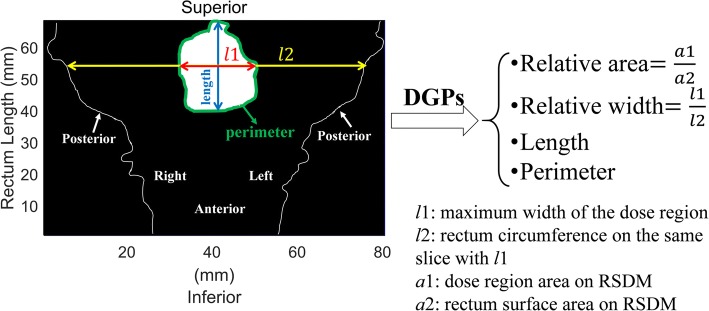
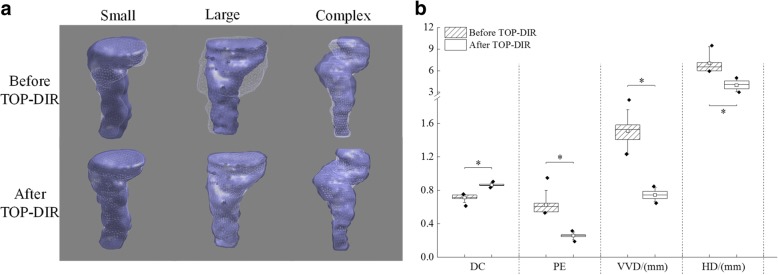
Forty-two cervical cancer patients treated with combined external beam radiotherapy (EBRT) and brachytherapy (BT) were retrospectively studied, including 12 with Grade ≥ 2 rectum toxicity and 30 patients with Grade 0-1 toxicity (non-toxicity patients). The cumulative equivalent 2-Gy rectal surface dose was deformably summed using the deformation vector fields obtained through a recent developed local topology preserved non-rigid point matching algorithm. The cumulative three-dimensional (3D) dose was flattened and mapped to a two-dimensional (2D) plane to obtain the rectum surface dose map (RSDM). The dose volume parameters (DVPs) were calculated from the 3D rectum surface, while the texture features and the dose geometric parameters (DGPs) were extracted from the 2D RSDM. Representative features further computed from DVPs, textures and DGPs by principle component analysis (PCA) and statistical analysis were respectively fed into a support vector machine equipped with a sequential feature selection procedure. The predictive powers of the representative features were compared with the GEC-ESTRO dosimetric parameters D.
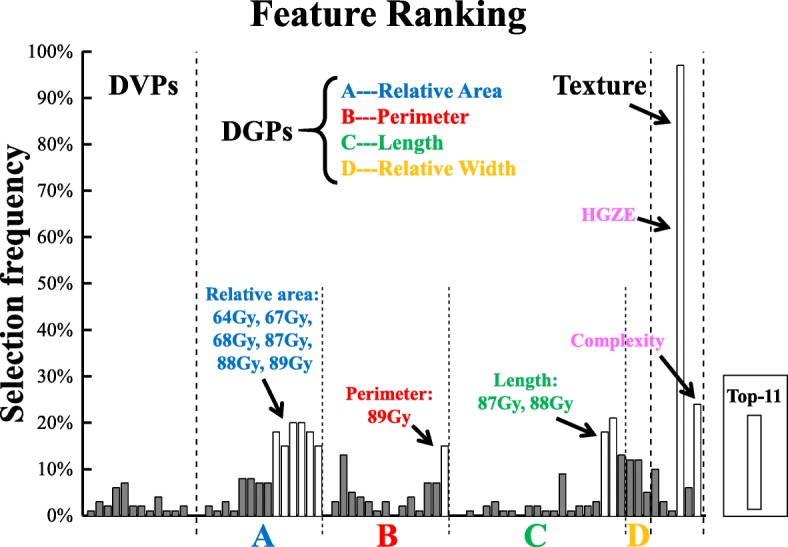
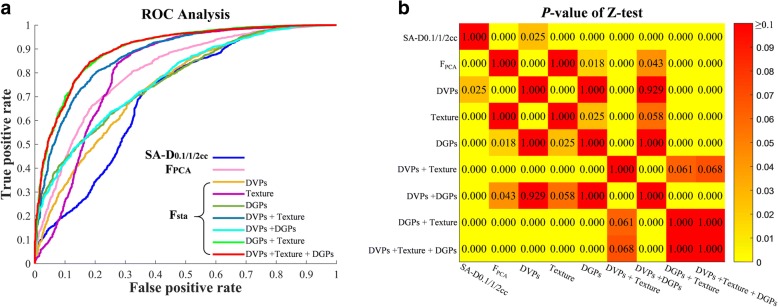
Satisfactory predictive accuracy of sensitivity 74.75 and 84.75%, specificity 72.67 and 79.87%, and area under the receiver operating characteristic curve (AUC) 0.82 and 0.91 were respectively achieved by the PCA features and statistical significant features, which were superior to the D (AUC 0.71). The relative area in dose levels of 64Gy, 67Gy, 68Gy, 87Gy, 88Gy and 89Gy, perimeters in dose levels of 89Gy, as well as two texture features were ranked as the important factors that were closely correlated with rectal toxicity.
Our extensive experimental results have demonstrated the feasibility of the proposed scheme. A future large patient cohort study is still needed for model validation.
为了提高宫颈癌放疗的局部控制率,安全地提高剂量,更好地了解剂量-毒性关系至关重要。传统的剂量-毒性模型基于剂量体积直方图,该参数缺乏空间剂量信息。为了克服这一限制,我们探索了一种基于剂量体积直方图和剂量图特征的全面直肠剂量-毒性模型,以进行准确的放射毒性预测。
回顾性研究了 42 例接受外照射放疗(EBRT)和近距离放疗(BT)联合治疗的宫颈癌患者,其中 12 例出现 2 级及以上直肠毒性,30 例为 0-1 级毒性(非毒性患者)。使用最近开发的基于局部拓扑保持的非刚性点匹配算法获得的变形矢量场,可变形地求和累积等效 2-Gy 直肠表面剂量。将累积的三维(3D)剂量展平并映射到二维(2D)平面上,以获得直肠表面剂量图(RSDM)。从 3D 直肠表面计算剂量体积参数(DVP),从 2D RSDM 中提取纹理特征和剂量几何参数(DGP)。通过主成分分析(PCA)和统计分析,从 DVP、纹理和 DGP 中进一步计算出具有代表性的特征,然后分别输入到配备顺序特征选择程序的支持向量机中。通过 PCA 特征和统计学显著特征分别实现了 74.75%和 84.75%的灵敏度、72.67%和 79.87%的特异性和 0.82 和 0.91 的接收器操作特征曲线(AUC)的预测精度,优于 D(AUC 0.71)。在 64Gy、67Gy、68Gy、87Gy、88Gy 和 89Gy 的剂量水平上的相对面积,89Gy 的剂量水平上的周长以及两个纹理特征,被评为与直肠毒性密切相关的重要因素。
我们的大量实验结果证明了所提出方案的可行性。仍需要进行大规模的患者队列研究来验证模型。