CIRAD (Centre de Coopération Internationale en Recherche Agronomique pour le Développement), UMR AGAP, F-34398, Montpellier, France.
AGAP, Univ Montpellier, CIRAD, INRA, Montpellier SupAgro, 34060, Montpellier, France.
Nat Commun. 2018 Jul 6;9(1):2638. doi: 10.1038/s41467-018-05051-5.
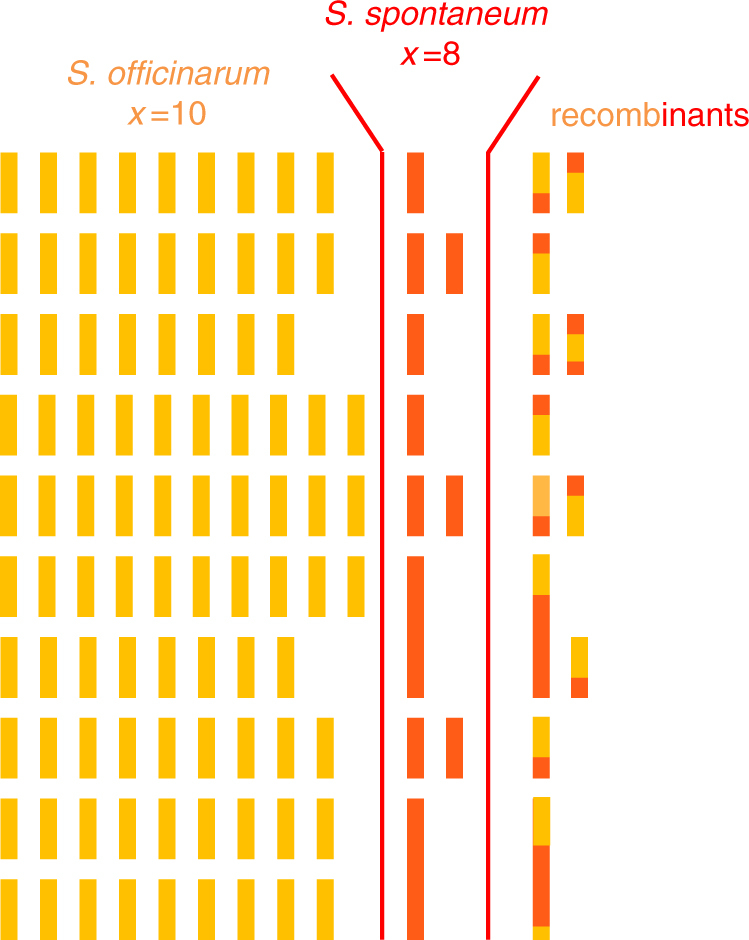
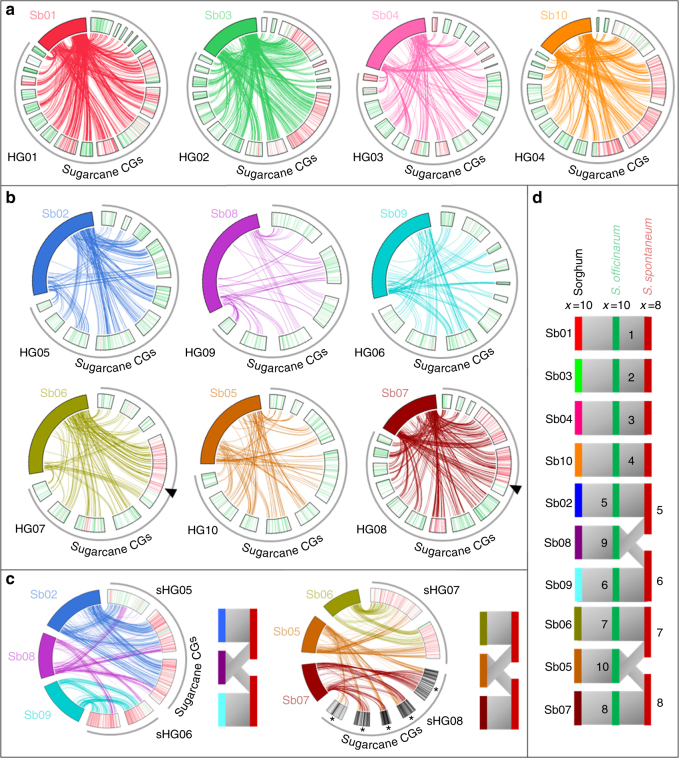
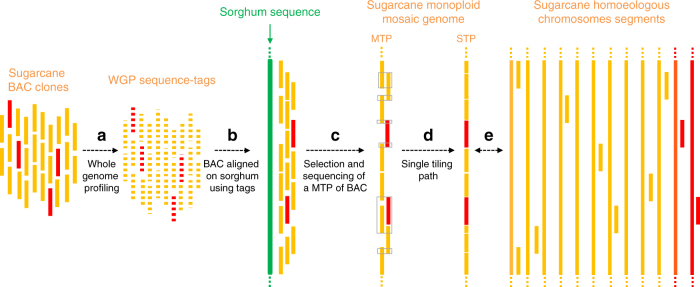
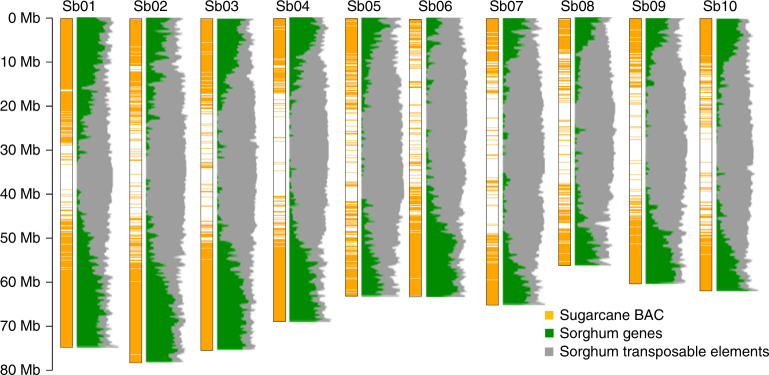
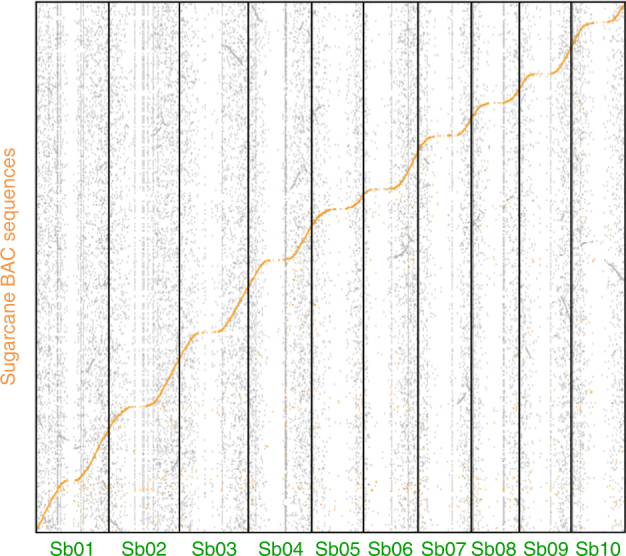
Sugarcane (Saccharum spp.) is a major crop for sugar and bioenergy production. Its highly polyploid, aneuploid, heterozygous, and interspecific genome poses major challenges for producing a reference sequence. We exploited colinearity with sorghum to produce a BAC-based monoploid genome sequence of sugarcane. A minimum tiling path of 4660 sugarcane BAC that best covers the gene-rich part of the sorghum genome was selected based on whole-genome profiling, sequenced, and assembled in a 382-Mb single tiling path of a high-quality sequence. A total of 25,316 protein-coding gene models are predicted, 17% of which display no colinearity with their sorghum orthologs. We show that the two species, S. officinarum and S. spontaneum, involved in modern cultivars differ by their transposable elements and by a few large chromosomal rearrangements, explaining their distinct genome size and distinct basic chromosome numbers while also suggesting that polyploidization arose in both lineages after their divergence.
甘蔗(Saccharum spp.)是生产糖和生物能源的主要作物。其高度多倍体、非整倍体、杂合和种间基因组给产生参考序列带来了重大挑战。我们利用与高粱的共线性关系,产生了基于 BAC 的甘蔗单倍体基因组序列。根据全基因组分析,选择了最佳覆盖高粱基因组基因丰富部分的最小平铺路径 4660 个甘蔗 BAC,对其进行测序,并在高质量序列的单个平铺路径中组装成 382-Mb 序列。共预测到 25316 个蛋白质编码基因模型,其中 17%与高粱的直系同源物没有共线性。我们表明,参与现代品种的两个物种,甘蔗和甘蔗野生种,其转座元件和少数大的染色体重排不同,这解释了它们不同的基因组大小和不同的基本染色体数,同时也表明多倍化是在它们分化后出现在两个谱系中的。