Janati Ali, Hasanpoor Edris, Hajebrahimi Sakineh, Sadeghi-Bazargani Homayoun, Khezri Ali
Iranian Center of Excellence in Health Management, School of Management and Medical Informatics, Tabriz University of Medical Sciences, Tabriz, Iran.
Department of Healthcare Management, Maragheh University of Medical Sciences, Maragheh, Iran.
Ethiop J Health Sci. 2018 May;28(3):305-314. doi: 10.4314/ejhs.v28i3.8.
Evidence-based management (EBMgt) is a growing literature concept in management sciences which claims that management decision-making must be based on the best available evidence. The aim of this paper is to present and provide an evidence-based framework for EBMgt to improve decision-making in healthcare organizations.
A two-round Delphi survey was used to collect the factors affecting EBMgt. Purposive and snowball sampling methods were used in both rounds. In round 1, we conducted a systematic review and a series of semi-structured interviews (n=45). In round 2, a specific questionnaire with four main parts was designed. The experts (n=21) were asked to rate on a 9-point Likert scale the importance of each factor. The data was collected through Google Forms (n=11) and paper forms (n=10).
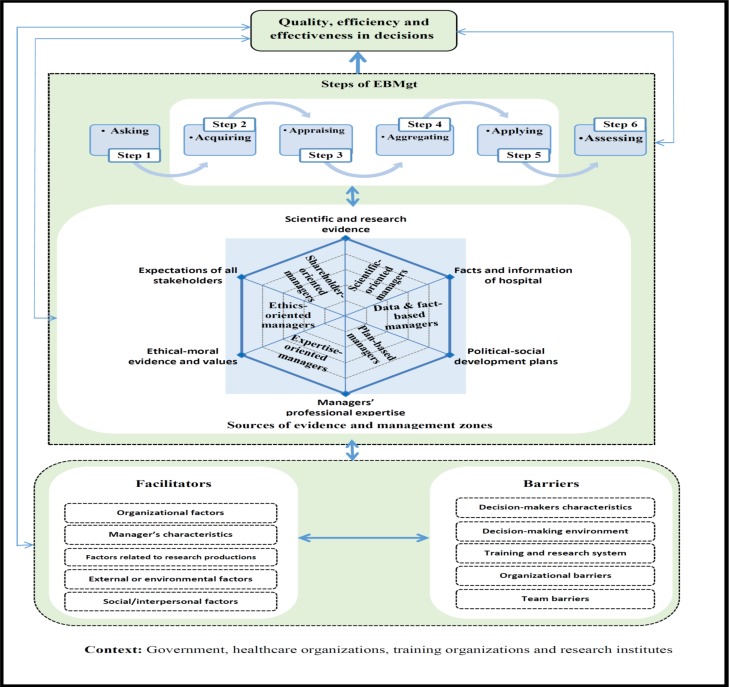
Participants were mostly men (73%). Overall, 126 factors were selected in round 1. Factors were classified into 4 categories: facilitators, barriers, the sources of evidence and EBMgt process that consisted of 48, 46, 22 and 10 factors, respectively. In round 2, based on median scores, many factors (n=114) were found to be very important. Only, 12 factors have a median score of less than 3 and were excluded from the study. Finally, 114 factors were confirmed.
Confirmed factors played significant roles in affecting the practice of EBMgt among healthcare managers. We tried to facilitate interaction between these factors in the framework. Depending on the type of problem, using six steps of EBMgt process, managers will select the best evidence among six sources of evidence.
循证管理(EBMgt)是管理科学领域中一个不断发展的文献概念,它主张管理决策必须基于可得的最佳证据。本文旨在提出并提供一个循证管理的框架,以改善医疗组织中的决策制定。
采用两轮德尔菲调查来收集影响循证管理的因素。两轮调查均采用了目的抽样和滚雪球抽样方法。在第一轮中,我们进行了系统综述和一系列半结构化访谈(n = 45)。在第二轮中,设计了一份包含四个主要部分的特定问卷。要求专家(n = 21)根据9点李克特量表对每个因素的重要性进行评分。数据通过谷歌表单(n = 11)和纸质表单(n = 10)收集。
参与者大多为男性(73%)。总体而言,第一轮共选出126个因素。这些因素被分为4类:促进因素、阻碍因素、证据来源以及循证管理过程,分别包含48、46、22和10个因素。在第二轮中,根据中位数得分,发现许多因素(n = 114)非常重要。只有12个因素的中位数得分低于3,被排除在研究之外。最终,确认了114个因素。
确认的因素在影响医疗管理者的循证管理实践中发挥了重要作用。我们试图在框架中促进这些因素之间的相互作用。根据问题类型,通过循证管理过程的六个步骤,管理者将从六个证据来源中选择最佳证据。