Department of Cardiology, T. Marciniak Hospital, Wrocław, Poland,
Faculty of Mechanical Engineering, Wrocław University of Technology, Wrocław, Poland.
Clin Interv Aging. 2018 Jun 27;13:1183-1191. doi: 10.2147/CIA.S161711. eCollection 2018.
In recent years, there has been growing interest in the impact of gender-related factors on the function and structure of the arterial tree. The aim of our study was to identify gender-specific differences in the progression of carotid stiffness parameters with age and in the impact of risk factors on carotid stiffness.
The study group included 256 subjects (mean age: 54.7 years): 134 women (52%) and 122 men (48%) with cardiovascular risk factors: hypertension, type 2 diabetes mellitus, dyslipidemia, smoking, and obesity. Local parameters of carotid stiffness: β stiffness index (β), Peterson's elastic modulus (Ep), pulse wave velocity β (PWV-β) and arterial compliance (AC) were determined with ultrasound echo-tracking software application.
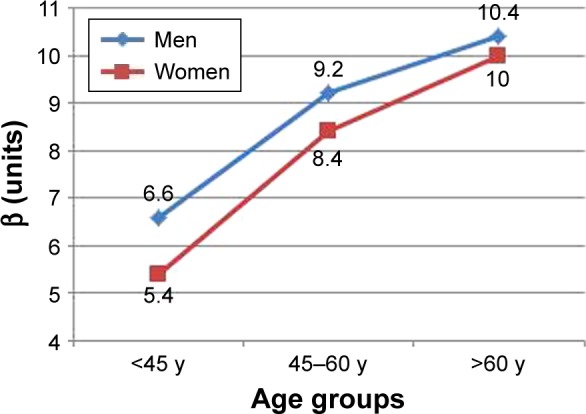
Women were characterized by lower AC than men (women: 0.57 mm/kPa vs men: 0.69 mm/kPa, < 0.001) and the subanalysis in three age groups revealed that the difference in AC value between genders became significant over the age of 45 years. Although no significant difference in the value of β, Ep and PWV-β were found between genders in the whole study group, women <45 years were characterized by lower values of β and Ep than their men counterparts (β: women: 5.4 vs men: 6.6, = 0.002; Ep: women: 72 kPa vs men: 84 kPa, = 0.015). Among analyzed risk factors, the significant determinants of carotid stiffness were age, blood pressure components (pulse pressure and mean arterial pressure), type 2 diabetes mellitus and heart rate. The relationship between carotid stiffness and pulse pressure was observed only in women and between carotid stiffness and heart rate - only in men.
There are gender-related differences in the progression of carotid stiffness parameters with age and in the influence of risk factors on carotid stiffness.
近年来,人们对性别相关因素对动脉树功能和结构的影响越来越感兴趣。我们的研究目的是确定颈动脉僵硬参数随年龄的变化以及危险因素对颈动脉僵硬的影响存在性别差异。
研究组包括 256 名受试者(平均年龄:54.7 岁):134 名女性(52%)和 122 名男性(48%),患有心血管危险因素:高血压、2 型糖尿病、血脂异常、吸烟和肥胖。使用超声回声跟踪软件应用程序确定颈动脉僵硬的局部参数:β 僵硬指数(β)、Peterson 弹性模量(Ep)、脉搏波速度β(PWV-β)和动脉顺应性(AC)。
女性的 AC 值低于男性(女性:0.57 mm/kPa 比男性:0.69 mm/kPa, < 0.001),在三个年龄组的亚分析中发现,女性和男性的 AC 值之间的差异在 45 岁以上变得显著。尽管在整个研究组中,性别之间β、Ep 和 PWV-β 的值没有显著差异,但 45 岁以下的女性β和 Ep 值低于同龄男性(β:女性:5.4 比男性:6.6, = 0.002;Ep:女性:72 kPa 比男性:84 kPa, = 0.015)。在分析的危险因素中,颈动脉僵硬的显著决定因素是年龄、血压成分(脉压和平均动脉压)、2 型糖尿病和心率。颈动脉僵硬与脉压之间的关系仅在女性中观察到,而颈动脉僵硬与心率之间的关系仅在男性中观察到。
颈动脉僵硬参数随年龄的变化以及危险因素对颈动脉僵硬的影响存在性别差异。