Department of Electrical EngineeringIndian Institute of Technology MadrasChennai600036India.
Healthcare Technology Innovation CentreIndian Institute of Technology MadrasChennai600113India.
IEEE J Transl Eng Health Med. 2020 Dec 3;9:1900111. doi: 10.1109/JTEHM.2020.3042386. eCollection 2021.
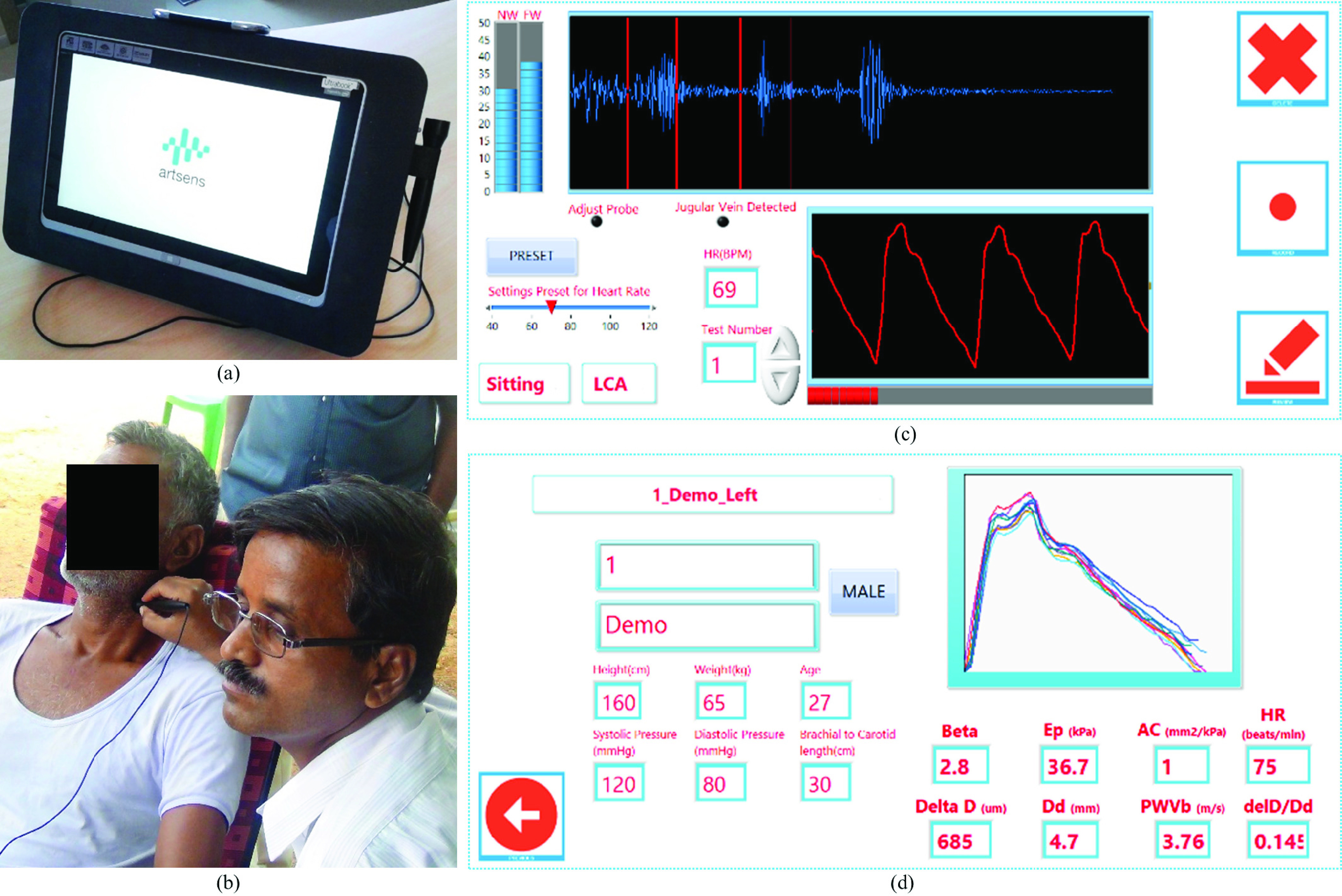
We investigate the field feasibility of carotid stiffness measurement using ARTSENS® Touch and report the first community-level data from India.
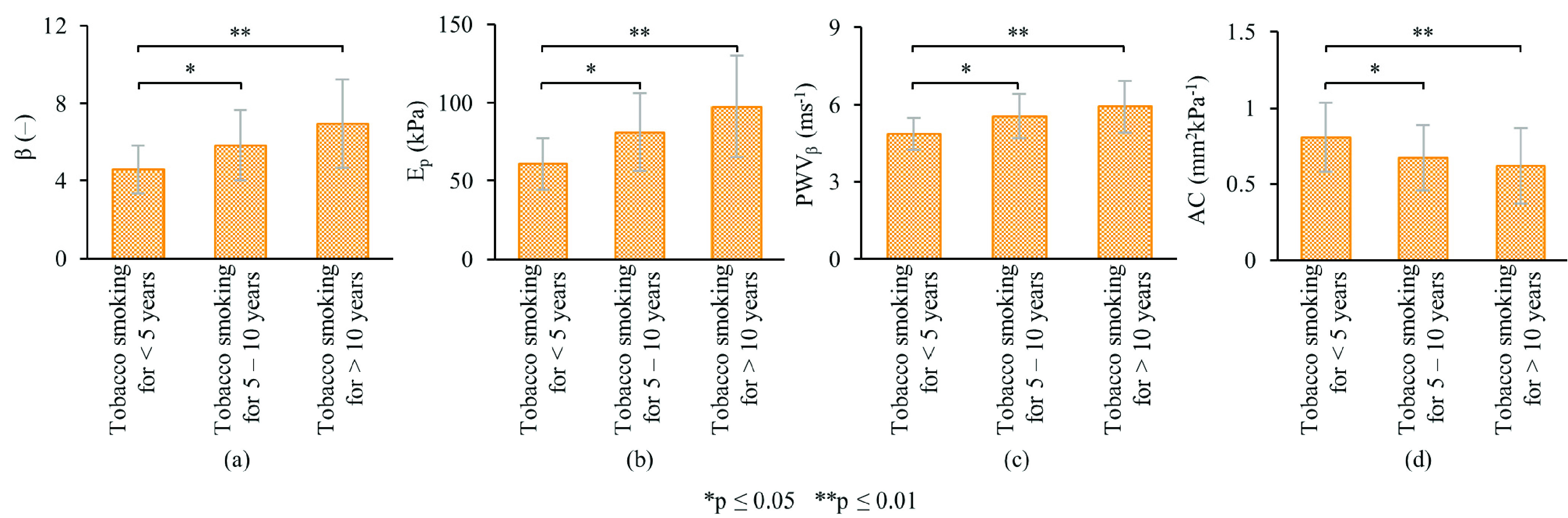
In an analytical cross-sectional survey among 1074 adults, we measured specific stiffness index ([Formula: see text]), pressure-strain elastic modulus ([Formula: see text]), arterial compliance (AC), and one-point pulse wave velocity (PWV[Formula: see text]) from the left common carotid artery. Data for established risk factors (waist circumference, blood pressure, plasma glucose, triglycerides, and HDL-C) were also collected. The association of carotid stiffness with age, gender, hypertension/diabetes, smoking, and clustering of risk factors was studied.
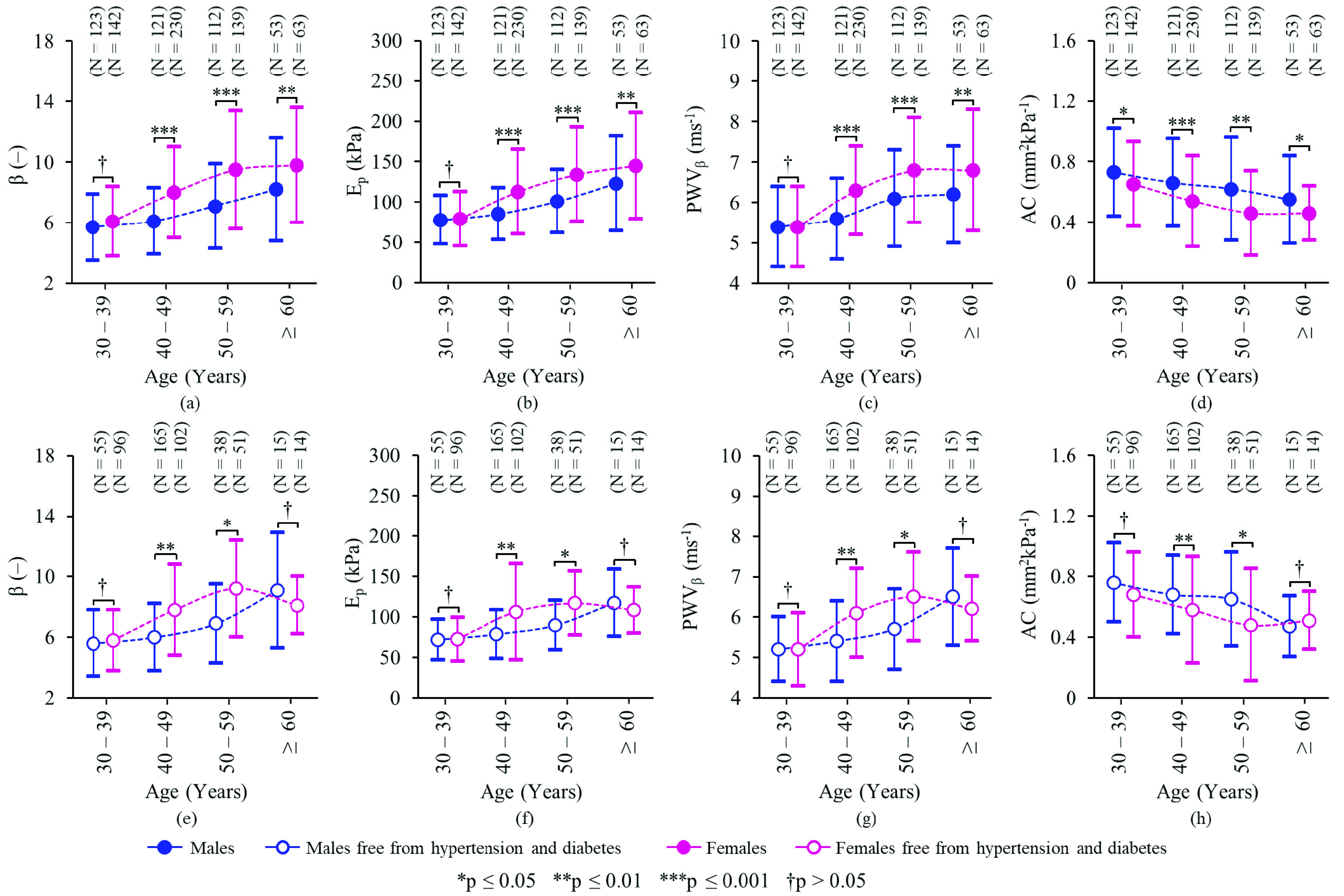
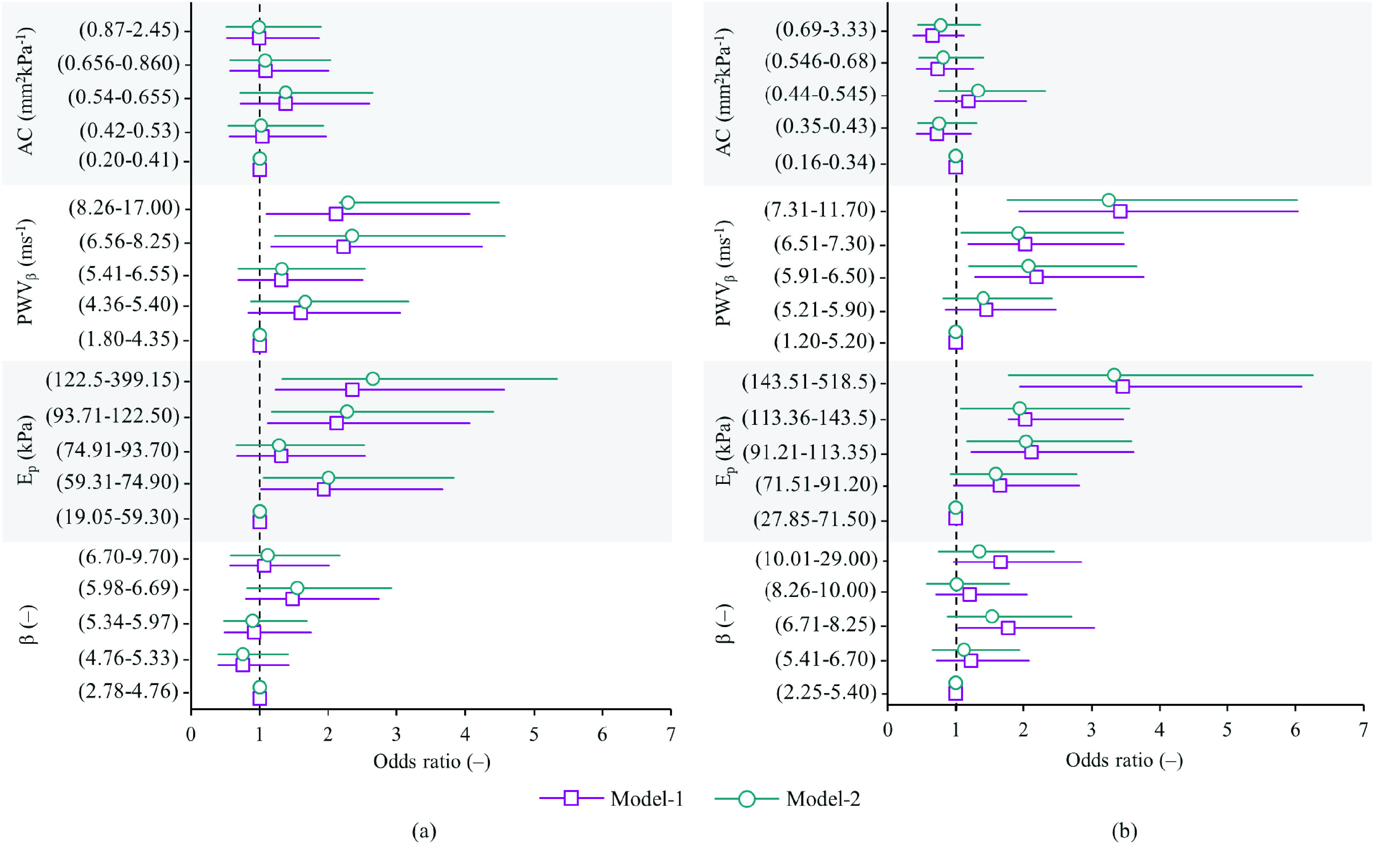
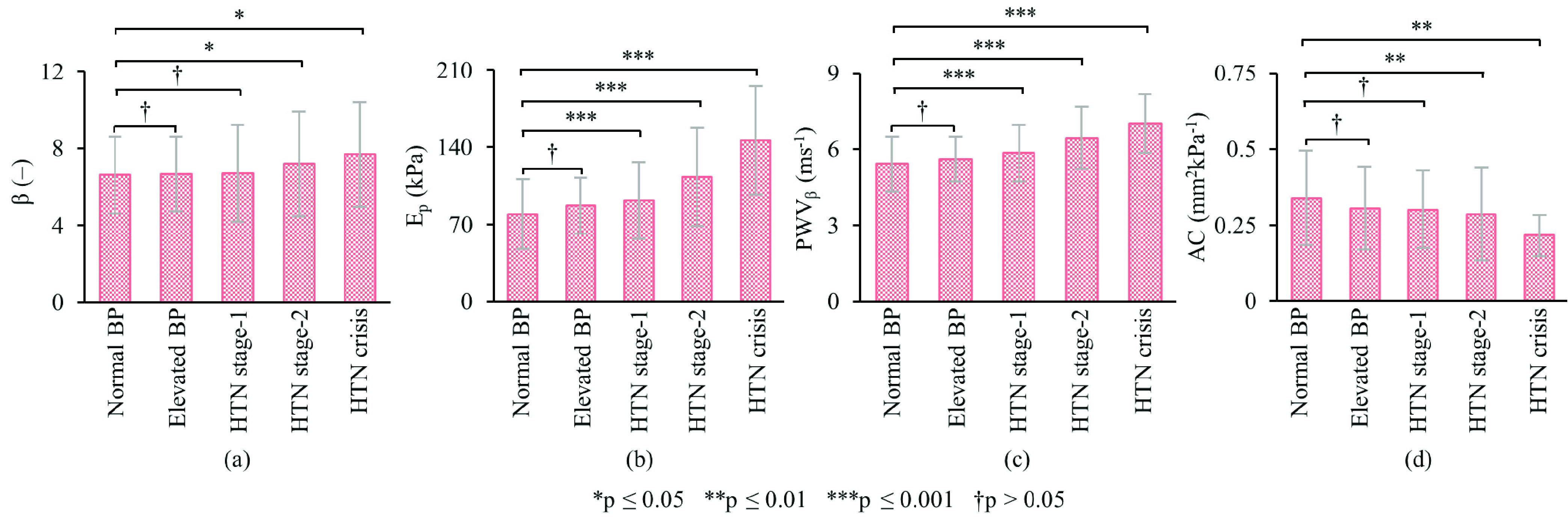
Measurements were repeatable with a relative difference (RD) between consecutive readings of < 5% for blood pressure and < 15% for [Formula: see text]% of arterial diameter values. The average RDs for [Formula: see text], [Formula: see text], AC, and PWV[Formula: see text], were 20.51%, 22.31%, 25.10%, and 14.13%, respectively. Typical range for stiffness indices among females and males were [Formula: see text]: 8.12 ± 3.59 vs 6.51 ± 2.78, [Formula: see text]: 113.24 ± 56.12 kPa vs 92.33 ± 40.65 kPa, PWV[Formula: see text]: 6.32 ± 1.38 ms vs 5.81 ± 1.16 ms, and AC: 0.54 ± 0.36 mm kPa vs 0.72 ± 0.38 mm kPa. Mean [Formula: see text], [Formula: see text], and PWV[Formula: see text] increased (and mean AC decreased) across decades of age; the trend persisted even after excluding hypertensives and subjects with diabetes. The odds ratio of presence of multiple risk factors for [Formula: see text] kPa and/or PWV[Formula: see text] ms was ≥ 2.12 or above in males. In females, it was just above 2.00 for [Formula: see text] kPa and/or PWV[Formula: see text] ms and increased to ≥ 3.33 for [Formula: see text] kPa and ≥ 3.25 for PWV[Formula: see text] ms.
The study demonstrated the feasibility of carotid stiffness measurement in a community setting. A positive association between the risk factors and carotid artery stiffness provides evidence for the device's use in resource-constrained settings. Clinical Impact: The device paves the way for epidemiological and clinical studies that are essential for establishing population-level nomograms for wide-spread use of carotid stiffness in clinical practice and field screening of 'at-risk' subjects.
我们研究了使用 ARTSENS® Touch 测量颈动脉僵硬度的现场可行性,并报告了来自印度的首个社区水平数据。
在一项针对 1074 名成年人的分析性横断面调查中,我们从左颈总动脉测量了特定僵硬度指数 ([Formula: see text])、压力-应变弹性模量 ([Formula: see text])、动脉顺应性 (AC) 和单点脉搏波速度 (PWV[Formula: see text])。还收集了与 established risk factors(腰围、血压、血浆葡萄糖、甘油三酯和高密度脂蛋白胆固醇)相关的数据。研究了颈动脉僵硬度与年龄、性别、高血压/糖尿病、吸烟以及危险因素聚集之间的关系。
血压的连续读数之间的相对差异 (RD) 小于 5%,[Formula: see text]%的动脉直径值的 RD 小于 15%,测量结果具有可重复性。[Formula: see text]、[Formula: see text]、AC 和 PWV[Formula: see text]的平均 RD 分别为 20.51%、22.31%、25.10%和 14.13%。女性和男性的典型僵硬度指数范围为 [Formula: see text]:8.12 ± 3.59 vs 6.51 ± 2.78,[Formula: see text]:113.24 ± 56.12 kPa vs 92.33 ± 40.65 kPa,PWV[Formula: see text]:6.32 ± 1.38 ms vs 5.81 ± 1.16 ms,AC:0.54 ± 0.36 mm kPa vs 0.72 ± 0.38 mm kPa。[Formula: see text]、[Formula: see text]和 PWV[Formula: see text]随着年龄的增长而增加(而平均 AC 则降低);即使排除高血压患者和糖尿病患者,这种趋势仍然存在。对于 [Formula: see text]kPa 和/或 PWV[Formula: see text]ms,男性出现多个危险因素的比值比≥2.12 或更高。对于女性,[Formula: see text]kPa 和/或 PWV[Formula: see text]ms 刚刚超过 2.00,对于 [Formula: see text]kPa 增加到≥3.33,对于 PWV[Formula: see text]ms 增加到≥3.25。
该研究证明了在社区环境中测量颈动脉僵硬度的可行性。危险因素与颈动脉僵硬度之间的正相关为该设备在资源有限的环境中的使用提供了证据。临床影响:该设备为流行病学和临床研究铺平了道路,这些研究对于建立基于人群的颈动脉僵硬度指标至关重要,以便在临床实践中广泛使用颈动脉僵硬度,并对“高危”人群进行现场筛查。