Walsh Tom P, Gill Tiffany K, Evans Angela M, Yaxley Alison, Chisholm Jacob A, Kow Lilian, Arnold John B, Shanahan E Michael
1College of Medicine and Public Health, Flinders University, Bedford Park, South Australia 5042 Australia.
2Department of Orthopaedics and Trauma, The Queen Elizabeth Hospital, Woodville South, South Australia 5011 Australia.
J Foot Ankle Res. 2018 Jun 28;11:35. doi: 10.1186/s13047-018-0277-y. eCollection 2018.
Bariatric surgery candidates have a high prevalence of foot pain, depression and elevated plantar pressures. There is, however, limited research into how these factors interact pre- and post-surgery. The aims of this study were therefore to investigate the mechanical and non-mechanical factors associated with foot pain severity before, and the change after, surgery.
Bariatric surgery candidates underwent baseline and six-month follow-up measures. Foot pain was measured with the Manchester-Oxford Foot Questionnaire. Mechanical measures included body mass index (BMI), dynamic plantar pressures, radiographic foot posture, and hindfoot range of motion. Depressive symptoms, the non-mechanical measure, were assessed by questionnaire. Multivariable linear regression was used to determine which variables were associated with foot pain at baseline and at follow-up. Multilevel repeated models assessed the associations between foot pain and plantar pressure, adjusting for the interaction between group and follow-up time.
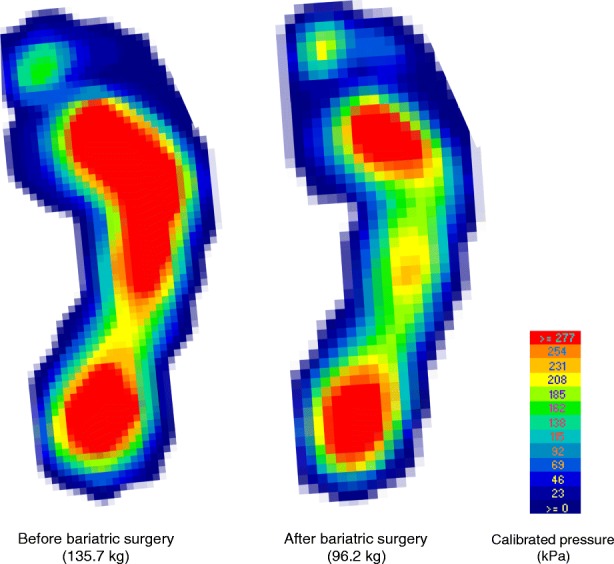
Forty-five participants (84% female), with mean (SD) age of 45.7 (9.4) years were recruited. Twenty-nine participants had bariatric surgery and 16 participants remained on the waiting list (controls). Following bariatric surgery, foot pain reduced significantly by - 35.7 points (95% CI -42.2 to - 28.8), while depressive symptoms and whole foot peak pressures had a significant mean change of - 5.9 points (95% CI -10.3 to - 1.5) and - 36 kPa (95% CI -50 to - 22), respectively. In multivariable analysis, depressive symptoms were associated with foot pain at baseline β = 0.7 (95% CI 0.2 to 1.2) after controlling for age, gender, BMI, foot posture and plantar pressure. Depressive symptoms were also associated with foot pain at follow-up in those undergoing bariatric surgery, β = 1.2 (95% CI 0.8 to 1.7). Foot posture and hindfoot range of motion did not change following surgery and a change in plantar pressures was not associated with a change in foot pain.
Foot pain severity in bariatric surgery candidates was associated with depressive symptoms at baseline. Reduced foot pain following bariatric surgery was associated with an improvement in depressive symptoms, without a significant change in foot posture or foot function. Foot pain severity in bariatric candidates may be mediated by non-mechanical or non-local factors before and following surgery.
肥胖症手术候选者中足部疼痛、抑郁和足底压力升高的患病率较高。然而,关于这些因素在手术前后如何相互作用的研究有限。因此,本研究的目的是调查与手术前足部疼痛严重程度相关的机械和非机械因素,以及手术后的变化情况。
肥胖症手术候选者接受了基线和六个月的随访测量。使用曼彻斯特-牛津足部问卷测量足部疼痛。机械测量包括体重指数(BMI)、动态足底压力、足部X线姿势和后足活动范围。通过问卷调查评估抑郁症状这一非机械测量指标。采用多变量线性回归来确定哪些变量与基线和随访时的足部疼痛相关。多级重复模型评估了足部疼痛与足底压力之间的关联,并对组间和随访时间的相互作用进行了调整。
招募了45名参与者(84%为女性),平均(标准差)年龄为45.7(9.4)岁。29名参与者接受了肥胖症手术,16名参与者仍在等待名单上(对照组)。肥胖症手术后,足部疼痛显著降低了-35.7分(95%置信区间-42.2至-28.8),而抑郁症状和全足峰值压力的平均变化分别为-5.9分(95%置信区间-10.3至-1.5)和-36 kPa(95%置信区间-50至-22)。在多变量分析中,在控制了年龄、性别、BMI、足部姿势和足底压力后,抑郁症状与基线时的足部疼痛相关,β = 0.7(95%置信区间0.2至1.2)。在接受肥胖症手术的患者中,抑郁症状在随访时也与足部疼痛相关,β = 1.2(95%置信区间0.8至1.7)。手术后足部姿势和后足活动范围没有变化,足底压力的变化与足部疼痛的变化无关。
肥胖症手术候选者的足部疼痛严重程度与基线时的抑郁症状相关。肥胖症手术后足部疼痛的减轻与抑郁症状的改善相关,而足部姿势或足部功能没有显著变化。肥胖症候选者的足部疼痛严重程度在手术前后可能由非机械或非局部因素介导。