Exposure, Epidemiology, and Risk Program, Department of Environmental Health, Harvard T.H. Chan School of Public Health, Boston, Massachusetts, United States of America.
PLoS Med. 2018 Jul 10;15(7):e1002605. doi: 10.1371/journal.pmed.1002605. eCollection 2018 Jul.
In many regions globally, buildings designed for harnessing heat during the cold exacerbate thermal exposures during heat waves (HWs) by maintaining elevated indoor temperatures even when high ambient temperatures have subdued. While previous experimental studies have documented the effects of ambient temperatures on cognitive function, few have observed HW effects on indoor temperatures following subjects' habitual conditions. The objective was to evaluate the differential impact of having air conditioning (AC) on cognitive function during a HW among residents of AC and non-AC buildings using a prospective observational cohort study.
We followed 44 students (mean age = 20.2 years; SD = 1.8 years) from a university in the Greater Boston area, Massachusetts in the United States living in AC (n = 24) and non-AC (n = 20) buildings before, during, and after a HW. Two cognition tests were self-administered daily for a period of 12 days (July 9-July 20, 2016), the Stroop color-word test (STROOP) to assess selective attention/processing speed and a 2-digit, visual addition/subtraction test (ADD) to evaluate cognitive speed and working memory. The effect of the HW on cognitive function was evaluated using difference-in-differences (DiD) modelling.
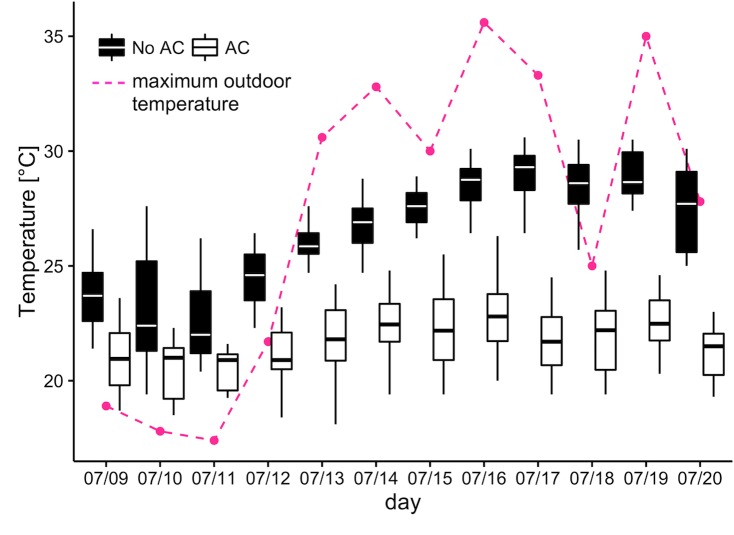
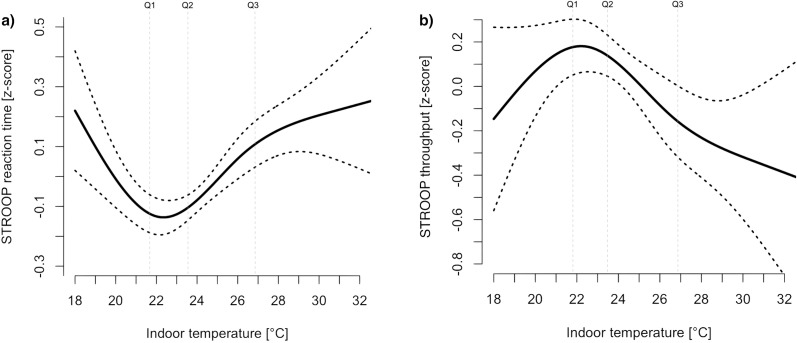
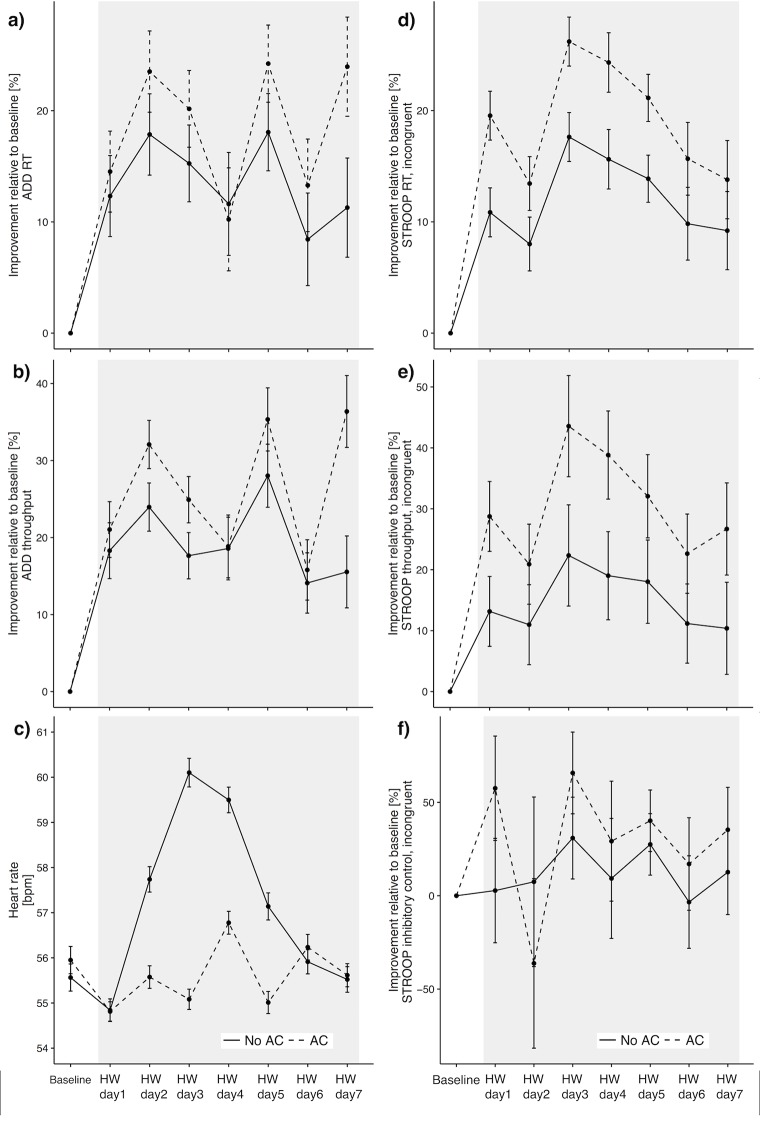
Mean indoor temperatures in the non-AC group (mean = 26.3°C; SD = 2.5°C; range = 19.6-30.4°C) were significantly higher (p < 0.001) than in the AC group (mean = 21.4°C; SD = 1.9°C; range = 17.5-25.0°C). DiD estimates show an increase in reaction time (STROOP = 13.4%, p < 0001; ADD = 13.3%, p < 0.001) and reduction in throughput (STROOP = -9.9%, p < 0.001; ADD = -6.3%, p = 0.08) during HWs among non-AC residents relative to AC residents at baseline. While ADD showed a linear relationship with indoor temperatures, STROOP was described by a U-shaped curve with linear effects below and above an optimum range (indoor temperature = 22°C-23°C), with an increase in reaction time of 16 ms/°C and 24 ms/°C for STROOP and ADD, respectively. Cognitive tests occurred right after waking, so the study is limited in that it cannot assess whether the observed effects extended during the rest of the day. Although the range of students' ages also represents a limitation of the study, the consistent findings in this young, healthy population might indicate that greater portions of the population are susceptible to the effects of extreme heat.
Cognitive function deficits resulting from indoor thermal conditions during HWs extend beyond vulnerable populations. Our findings highlight the importance of incorporating sustainable adaptation measures in buildings to preserve educational attainment, economic productivity, and safety in light of a changing climate.
在全球许多地区,为寒冷季节设计的建筑在热浪期间(HWs)通过保持较高的室内温度来加剧热暴露,即使环境温度较高也不例外。虽然之前的实验研究已经记录了环境温度对认知功能的影响,但很少有研究观察到 HW 对室内温度的影响,而这些影响是在研究对象的习惯条件之后。本研究的目的是通过前瞻性观察队列研究,评估在 HW 期间 AC 居民和非 AC 居民的 AC 对认知功能的差异影响。
我们在美国马萨诸塞州大波士顿地区的一所大学中,对 44 名学生(平均年龄 = 20.2 岁;标准差 = 1.8 岁)进行了前瞻性观察,这些学生居住在 AC(n = 24)和非 AC(n = 20)建筑中,在 HW 之前、期间和之后。在 12 天(2016 年 7 月 9 日至 7 月 20 日)内,每天自行进行两项认知测试,即斯特鲁普颜色词测试(STROOP)以评估选择性注意/处理速度,以及两位数、视觉加法/减法测试(ADD)以评估认知速度和工作记忆。使用差异分析(DiD)模型评估 HW 对认知功能的影响。
非 AC 组的平均室内温度(平均值 = 26.3°C;标准差 = 2.5°C;范围 = 19.6-30.4°C)明显高于 AC 组(平均值 = 21.4°C;标准差 = 1.9°C;范围 = 17.5-25.0°C)(p < 0.001)。DiD 估计表明,与基线时的 AC 居民相比,HW 期间非 AC 居民的反应时间(STROOP = 13.4%,p < 0.001;ADD = 13.3%,p < 0.001)增加,吞吐量减少(STROOP = -9.9%,p < 0.001;ADD = -6.3%,p = 0.08)。虽然 ADD 与室内温度呈线性关系,但 STROOP 呈 U 形曲线,在最佳范围(室内温度 = 22°C-23°C)内具有线性效应,STROOP 和 ADD 的反应时间分别增加了 16 ms/°C 和 24 ms/°C。认知测试是在刚醒来后进行的,因此该研究的局限性在于它无法评估观察到的影响是否会持续到一天中的其他时间。尽管学生年龄范围也是该研究的一个局限性,但在这个年轻、健康的人群中一致的发现可能表明,更多的人群容易受到极端高温的影响。
HW 期间室内热条件导致的认知功能缺陷不仅限于脆弱人群。我们的研究结果强调了在气候变化的背景下,将可持续适应措施纳入建筑物的重要性,以维护教育水平、经济生产力和安全。