From the ‡Lunenfeld-Tanenbaum Research Institute, Sinai Health System, Toronto, Canada.
§Department of Molecular Genetics, University of Toronto, Toronto, Canada.
Mol Cell Proteomics. 2018 Nov;17(11):2256-2269. doi: 10.1074/mcp.TIR118.000902. Epub 2018 Jul 10.
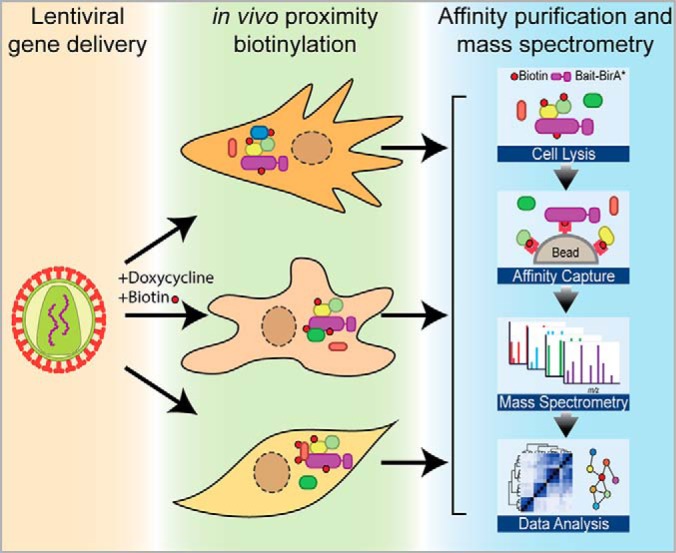
Proximity-dependent biotinylation strategies have emerged as powerful tools to characterize the subcellular context of proteins in living cells. The popular BioID approach employs an abortive biotin ligase mutant (R118G; denoted as BirA*), which when fused to a bait protein enables the covalent biotinylation of endogenous proximal polypeptides. This approach has been mainly applied to the study of protein proximity in immortalized mammalian cell lines. To expand the application space of BioID, here we describe a set of lentiviral vectors that enable the inducible expression of BirA*-tagged bait fusion proteins for performing proximity-dependent biotinylation in diverse experimental systems. We benchmark this highly adaptable toolkit across immortalized and primary cell systems, demonstrating the ease, versatility and robustness of the system. We also provide guidelines to perform BioID using these reagents.
邻近依赖性生物素化策略已成为在活细胞中描绘蛋白质亚细胞环境的有力工具。流行的 BioID 方法采用一种无效的生物素连接酶突变体(R118G;称为 BirA*),当与诱饵蛋白融合时,可使内源性邻近多肽发生共价生物素化。该方法主要应用于永生化哺乳动物细胞系中蛋白质邻近性的研究。为了扩展 BioID 的应用空间,我们在这里描述了一组慢病毒载体,可诱导表达 BirA*-标记的诱饵融合蛋白,用于在不同的实验系统中进行邻近依赖性生物素化。我们在永生化和原代细胞系统中对这个高度适应性的工具包进行了基准测试,证明了该系统的易用性、多功能性和稳健性。我们还提供了使用这些试剂进行 BioID 的指南。