Garg Anu, Madan Manish, Dua Parminder, Saini Sheeba, Mangla Ritu, Singhal Pallav, Dupper Akash
Postgraduate Student, Department of Pedodontics and Preventive Dentistry Himachal Institute of Dental Sciences, Paonta Sahib, Himachal Pradesh, India.
Professor and Head, Department of Pedodontics and Preventive Dentistry Himachal Institute of Dental Sciences, Paonta Sahib, Himachal Pradesh, India.
Int J Clin Pediatr Dent. 2018 Mar-Apr;11(2):110-115. doi: 10.5005/jp-journals-10005-1495. Epub 2018 Apr 1.
To validate the caries risk profiles in 5- and 12-year-old school-going children and to single out main contributing factor, if any, using cariogram over a period of 1 year.
A cariogram model was used to create caries risk profiles on 499 children aged 5 and 12 years ±6 months. They were divided into 2 groups. The group I and group II consisted of 250 and 249 children respectively. Re-examination was done after 1 year and caries increment was recorded. The caries risk profiles generated by the cariogram software were compared with caries increment.
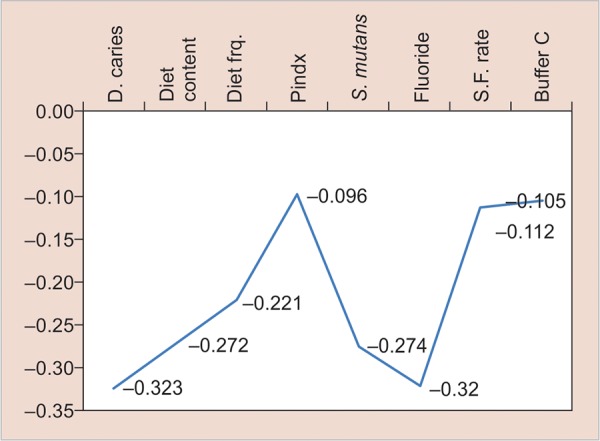
Percentage of subject having caries increment in groups I and II in high-, medium-, and low-risk group after 1 year was 66.2, 39.5, and 13%, and 48.5, 27.3, and 13.9% respectively. The mean caries increment after 1 year in groups I and II in high-, medium-, and low-risk patients was 0.96, 0.49, and 0.13, and 0.7, 0.36, and 0.11 respectively. Linear regression analysis showed dental caries, diet content, diet frequency, plaque index, count, fluoride, salivary flow rate, and buffer capacity are significantly associated with actual chance to avoid caries.
The risk of developing new carious lesions consistently reduced from high-risk category to low-risk category, reflecting the cariogram ability in accurately estimating future caries. Hence, cariogram can be said to be a useful tool for caries prediction. Initial dental caries came out to be the strongest predictor of future caries. Garg A, Madan M, Dua P, Saini S, Mangla R, Singhal P, Dupper A. Validating the Usage of Car-iogram in 5- and 12-year-old School-going Children in Paonta Sahib, Himachal Pradesh, India: A 12-month Prospective Study. Int J Clin Pediatr Dent 2018;11(2):110-115.
验证5岁和12岁学龄儿童的龋病风险概况,并在1年的时间内使用龋病预测模型找出主要影响因素(若存在)。
采用龋病预测模型为499名年龄在5岁和12岁±6个月的儿童建立龋病风险概况。他们被分为两组。第一组和第二组分别有250名和249名儿童。1年后进行复查并记录龋病增量。将龋病预测软件生成的龋病风险概况与龋病增量进行比较。
1年后,第一组和第二组中高、中、低风险组发生龋病增量的受试者百分比分别为66.2%、39.5%和13%,以及48.5%、27.3%和13.9%。1年后,第一组和第二组中高、中、低风险患者的平均龋病增量分别为0.96、0.49和0.13,以及0.7、0.36和0.11。线性回归分析表明,龋齿、饮食成分、饮食频率、菌斑指数、计数、氟化物、唾液流速和缓冲能力与预防龋齿的实际机会显著相关。
新发龋病病变的风险从高风险类别持续降低到低风险类别,反映了龋病预测模型在准确估计未来龋齿方面的能力。因此,可以说龋病预测模型是一种有用的龋齿预测工具。初始龋齿是未来龋齿最强的预测指标。加尔格A、马丹M、杜阿P、赛尼S、曼格拉R、辛哈尔P、杜珀A。印度喜马偕尔邦蓬塔萨希卜5岁和12岁学龄儿童龋病预测模型使用情况的验证:一项为期12个月的前瞻性研究。《国际临床儿科牙科学杂志》2018年;11(2):110 - 115。