Adjenti Saviour Kweku, Louw Graham Jacob, Jelsma Jennifer, Unger Marianne
1Department of Anatomy, School of Biomedical & Allied Health Sciences, College of Health Sciences, Korle-Bu Campus, University of Ghana, P.O. Box KB 143, Korle-Bu, Accra, Ghana.
2Division of Clinical Anatomy & Biological Anthropology, Department of Human Biology, Faculty of Health Sciences, University of Cape Town, Cape Town, South Africa.
Arch Physiother. 2018 Jun 5;8:9. doi: 10.1186/s40945-018-0048-x. eCollection 2018.
Abdominal muscles have stiffer appearance in individuals with spastic type cerebral palsy (STCP) than in their typically developing (TD) peers. This apparent stiffness has been implicated in pelvic instability, mal-rotation, poor gait and locomotion. This study was aimed at investigating whether abdominal muscles activation patterns from rest to activity differ in the two groups.
From ultrasound images, abdominal muscles thickness during the resting and active stages was measured in 63 STCP and 82 TD children. The thickness at each stage and the change in thickness from rest to activity were compared between the two groups.
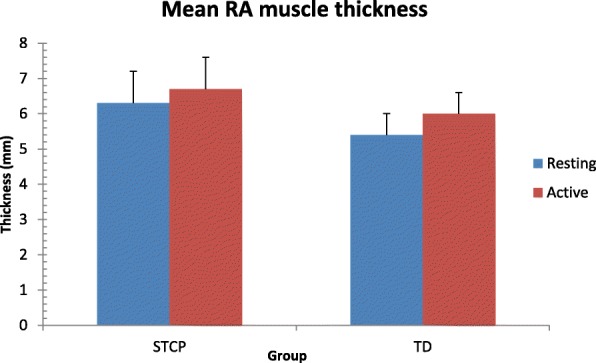
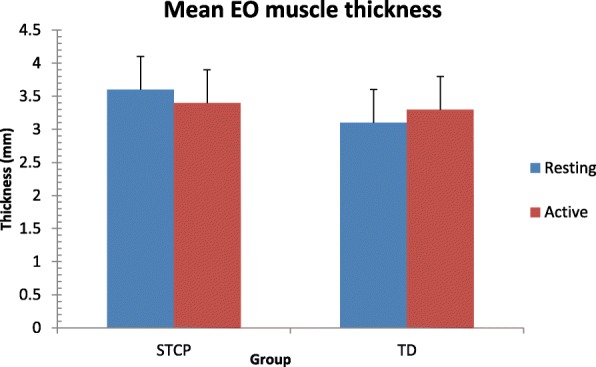
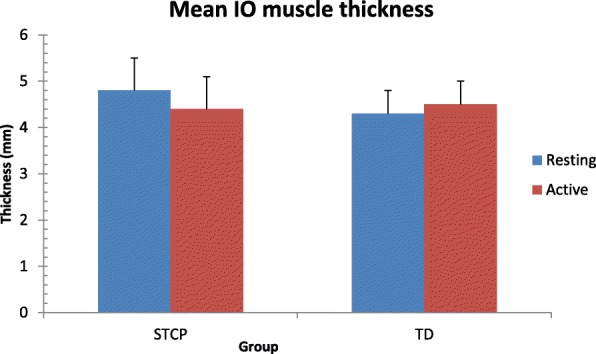
Rectus abdominis (RA) muscle was the thickest muscle at rest as well as in active stage in both groups. At rest, all muscles were significantly thicker in the STCP children ( < 0.001). From rest to active stages muscle thickness significantly increased (p < 0.001) in the TD group and significantly decreased (p < 0.001) in the STCP children, except for RA, which became thicker during activity in both groups. In active stages, no significant differences in the thickness in the four abdominal muscles were found between the STCP and the TD children.
Apart from the RA muscle, the activation pattern of abdominal muscles in individuals with STCP differs from that of TD individuals. Further studies required for understanding the activation patterns of abdominal muscles prior to any physical fitness programmes aimed at improving the quality of life in individuals with STCP.
HREC REF: 490/2011. Human Research Ethics Committee, Faculty of Health Sciences, University of Cape Town, South Africa. November 17, 2011.
痉挛型脑瘫(STCP)患者的腹部肌肉外观比正常发育(TD)的同龄人更僵硬。这种明显的僵硬与骨盆不稳定、旋转不良、步态和运动能力差有关。本研究旨在调查两组从休息到活动时腹部肌肉的激活模式是否不同。
通过超声图像,测量了63名STCP儿童和82名TD儿童在休息和活动阶段的腹部肌肉厚度。比较了两组在每个阶段的厚度以及从休息到活动时厚度的变化。
两组中,腹直肌(RA)在休息和活动阶段都是最厚的肌肉。休息时,STCP儿童的所有肌肉都明显更厚(<0.001)。从休息到活动阶段,TD组肌肉厚度显著增加(p<0.001),STCP儿童显著减少(p<0.001),但RA除外,两组在活动时RA都变厚。在活动阶段,STCP儿童和TD儿童的四块腹部肌肉厚度没有显著差异。
除了RA肌肉外,STCP患者腹部肌肉的激活模式与TD个体不同。在任何旨在改善STCP患者生活质量的健身计划之前,需要进一步研究以了解腹部肌肉的激活模式。
HREC REF: 490/2011。南非开普敦大学健康科学学院人类研究伦理委员会。2011年11月17日。