College of Medicine, University of Central Florida, 6900 Lake Nona Boulevard, Orlando, FL 32827, USA.
Immunity and Pathogenesis Division, Burnett School of Biomedical Sciences, College of Medicine, University of Central Florida, 6900 Lake Nona Boulevard, Orlando, FL 32827, USA.
J Immunol Res. 2018 Jun 11;2018:1467538. doi: 10.1155/2018/1467538. eCollection 2018.
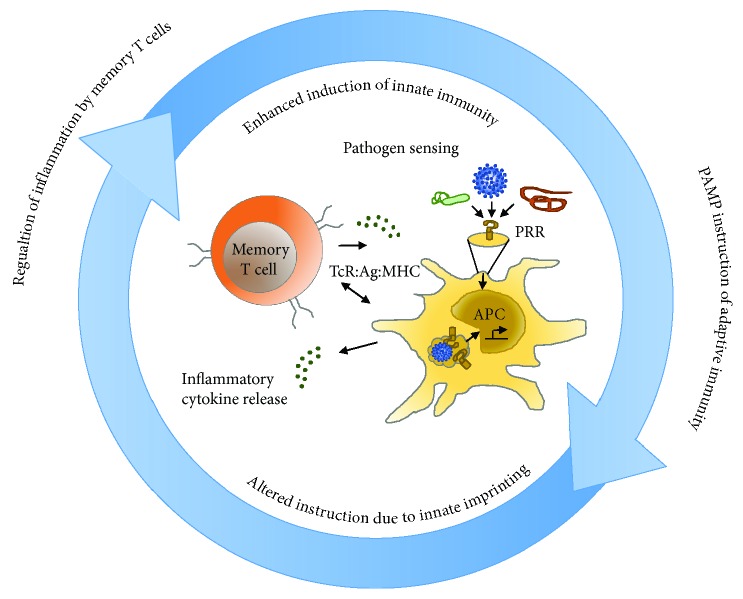
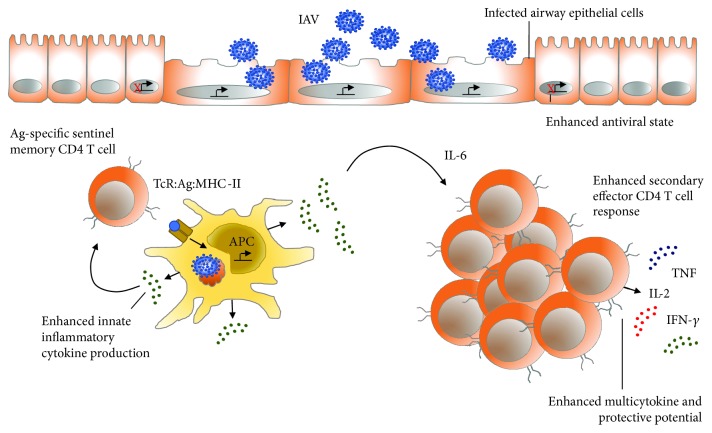
Inflammation plays an essential role in the control of pathogens and in shaping the ensuing adaptive immune responses. Traditionally, innate immunity has been described as a rapid response triggered through generic and nonspecific means that by definition lacks the ability to remember. Recently, it has become clear that some innate immune cells are epigenetically reprogrammed or "imprinted" by past experiences. These "trained" innate immune cells display altered inflammatory responses upon subsequent pathogen encounter. Remembrance of past pathogen encounters has classically been attributed to cohorts of antigen-specific memory T and B cells following the resolution of infection. During recall responses, memory T and B cells quickly respond by proliferating, producing effector cytokines, and performing various effector functions. An often-overlooked effector function of memory CD4 and CD8 T cells is the promotion of an inflammatory milieu at the initial site of infection that mirrors the primary encounter. This memory-conditioned inflammatory response, in conjunction with other secondary effector T cell functions, results in better control and more rapid resolution of both infection and the associated tissue pathology. Recent advancements in our understanding of inflammatory triggers, imprinting of the innate immune responses, and the role of T cell memory in regulating inflammation are discussed.
炎症在病原体的控制和随后的适应性免疫反应的形成中起着至关重要的作用。传统上,先天性免疫被描述为通过通用和非特异性手段触发的快速反应,其定义缺乏记忆能力。最近,人们已经清楚地认识到,一些先天免疫细胞通过过去的经验被表观遗传重新编程或“印记”。这些“训练有素”的先天免疫细胞在随后遇到病原体时会表现出不同的炎症反应。过去遇到病原体的记忆通常归因于感染消退后抗原特异性记忆 T 和 B 细胞的群体。在回忆反应中,记忆 T 和 B 细胞通过增殖、产生效应细胞因子和发挥各种效应功能迅速作出反应。记忆 CD4 和 CD8 T 细胞的一个经常被忽视的效应功能是在感染的初始部位促进炎症环境的形成,这种环境与初次接触相吻合。这种记忆条件下的炎症反应,加上其他次级效应 T 细胞功能,导致感染和相关组织病理学的更好控制和更快解决。本文讨论了我们对炎症触发因素、先天免疫反应的印记以及 T 细胞记忆在调节炎症中的作用的理解的最新进展。