Telomere Biology Laboratory, Cancer Research UK, London Research Institute, London, WC2A 3LY, UK.
Cell Cycle Lab, The Francis Crick Institute, 1 Midland Road, London NW1 1AT, UK.
Nucleic Acids Res. 2018 Sep 28;46(17):8865-8875. doi: 10.1093/nar/gky605.
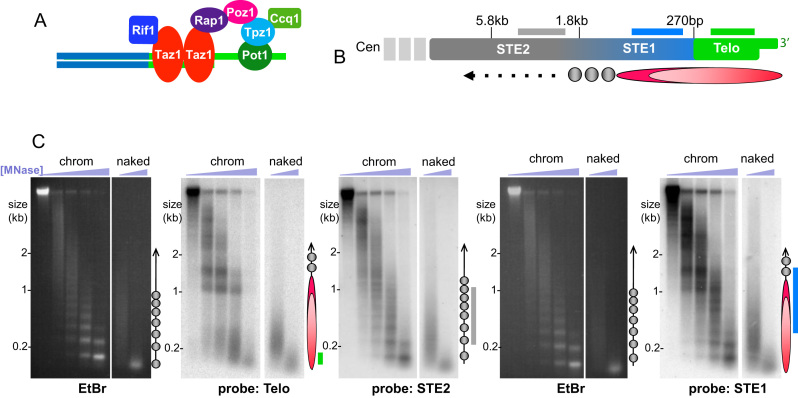
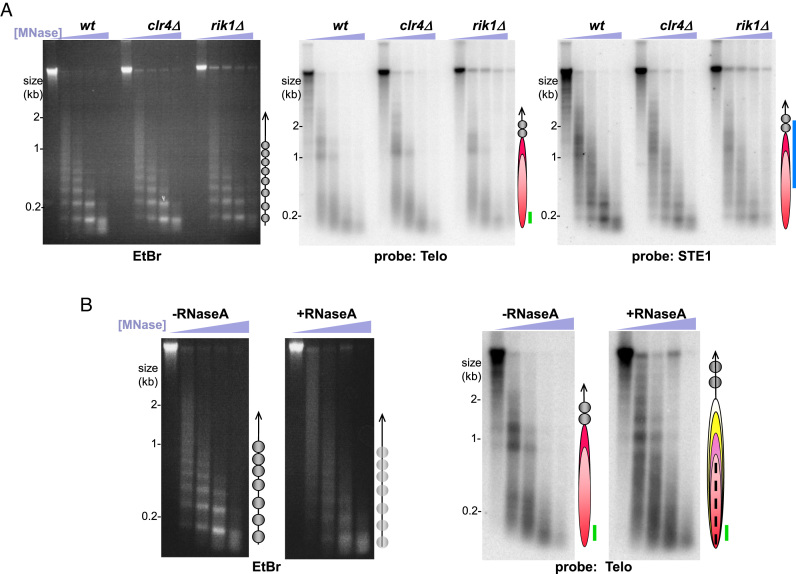
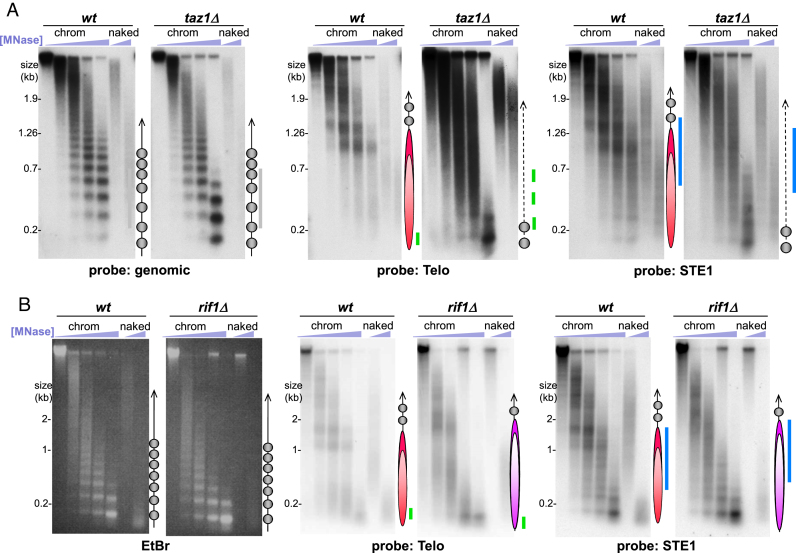
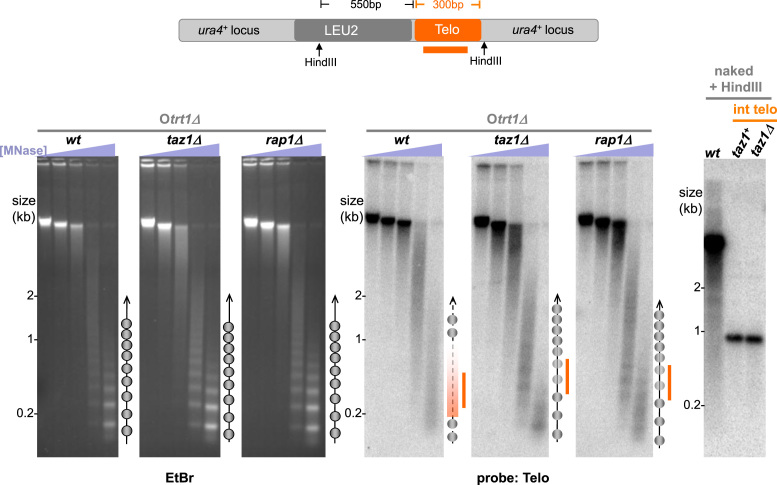
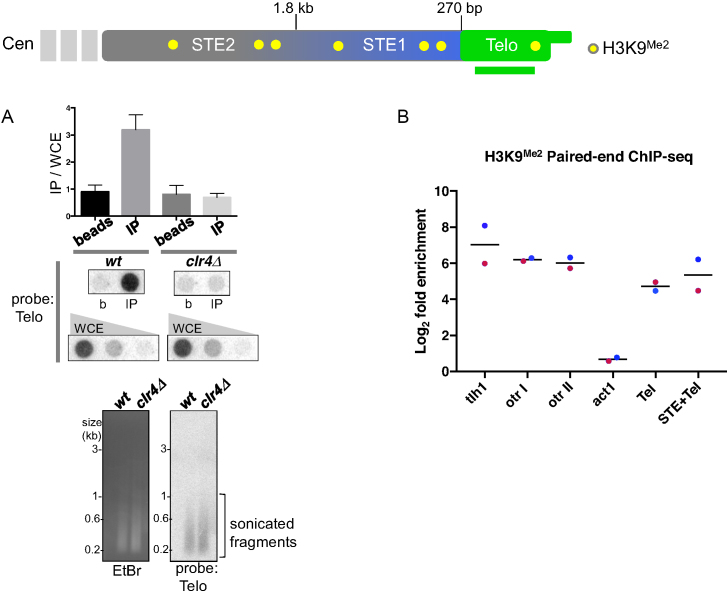
Despite the prime importance of telomeres in chromosome stability, significant mysteries surround the architecture of telomeric chromatin. Through micrococcal nuclease mapping, we show that fission yeast chromosome ends are assembled into distinct protected structures ('telosomes') encompassing the telomeric DNA repeats and over half a kilobase of subtelomeric DNA. Telosome formation depends on the conserved telomeric proteins Taz1 and Rap1, and surprisingly, RNA. Although yeast telomeres have long been thought to be free of histones, we show that this is not the case; telomere repeats contain histones. While telomeric histone H3 bears the heterochromatic lys9-methyl mark, we show that this mark is dispensable for telosome formation. Therefore, telomeric chromatin is organized at an architectural level, in which telomere-binding proteins and RNAs impose a unique nucleosome arrangement, and a second level, in which histone modifications are superimposed upon the higher order architecture.
尽管端粒在染色体稳定性方面具有重要意义,但端粒染色质的结构仍然存在许多未解之谜。通过微球菌核酸酶作图,我们发现裂殖酵母染色体末端被组装成独特的保护结构(“端粒体”),包含端粒 DNA 重复序列和超过半千碱基的端粒 DNA 序列。端粒体的形成依赖于保守的端粒蛋白 Taz1 和 Rap1,以及出人意料的 RNA。尽管酵母端粒长期以来被认为不含组蛋白,但我们发现事实并非如此;端粒重复序列包含组蛋白。虽然端粒组蛋白 H3 带有异染色质赖氨酸 9 甲基标记,但我们发现该标记对于端粒体的形成并非必需。因此,端粒染色质在结构水平上进行组织,其中端粒结合蛋白和 RNA 施加独特的核小体排列,在更高层次的结构上叠加第二个层次的组蛋白修饰。