Key Laboratory of Dairy Biotechnology and Engineering, Ministry of Education P.R. C, Inner Mongolia Agricultural University, Huhhot, 010018, People's Republic of China.
Key Laboratory of Dairy Products Processing, Ministry of Agriculture P.R.C, Inner Mongolia Agricultural University, Huhhot, 010018, People's Republic of China.
BMC Genomics. 2018 Jul 11;19(1):527. doi: 10.1186/s12864-018-4887-3.
Enterococcus faecalis is widely studied as a common gut commensal and a nosocomial pathogen. In fact, Enterococcus faecalis is ubiquitous in nature, and it has been isolated from various niches, including the gastrointestinal tract, faeces, blood, urine, water, and fermented foods (such as dairy products). In order to elucidate the role of habitat in shaping the genome of Enterococcus faecalis, we performed a comparative genomic analysis of 78 strains of various origins.
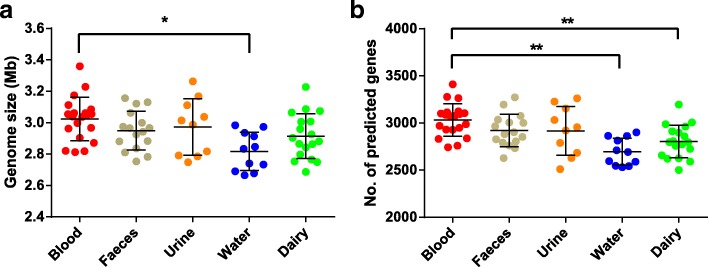
Although no correlation was found between the strain isolation habitat and the phylogeny of Enterococcus faecalis from our whole genome-based phylogenetic analysis, our results revealed some environment-associated features in the analysed Enterococcus faecalis genomes. Significant differences were found in the genome size and the number of predicted open reading frames (ORFs) between strains originated from different environments. In general, strains from water sources had the smallest genome size and the least number of predicted ORFs. We also identified 293 environment-specific genes, some of which might link to the adaptive strategies for survival in particular environments. In addition, the number of antibiotic resistance genes was significantly different between strains isolated from dairy products, water, and blood. Strains isolated from blood had the largest number of antibiotic resistance genes.
These findings improve our understanding of the role of habitat in shaping the genomes of Enterococcus faecalis.
粪肠球菌是一种广泛研究的常见肠道共生菌和医院病原体。事实上,粪肠球菌在自然界中无处不在,它已从各种生态位中分离出来,包括胃肠道、粪便、血液、尿液、水和发酵食品(如乳制品)。为了阐明生境在塑造粪肠球菌基因组中的作用,我们对 78 株来自不同来源的菌株进行了比较基因组分析。
尽管我们基于全基因组的系统发育分析发现,菌株分离生境与粪肠球菌的系统发育之间没有相关性,但我们的结果揭示了分析的粪肠球菌基因组中一些与环境相关的特征。来自不同环境的菌株在基因组大小和预测的开放阅读框(ORF)数量上存在显著差异。一般来说,来自水源的菌株具有最小的基因组大小和最少的预测 ORF。我们还鉴定了 293 个环境特异性基因,其中一些可能与在特定环境中生存的适应策略有关。此外,来自乳制品、水和血液的菌株中抗生素耐药基因的数量存在显著差异。来自血液的菌株具有最多的抗生素耐药基因。
这些发现提高了我们对生境在塑造粪肠球菌基因组中的作用的理解。