Liu Zhimin, Zhang Zhifeng, Huang Mei, Sun Xiaoping, Liu Bojia, Guo Qiyang, Chang Qingshan, Duan Zhijun
Second department of Gastroenterology, First Affiliated Hospital of Dalian Medical University, Dalian, 116011, China.
The Sixth People's Hospital of Dalian, Dalian, 116021, China.
BMC Gastroenterol. 2018 Jul 11;18(1):112. doi: 10.1186/s12876-018-0842-7.
Previous studies have indicated that bile acid is associated with progression of liver cirrhosis. However, the particular role of specific bile acid in the development of liver cirrhosis is not definite. The present study aims to identify the specific bile acid and explore its possible mechanisms in promoting liver cirrhosis.
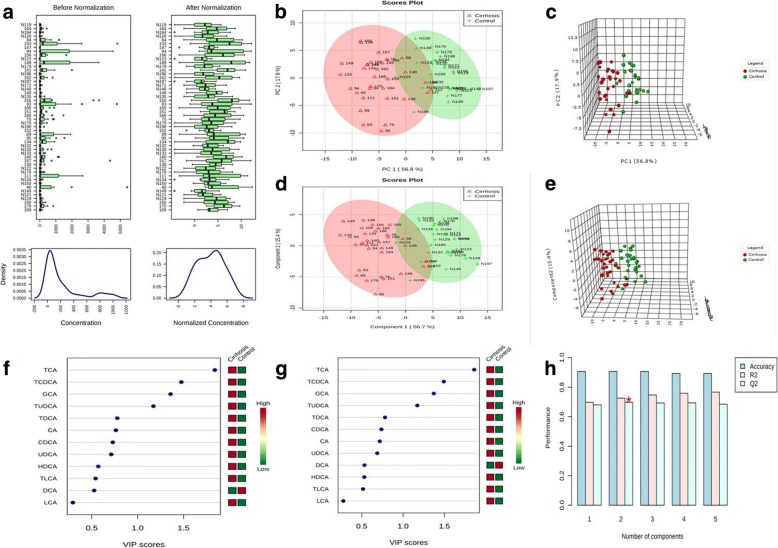
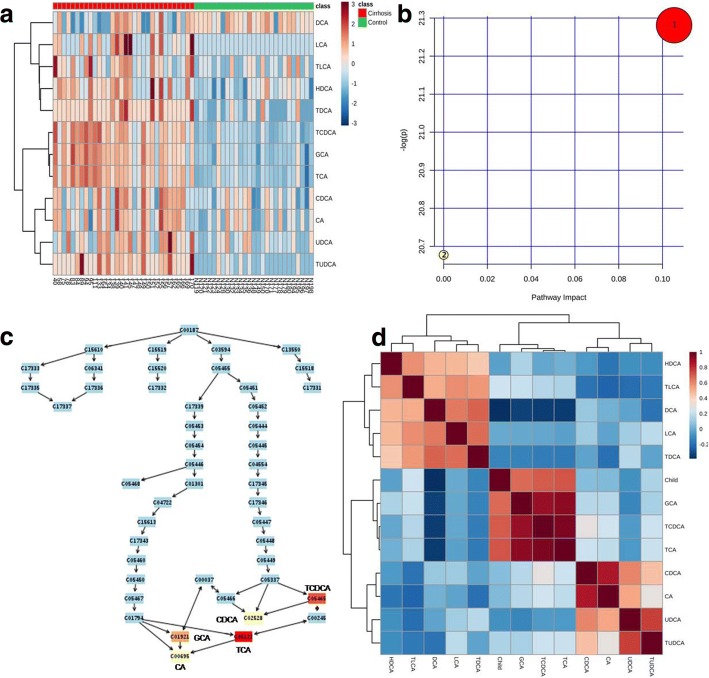
Thirty two cirrhotic patients and 27 healthy volunteers were enrolled. Age, gender, Child-Pugh classification and serum of patients and volunteers were collected. Liquid chromatography tandem mass spectrometry (LC-MS) was utilized to determine concentrations of 12 bile acids in serum. Principal component analysis, fold change analysis and heatmap analysis were used to identify the most changed bile acid. And pathway analysis was used to identify the most affected pathway in bile acid metabolism. Spearman rank correlation analysis was employed to assess correlation between concentrations of bile acids and Child-Pugh classification. Hepatic stellate cells (LX-2) were cultured in DMEM. LX-2 cells were also co-cultured with HepG2 cells in the transwell chambers. LX-2 cells were treated with Na+/taurocholate in different concentrations. Western blot was used to evaluate the expression of alpha smooth muscle actin (α-SMA), type I collagen, and Toll-like receptor 4 (TLR4) in LX-2 cells.
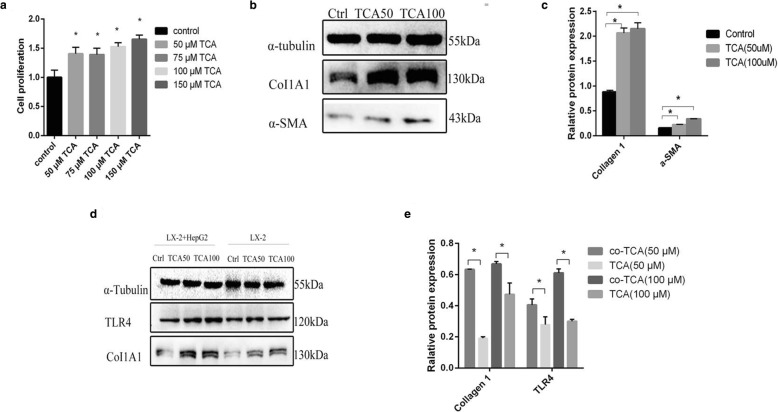
Concentrations of 12 bile acids in serum of patients and healthy volunteers were determined with LC-MS successively. Principal component analysis, fold change analysis and heatmap analysis identified taurocholic acid (TCA) to be the most changed bile acid. Pathway analysis showed that TCA biosynthesis increased significantly. Spearman rank correlation analysis showed that concentration of TCA in serum of cirrhotic patients was positively associated with Child-Pugh classification. TCA increased the expression of α-SMA, type I collagen, and TLR4 in LX-2 cells. Moreover, the above effect was strengthened when LX-2 cells were co-cultured with HepG2 cells.
Increased TCA concentration in serum of liver cirrhotic patients is mainly due to increased bile acid biosynthesis. TCA is an active promoter of the progression of liver cirrhosis. TCA promoting liver cirrhosis is likely through activating hepatic stellate cells via upregulating TLR4 expression. TCA is a potential therapeutic target for the prevention and treatment of liver cirrhosis.
既往研究表明胆汁酸与肝硬化进展相关。然而,特定胆汁酸在肝硬化发展中的具体作用尚不明确。本研究旨在鉴定特定胆汁酸,并探讨其促进肝硬化的可能机制。
纳入32例肝硬化患者和27名健康志愿者。收集患者和志愿者的年龄、性别、Child-Pugh分级及血清。采用液相色谱串联质谱法(LC-MS)测定血清中12种胆汁酸的浓度。运用主成分分析、倍数变化分析和热图分析来鉴定变化最大的胆汁酸。并通过通路分析来鉴定胆汁酸代谢中受影响最大的通路。采用Spearman秩相关分析评估胆汁酸浓度与Child-Pugh分级之间的相关性。肝星状细胞(LX-2)在DMEM中培养。LX-2细胞也在Transwell小室中与HepG2细胞共培养。用不同浓度的牛磺胆酸钠处理LX-2细胞。采用蛋白质免疫印迹法评估LX-2细胞中α平滑肌肌动蛋白(α-SMA)、I型胶原蛋白和Toll样受体4(TLR4)的表达。
先后用LC-MS测定了患者和健康志愿者血清中12种胆汁酸的浓度。主成分分析、倍数变化分析和热图分析确定牛磺胆酸(TCA)是变化最大的胆汁酸。通路分析表明TCA生物合成显著增加。Spearman秩相关分析显示,肝硬化患者血清中TCA浓度与Child-Pugh分级呈正相关。TCA增加了LX-2细胞中α-SMA、I型胶原蛋白和TLR4的表达。此外,当LX-2细胞与HepG2细胞共培养时,上述作用增强。
肝硬化患者血清中TCA浓度升高主要是由于胆汁酸生物合成增加。TCA是肝硬化进展的活跃促进因子。TCA促进肝硬化可能是通过上调TLR4表达激活肝星状细胞。TCA是预防和治疗肝硬化的潜在治疗靶点。