Department of Surgery, Centre Hospitalier Universitaire de Kigali, Kigali, Rwanda.
Program in Global Surgery and Social Change, Harvard Medical School, Boston, MA, United States of America.
Hum Resour Health. 2018 Jul 11;16(1):29. doi: 10.1186/s12960-018-0295-7.
There is a strong need for expanding surgical workforce in low- and middle-income countries. However, the number of medical students selecting surgical careers is not sufficient to meet this need. In Rwanda, there is an additional gender gap in speciality selection. Our study aims to understand the early variables involved in junior medical students' preference of specialisation with a focus on gender disparities.
We performed a cross-sectional survey of medical students during their clinical rotation years at the University of Rwanda. Demographics, specialisation preference, and factors involved in that preference were obtained using questionnaires and analysed using descriptive statistics and odds ratios.
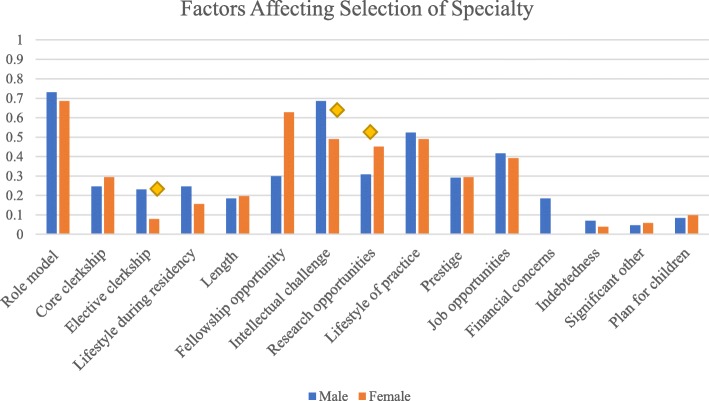
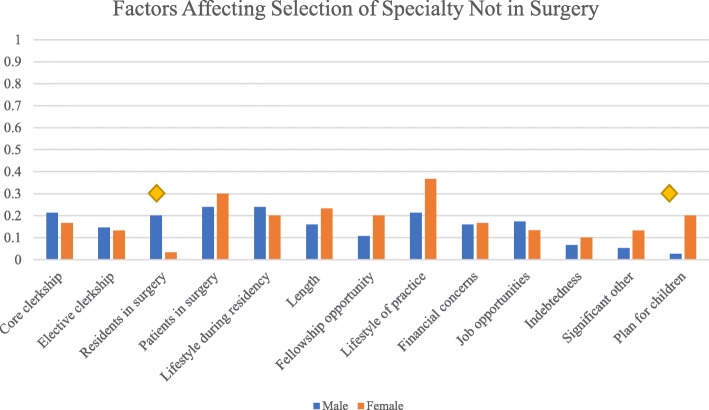
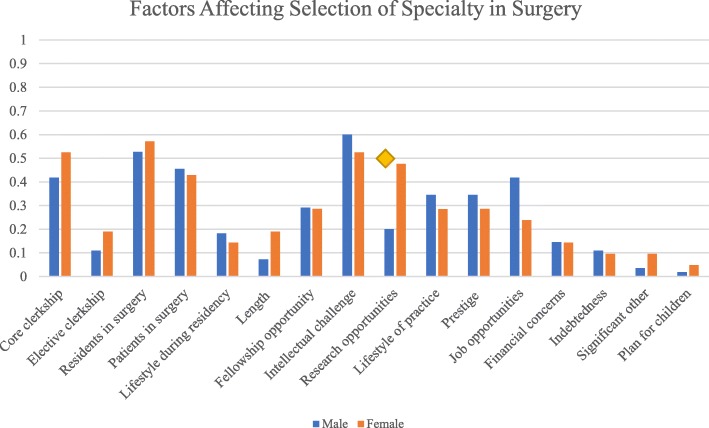
One hundred eighty-one respondents participated in the study (49.2% response rate) with a female-to-male ratio of 1 to 2.5. Surgery was the preferred speciality for 46.9% of male participants, and obstetrics/gynaecology for 29.4% of females. The main selection criteria for those who had already decided on surgery as a career included intellectual challenge (60.0%), interaction with residents (52.7%), and core clerkship experience (41.8%) for male participants and interaction with residents (57.1%), intellectual challenge (52.4%), and core clerkship experience (52.4%) for female participants. Females were more likely than males to join surgery based on perceived research opportunities (OR 2.7, p = 0.04). Male participants were more likely than their female participants to drop selection of surgery as a speciality when an adverse interaction with a resident was encountered (OR 0.26, p = 0.03).
This study provides insight into factors that guide Rwandan junior medical students' speciality preference. Medical students are more likely to consider surgical careers when exposed to positive clerkship experiences that provide intellectual challenges, as well as focused mentorship that facilitates effective research opportunities. Ultimately, creating a comprehensive curriculum that supports students' preferences may help encourage their selection of surgical careers.
在中低收入国家,扩大外科劳动力队伍的需求非常强烈。然而,选择外科职业的医学生人数不足以满足这一需求。在卢旺达,专业选择方面还存在额外的性别差距。我们的研究旨在了解影响低年级医学生专业选择的早期变量,重点关注性别差异。
我们对卢旺达大学临床轮转期间的医学生进行了横断面调查。使用问卷获取人口统计学资料、专业偏好以及影响这些偏好的因素,并进行描述性统计和优势比分析。
181 名受访者参加了这项研究(49.2%的回应率),男女比例为 1:2.5。46.9%的男性参与者首选外科,29.4%的女性参与者首选妇产科。那些已经决定从事外科职业的人选择该专业的主要标准包括智力挑战(60.0%)、与住院医师的互动(52.7%)和核心实习经验(41.8%),而女性参与者则更倾向于选择与住院医师的互动(57.1%)、智力挑战(52.4%)和核心实习经验(52.4%)。女性比男性更有可能因为认为有研究机会而选择外科(优势比 2.7,p=0.04)。当与住院医师的互动不佳时,男性参与者比女性参与者更有可能放弃选择外科作为专业(优势比 0.26,p=0.03)。
这项研究深入了解了指导卢旺达低年级医学生专业偏好的因素。当医学生接触到提供智力挑战的积极实习经验以及促进有效研究机会的重点指导时,他们更有可能考虑从事外科职业。最终,创建一个支持学生偏好的综合课程可能有助于鼓励他们选择外科职业。