Department of Medical and Molecular Genetics, Indiana University School of Medicine, 1234 Notre Dame Avenue, Raclin-Carmichael Hall, South Bend, IN, 46617, USA.
The University of Notre Dame Eck Institute for Global Health, Notre Dame, IN, 46556, USA.
Parasit Vectors. 2018 Jul 11;11(1):406. doi: 10.1186/s13071-018-2982-6.
Sophisticated tools for manipulation of gene expression in select neurons, including neurons that regulate sexually dimorphic behaviors, are increasingly available for analysis of genetic model organisms. However, we lack comparable genetic tools for analysis of non-model organisms, including Aedes aegypti, a vector mosquito which displays sexually dimorphic behaviors that contribute to pathogen transmission. Formaldehyde-assisted isolation of regulatory elements followed by sequencing (FAIRE-seq) recently facilitated genome-wide discovery of putative A. aegypti cis-regulatory elements (CREs), many of which could be used to manipulate gene expression in mosquito neurons and other tissues. The goal of this investigation was to identify FAIRE DNA elements that promote gene expression in the olfactory system, a tissue of vector importance.
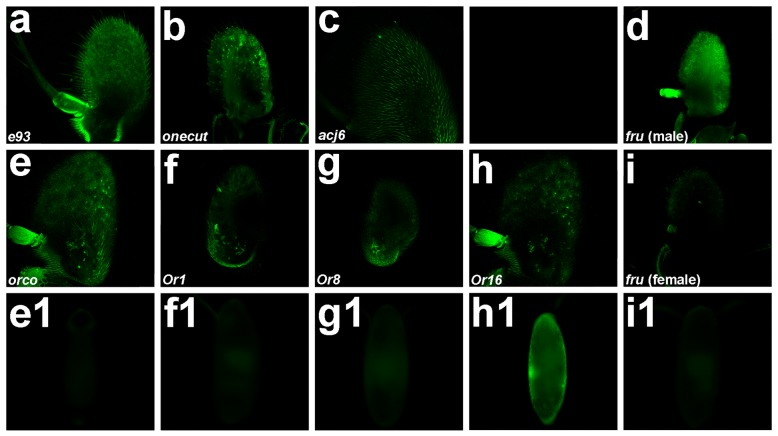
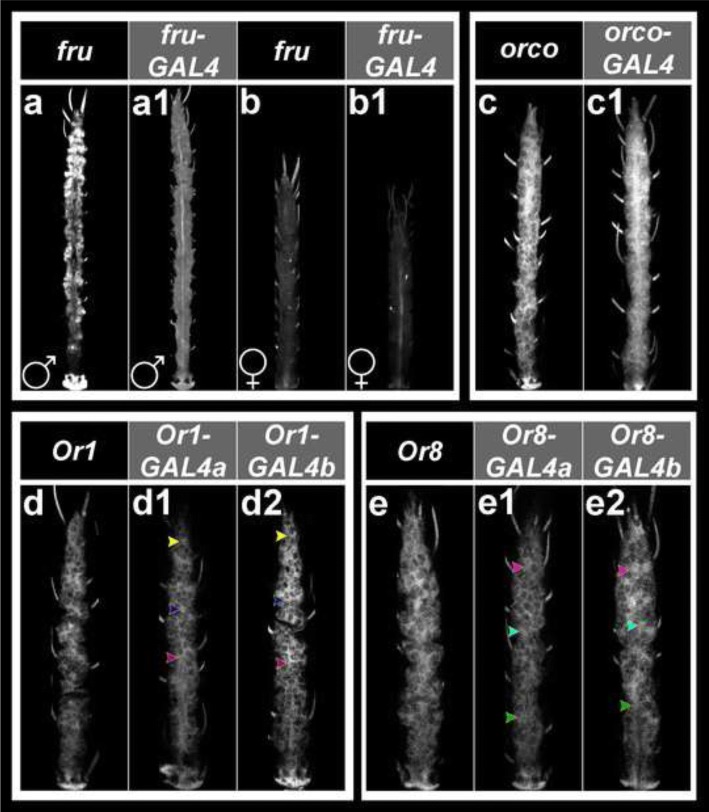
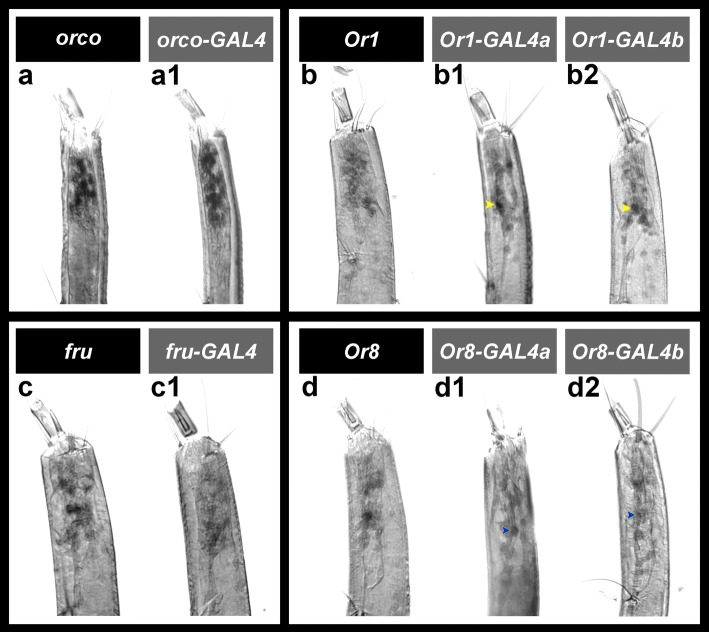
Eight A. aegypti CREs that promote gene expression in antennal olfactory receptor neurons (ORNs) were identified in a Drosophila melanogaster transgenic reporter screen. Four CREs identified in the screen were cloned upstream of GAL4 in a transgenic construct that is compatible with transformation of a variety of insect species. These constructs, which contained FAIRE DNA elements associated with the A. aegypti odorant coreceptor (orco), odorant receptor 1 (Or1), odorant receptor 8 (Or8) and fruitless (fru) genes, were used for transformation of A. aegypti. Six A. aegypti strains, including strains displaying transgene expression in all ORNs, subsets of these neurons, or in a sex-specific fashion, were isolated. The CREs drove transgene expression in A. aegypti that corresponded to endogenous gene expression patterns of the orco, Or1, Or8 and fru genes in the mosquito antenna. CRE activity in A. aegypti was found to be comparable to that observed in D. melanogaster reporter assays.
These results provide further evidence that FAIRE-seq, which can be paired with D. melanogaster reporter screening to test FAIRE DNA element activity in select tissues, is a useful method for identification of mosquito cis-regulatory elements. These findings expand the genetic toolkit available for the study of Aedes neurobiology. Moreover, given that the CREs drive comparable olfactory neural expression in both A. aegypti and D. melanogaster, it is likely that they may function similarly in multiple dipteran insects, including other disease vector mosquito species.
用于在特定神经元(包括调节性别二态行为的神经元)中操纵基因表达的复杂工具,越来越多地可用于遗传模式生物的分析。然而,我们缺乏用于分析非模式生物的可比遗传工具,包括埃及伊蚊,这是一种传播病原体的媒介蚊子,具有性别二态行为。最近,通过甲醛辅助分离调控元件测序(FAIRE-seq)促进了埃及伊蚊顺式调控元件(CRE)的全基因组发现,其中许多元件可用于操纵蚊子神经元和其他组织中的基因表达。本研究的目的是鉴定促进嗅觉系统(一种媒介重要组织)中基因表达的 FAIRE DNA 元件。
在黑腹果蝇转基因报告基因筛选中鉴定了 8 个促进触角嗅觉受体神经元(ORNs)中基因表达的埃及伊蚊 CRE。在筛选中鉴定的 4 个 CRE 被克隆到一个转基因构建体的 GAL4 上游,该构建体与多种昆虫物种的转化兼容。这些构建体包含与埃及伊蚊气味受体核心受体(orco)、气味受体 1(Or1)、气味受体 8(Or8)和无果(fru)基因相关的 FAIRE DNA 元件,用于转化埃及伊蚊。分离出 6 种埃及伊蚊品系,包括在所有 ORNs、这些神经元的亚群或特定性别中显示转基因表达的品系。CRE 在埃及伊蚊中的表达与 ORN 中 orco、Or1、Or8 和 fru 基因的内源性基因表达模式相对应。在埃及伊蚊中观察到的 CRE 活性与在黑腹果蝇报告基因测定中观察到的活性相当。
这些结果进一步证明,FAIRE-seq 可与黑腹果蝇报告基因筛选结合使用,以测试特定组织中 FAIRE DNA 元件的活性,是鉴定蚊子顺式调控元件的有用方法。这些发现扩展了用于研究埃及伊蚊神经生物学的遗传工具包。此外,鉴于这些 CRE 在埃及伊蚊和黑腹果蝇中都能驱动类似的嗅觉神经表达,它们很可能在包括其他病媒蚊种在内的多种双翅目昆虫中具有类似的功能。