Musculoskeletal biology I, Institute of Ageing and Chronic Disease, University of Liverpool, Liverpool, UK.
Department of Academic Rheumatology, Aintree University Hospital, Liverpool, UK.
Arthritis Res Ther. 2018 Jul 11;20(1):140. doi: 10.1186/s13075-018-1644-6.
Depression is common among patients with axial spondyloarthritis (axSpA), but reports of its prevalence are highly variable. We performed a systematic review to (i) describe the prevalence of depression in axSpA, (ii) compare its prevalence between axSpA, ankylosing spondylitis (AS) and non-radiographic axSpA (nr-axSpA) cohorts, and (iii) compare disease activity and functional impairment between those with and without depression.
We searched Medline, PubMed, Web of Science, PsycINFO, CINAHL Plus, the Cochrane library and conference abstracts of the European League Against Rheumatism, British Society for Rheumatology and American College of Rheumatology using a predefined protocol in accordance with Preferred Reporting Items for Systematic reviews and Meta-Analyses (PRISMA) guidelines. Meta-analysis was performed using quality-effects model.
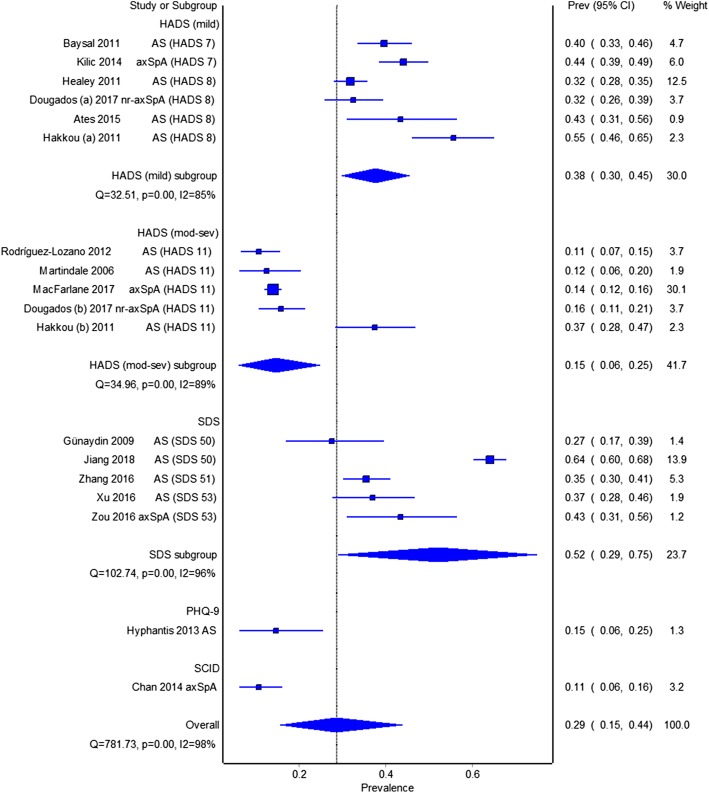
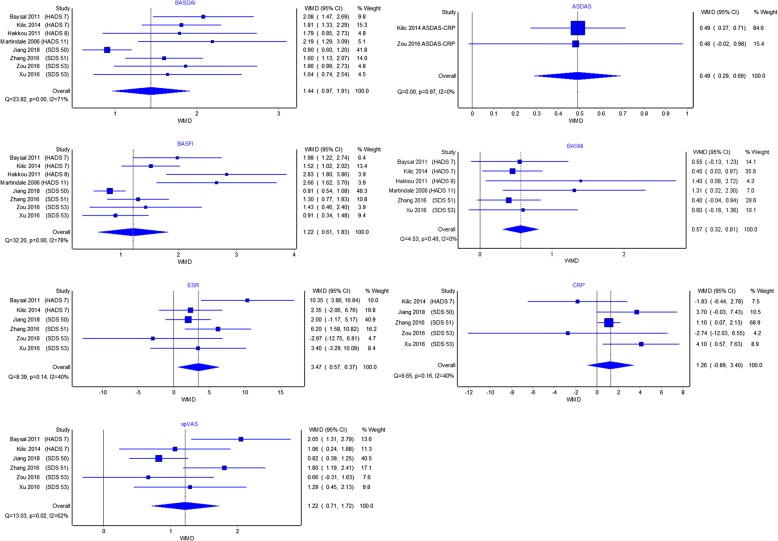
Fifteen original articles and one abstract were included for analysis; 14 studies described AS cohorts and two nr-axSpA. Three screening criteria and one diagnostic criterion were used to define depression. Prevalence ranged from 11 to 64% depending on criteria and thresholds used. Pooled prevalence of at least moderate depression was 15% using the Hospital Anxiety and Depression Scale (HADS) threshold of ≥ 11. The prevalence of depression was similar between axSpA, AS and nr-axSpA cohorts. Patients with depression had significantly worse disease activity, including higher BASDAI by 1.4 units (95% CI 1.0 to 1.9), ASDAS by 0.5 units (95% CI 0.3 to 0.7) and ESR by 3.5 mm/h (95% CI 0.6 to 6.4). They also had greater functional impairment with higher BASFI and BASMI by 1.2 units (95% CI 0.6 to 1.8) and 0.6 units (95% CI 0.3 to 0.8), respectively. Mean age of each study cohort inversely correlated with depression prevalence.
Depression is common among axSpA patients and is associated with more severe disease activity and functional impairment. Identifying and managing depression should form part of their holistic care. Further longitudinal studies are needed to explore the impact of depression on treatment outcomes and axSpA treatment on symptoms of depression.
抑郁症在中轴型脊柱关节炎(axSpA)患者中很常见,但报告的患病率差异很大。我们进行了一项系统评价,旨在:(i)描述 axSpA 患者中抑郁症的患病率;(ii)比较 axSpA、强直性脊柱炎(AS)和非放射学 axSpA(nr-axSpA)队列之间的患病率;(iii)比较伴有和不伴有抑郁症的患者的疾病活动度和功能障碍。
我们按照系统评价和荟萃分析的首选报告项目(PRISMA)指南,使用预定义的方案,在 Medline、PubMed、Web of Science、PsycINFO、CINAHL Plus、考科蓝图书馆和欧洲抗风湿病联盟、英国风湿病学会和美国风湿病学会会议摘要中进行了搜索。使用质量效应模型进行荟萃分析。
纳入了 15 篇原始文章和 1 篇摘要进行分析;14 项研究描述了 AS 队列,2 项研究描述了 nr-axSpA。使用三种筛查标准和一种诊断标准来定义抑郁症。根据使用的标准和阈值,患病率从 11%到 64%不等。使用医院焦虑和抑郁量表(HADS)≥11 的阈值,至少中度抑郁的总患病率为 15%。axSpA、AS 和 nr-axSpA 队列之间的抑郁症患病率相似。患有抑郁症的患者疾病活动度明显更差,包括 BASDAI 增加 1.4 个单位(95%CI 1.0 至 1.9)、ASDAS 增加 0.5 个单位(95%CI 0.3 至 0.7)和 ESR 增加 3.5mm/h(95%CI 0.6 至 6.4)。他们的功能障碍也更大,BASFI 和 BASMI 分别增加 1.2 个单位(95%CI 0.6 至 1.8)和 0.6 个单位(95%CI 0.3 至 0.8)。每个研究队列的平均年龄与抑郁症患病率呈反比。
抑郁症在 axSpA 患者中很常见,与更严重的疾病活动度和功能障碍相关。识别和管理抑郁症应成为其整体治疗的一部分。需要进一步的纵向研究来探讨抑郁症对治疗结果和 axSpA 治疗对抑郁症状的影响。