van Staaveren Nienke, Decina Caitlin, Baes Christine F, Widowski Tina M, Berke Olaf, Harlander-Matauschek Alexandra
Department of Animal Biosciences, Ontario Agricultural College, University of Guelph, Guelph, ON N1G 2W1, Canada.
Department of Population Medicine, Ontario Veterinary College, University of Guelph, Guelph, ON N1G 2W1, Canada.
Animals (Basel). 2018 Jul 11;8(7):114. doi: 10.3390/ani8070114.
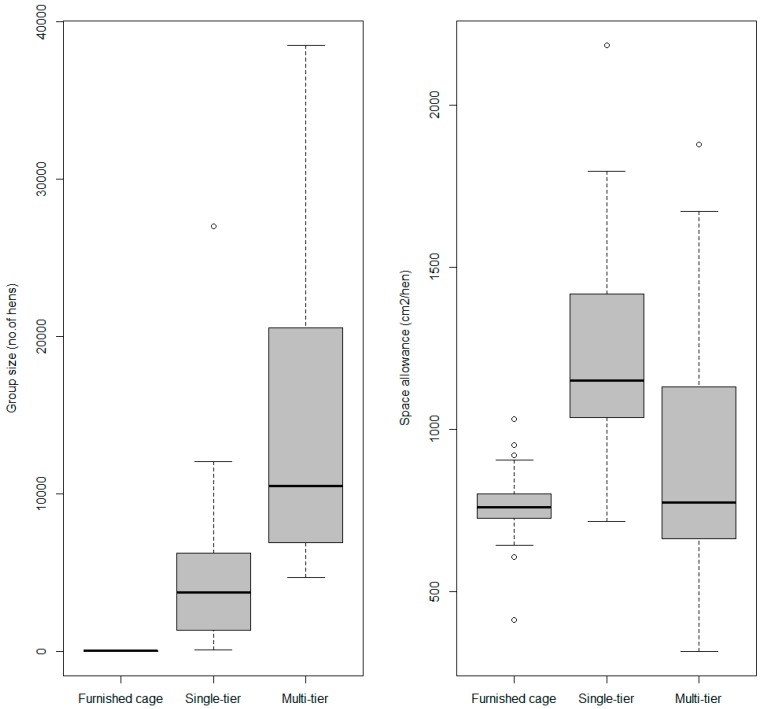
Canadian laying hen farms are transitioning from conventional cage housing to furnished cage and non-cage housing systems to improve laying hen welfare. However, little is known about the current housing and management systems in Canada. This study addresses this knowledge gap by describing different housing and management practices used on farms where laying hens were housed in furnished cages or non-cage housing systems. A questionnaire covering farm and housing conditions, litter management, nutrition and feeding, environmental control, flock characteristics, rearing and placement, health, egg production and performance were distributed through provincial egg boards to 122 producers across Canada. Data were collected from 65 laying hen flocks (52.5% response rate) in 26 furnished cage, 17 single-tier and 22 multi-tier systems. Flocks were on average 45.1 ± 14.59 weeks old (range: 19⁻69 weeks). Frequencies of different management practices were calculated according to housing system. Most flocks were reared in the same housing system as they were housed in during lay, with the exception of furnished cage layers which were reared in conventional cage systems. Results indicated that a large proportion of non-cage systems were either fully slatted or had manure as a litter substrate, which could have implications for consumer perspectives on these systems. Further research is needed to develop clear recommendations on proper litter management for farmers. In general, flock health was managed through daily inspections and vaccination schemes, whereas veterinarian involvement on-farm was less common. Vaccination, hygiene, and effective biosecurity should be maintained to ensure good health in laying hens in furnished cage and non-cage systems during the transition to these systems.
加拿大的蛋鸡养殖场正在从传统的笼养方式向配备家具的笼养和非笼养系统转变,以改善蛋鸡的福利。然而,人们对加拿大目前的养殖和管理系统知之甚少。本研究通过描述在配备家具的笼子或非笼养系统中饲养蛋鸡的农场所采用的不同养殖和管理方法,填补了这一知识空白。一份涵盖农场和养殖条件、垫料管理、营养与喂养、环境控制、鸡群特征、育雏与安置、健康、产蛋及生产性能的调查问卷,通过省级蛋品委员会分发给加拿大各地的122位生产商。从26个配备家具的笼养系统、17个单层和22个多层系统中的65个蛋鸡群收集了数据(回复率为52.5%)。鸡群平均年龄为45.1 ± 14.59周(范围:19至69周)。根据养殖系统计算了不同管理方法的频率。除了在传统笼养系统中育雏的配备家具的笼养蛋鸡外,大多数鸡群在产蛋期间的饲养环境与育雏时相同。结果表明,很大一部分非笼养系统要么完全是板条式的,要么以粪便作为垫料基质,这可能会影响消费者对这些系统的看法。需要进一步研究,为农民制定关于正确垫料管理的明确建议。总体而言,鸡群健康通过日常检查和疫苗接种计划进行管理,而兽医到农场参与管理的情况则较少见。在向这些系统过渡期间,应维持疫苗接种、卫生和有效的生物安全措施,以确保配备家具的笼养和非笼养系统中的蛋鸡保持良好健康状态。