School of Chinese Herbal Medicine, Guangzhou University of Chinese Medicine, Waihuan East Road No. 232, Guangzhou Higher Education Mega Center, Guangzhou 510006, China.
Innovative Research & Development Laboratory of TCM, Guangzhou University of Chinese Medicine, Waihuan East Road No. 232, Guangzhou Higher Education Mega Center, Guangzhou 510006, China.
Molecules. 2018 Jul 11;23(7):1692. doi: 10.3390/molecules23071692.
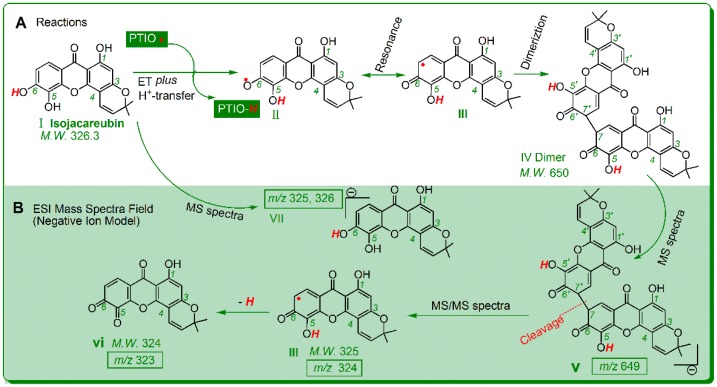
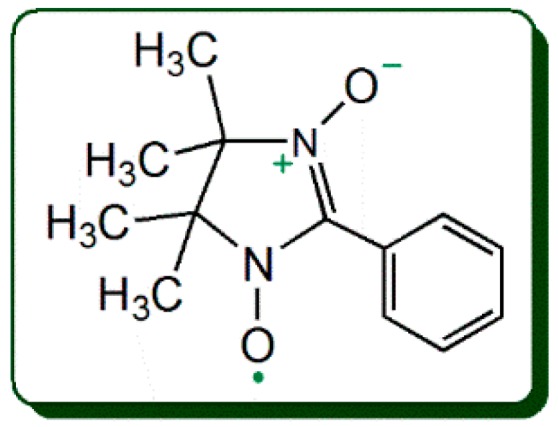
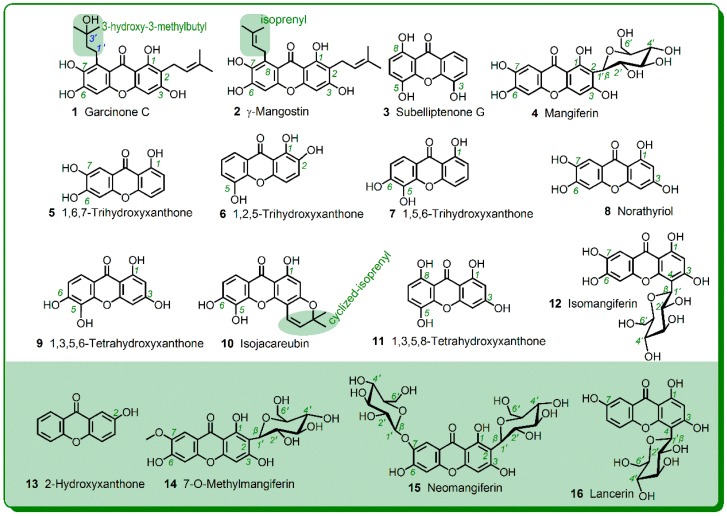
This study used the 2-phenyl-4,4,5,5-tetramethylimidazoline-1-oxyl 3-oxide radical (PTIO•) trapping model to study the antioxidant activities of 16 natural xanthones in aqueous solution, including garcinone C, γ-mangostin, subelliptenone G, mangiferin, 1,6,7-trihydroxy-xanthone, 1,2,5-trihydroxyxanthone, 1,5,6-trihydroxyxanthone, norathyriol, 1,3,5,6-tetrahydroxy-xanthone, isojacareubin, 1,3,5,8-tetrahydroxyxanthone, isomangiferin, 2-hydroxyxanthone, 7--methylmangiferin, neomangiferin, and lancerin. It was observed that most of the 16 xanthones could scavenge the PTIO• radical in a dose-dependent manner at pH 4.5 and 7.4. Among them, 12 xanthones of the -di-OHs (or -di-OHs) type always exhibited lower half maximal inhibitory concentration (IC) values than those not of the -di-OHs (or -di-OHs) type. Ultra-performance liquid chromatography coupled with electrospray ionization quadrupole time-of-flight tandem mass spectrometry (UPLC-ESI-Q-TOF-MS/MS) analysis revealed that most of these xanthones gave xanthone-xanthone dimers after incubation with PTIO•, except for neomangiferin. Based on these data, we concluded that the antioxidant activity of phenolic xanthone may be mediated by electron-transfer (ET) H⁺-transfer mechanisms. Through these mechanisms, some xanthones can further dimerize unless they bear huge substituents with steric hindrance. Four substituent types (i.e., -di-OHs, 5,6-di-OHs, 6,7-di-OHs, and 7,8-di-OHs) dominate the antioxidant activity of phenolic xanthones, while other substituents (including isoprenyl and 3-hydroxy-3-methylbutyl substituents) play a minor role as long as they do not break the above four types.
本研究采用 2-苯基-4,4,5,5-四甲基咪唑啉-1-氧自由基(PTIO•)捕获模型,研究了 16 种天然蒽酮在水溶液中的抗氧化活性,包括 garcinone C、γ-倒捻子素、subelliptenone G、芒果苷、1,6,7-三羟基-蒽酮、1,2,5-三羟基蒽酮、1,5,6-三羟基蒽酮、norathyriol、1,3,5,6-四羟基-蒽酮、isojacareubin、1,3,5,8-四羟基蒽酮、异芒果苷、2-羟基蒽酮、7-O-甲基芒果苷、新芒果苷和 lancerin。结果表明,在 pH 值为 4.5 和 7.4 时,大多数 16 种蒽酮均可在剂量依赖性方式下清除 PTIO•自由基。其中,12 种具有 -二-OHs(或 -二-OHs)结构的蒽酮的半数最大抑制浓度(IC)值总是低于不具有 -二-OHs(或 -二-OHs)结构的蒽酮。超高效液相色谱-电喷雾电离四极杆飞行时间串联质谱(UPLC-ESI-Q-TOF-MS/MS)分析表明,除新芒果苷外,大多数蒽酮与 PTIO•孵育后都会生成蒽酮-蒽酮二聚体。基于这些数据,我们得出结论,酚类蒽酮的抗氧化活性可能是通过电子转移(ET)-H⁺转移机制介导的。通过这些机制,一些蒽酮可以进一步二聚化,除非它们带有巨大的空间位阻取代基。四种取代基类型(即 -二-OHs、5,6-二-OHs、6,7-二-OHs 和 7,8-二-OHs)主导着酚类蒽酮的抗氧化活性,而其他取代基(包括异戊烯基和 3-羟基-3-甲基丁基取代基)则发挥次要作用,只要它们不破坏上述四种类型。