School of Chinese Herbal Medicine, Guangzhou University of Chinese Medicine, Guangzhou 510006, China.
Innovative Research & Development Laboratory of TCM, Guangzhou University of Chinese Medicine, Guangzhou 510006, China.
Molecules. 2018 Nov 26;23(12):3083. doi: 10.3390/molecules23123083.
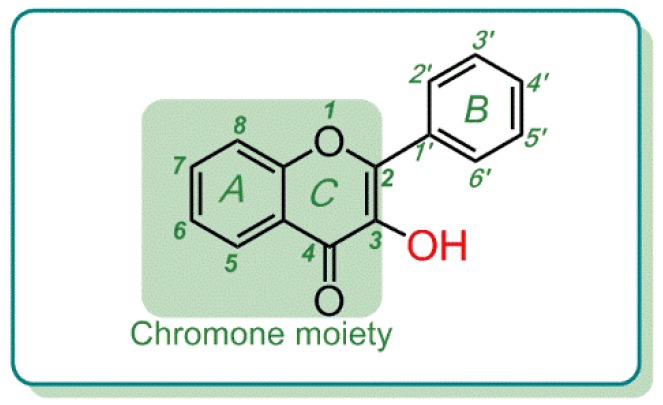
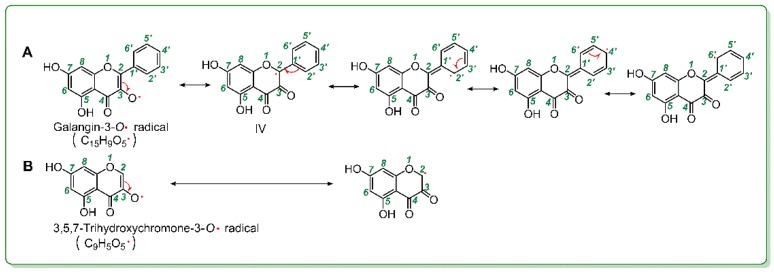
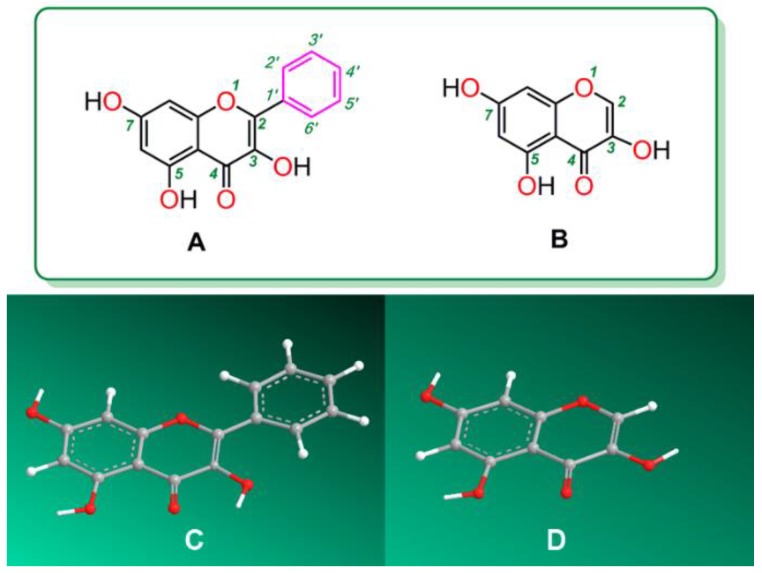
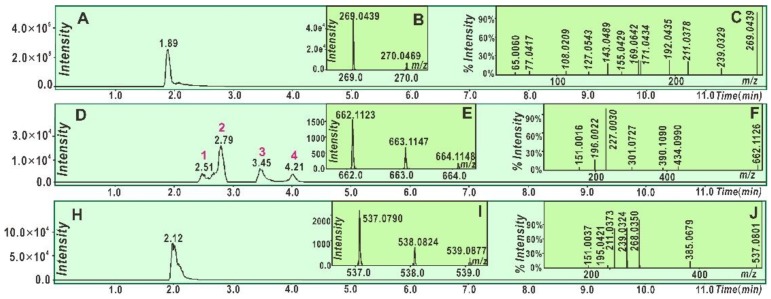
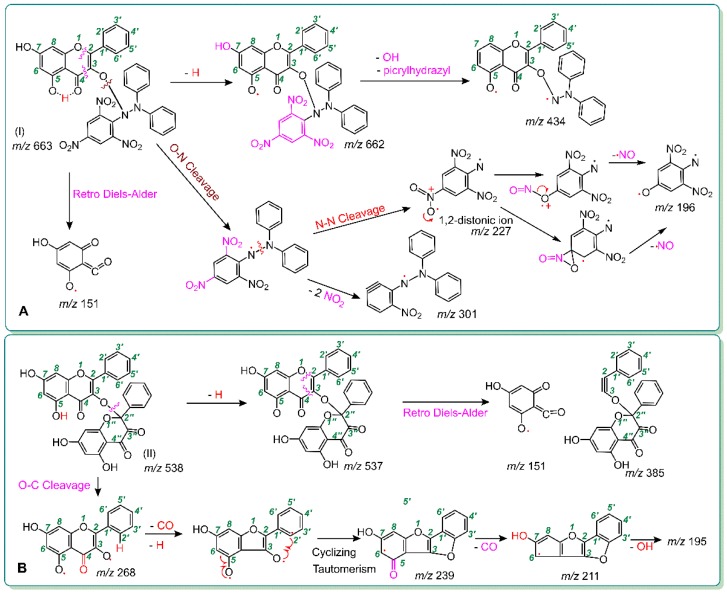
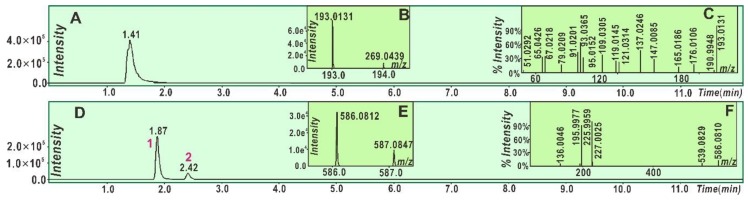
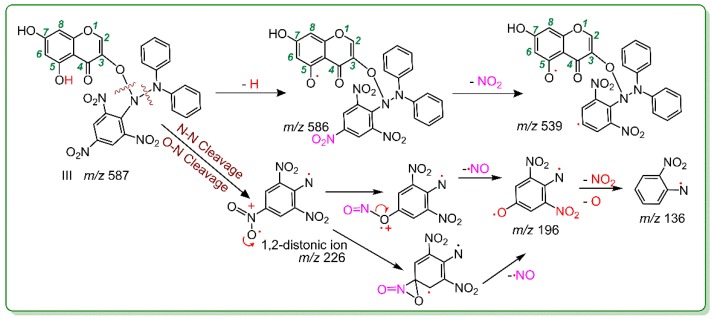
To clarify the role of the -ring in antioxidant flavonols, we performed a comparative study between galangin with a null -ring and 3,5,7-trihydroxychromone without a -ring using five spectrophotometric assays, namely, O₂-scavenging, 1,1-diphenyl-2-picrylhydrazyl radical (DPPH)-scavenging, 2-phenyl-4,4,5,5-tetramethylimidazoline-1-oxyl-3-oxide radical-scavenging, 2,2'-azino-bis(3-ethylbenzo-thiazoline-6-sulfonic acid) radical-scavenging, and Fe-reducing activity. The DPPH-scavenging reaction products of these assays were further analyzed by ultra-performance liquid chromatography coupled with electrospray ionization quadrupole time-of-flight tandem mass spectrometry (UPLC-ESI-Q-TOF-MS/MS) technology. In the five spectrophotometric assays, galangin and 3,5,7-trihydroxychromone dose-dependently increased their radical-scavenging (or Fe-reducing) percentages. However, galangin always gave lower IC values than those of 3,5,7-trihydroxychromone. In the UPLC-ESI-Q-TOF-MS/MS analysis, galangin yielded galangin-DPPH adduct MS peaks (/ 662, 434, 301, 227,196, and 151) and galangin-galangin dimer MS peaks (/ 538, 385, 268, 239, 211, 195, and 151). 3,5,7-Trihydroxychromone, however, only generated / 3,5,7-trihydroxychromone-DPPH adduct MS peaks (/ 586, 539, 227, 196, and 136). In conclusion, both galangin and 3,5,7-trihydroxychromone could similarly undergo multiple antioxidant pathways, including redox-dependent pathways (such as electron transfer (ET) and ET proton transfer (PT)) and a non-redox-dependent radical adduct formation (RAF) pathway; thus, the null -ring could hardly change their antioxidant pathways. However, it did improve their antioxidant levels in these pathways. Such improvement of the -ring toward an antioxidant flavonol is associated with its π-π conjugation, which can provide more resonance forms and bonding sites.
为了阐明 - 环在抗氧化黄酮醇中的作用,我们使用五种分光光度测定法(即 O₂ 清除、1,1-二苯基-2-苦基肼自由基(DPPH)清除、2-苯基-4,4,5,5-四甲基咪唑啉-1-氧-3-氧化物自由基清除、2,2'-联氮-双(3-乙基苯并噻唑啉-6-磺酸)自由基清除和 Fe 还原活性)对具有空 - 环的姜黄素和没有 - 环的 3,5,7-三羟基色酮进行了比较研究。这些测定法的 DPPH 清除反应产物进一步通过超高效液相色谱-电喷雾电离四极杆飞行时间串联质谱(UPLC-ESI-Q-TOF-MS/MS)技术进行分析。在五种分光光度测定法中,姜黄素和 3,5,7-三羟基色酮均呈剂量依赖性地增加其自由基清除(或 Fe 还原)百分比。然而,姜黄素的 IC 值始终低于 3,5,7-三羟基色酮。在 UPLC-ESI-Q-TOF-MS/MS 分析中,姜黄素生成姜黄素-DPPH 加合物 MS 峰(/ 662、434、301、227、196 和 151)和姜黄素-姜黄素二聚体 MS 峰(/ 538、385、268、239、211、195 和 151)。然而,3,5,7-三羟基色酮仅生成/ 3,5,7-三羟基色酮-DPPH 加合物 MS 峰(/ 586、539、227、196 和 136)。总之,姜黄素和 3,5,7-三羟基色酮都可以通过多种抗氧化途径,包括氧化还原依赖途径(如电子转移(ET)和 ET 质子转移(PT))和非氧化还原依赖的自由基加合物形成(RAF)途径,类似地发挥抗氧化作用;因此,空 - 环几乎不会改变它们的抗氧化途径。然而,它确实提高了它们在这些途径中的抗氧化水平。- 环对黄酮醇类抗氧化剂的这种改善与其 π-π 共轭有关,这可以提供更多的共振形式和键合位点。