Xu Hao, Xu Shangchen, Zhang Rui, Xin Tao, Pang Qi
Department of Neurosurgery, Shandong Provincial Hospital Affiliated to Shandong University, Jinan 250021, Shandong, China,
Onco Targets Ther. 2018 Jul 2;11:3775-3783. doi: 10.2147/OTT.S167552. eCollection 2018.
SIL1 is a ubiquitous protein localized to the endoplasmic reticulum and functions as a cochaperone of BiP. Previous studies have shown that function loss of SIL1 is often associated with neurological diseases, such as Marinesco-Sjögren Syndrome. However, no studies have investigated the function of SIL1 in tumors. In this study we aim to reveal functions of SIL1 and the underlying mechanisms in glioma.
First, by searching on Gene Expression Profiling Interactive Analysis, we examined SIL1 expression and prognostic value in glioblastoma multiforme (GBM) and brain lower grade glioma (LGG). Immunohistochemical analysis (IHC) was also performed to determine the endogenic SIL1 level. Cell counting kit-8 (CCK8) and clone formation assays were used to detect cell proliferation of U251 cells. Cell migration was detected by transwell assay and cell cycle and apoptosis were detected by flow cytometry. Western blot was performed to determine protein expression.
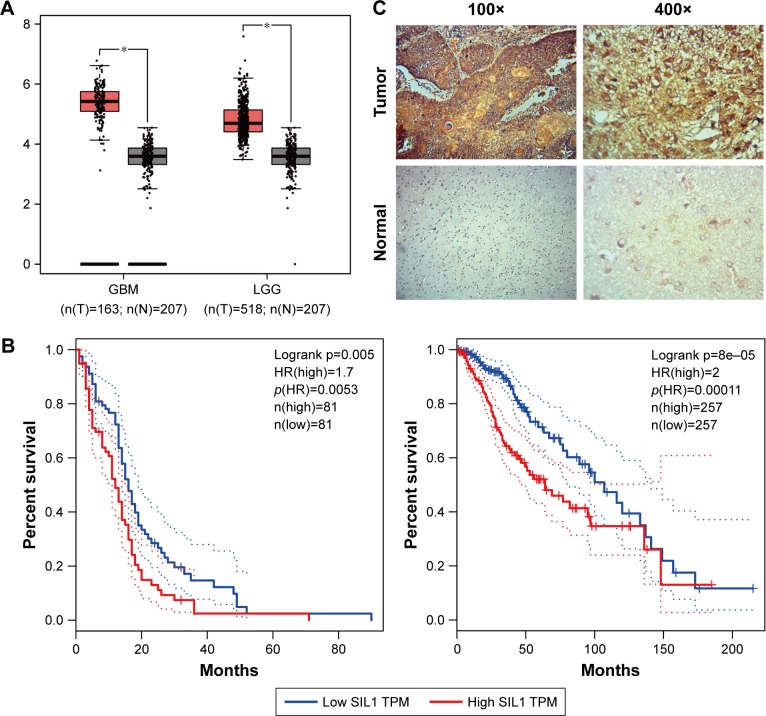
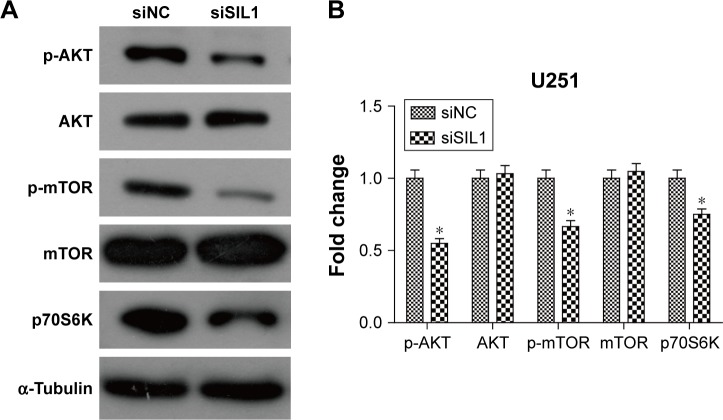
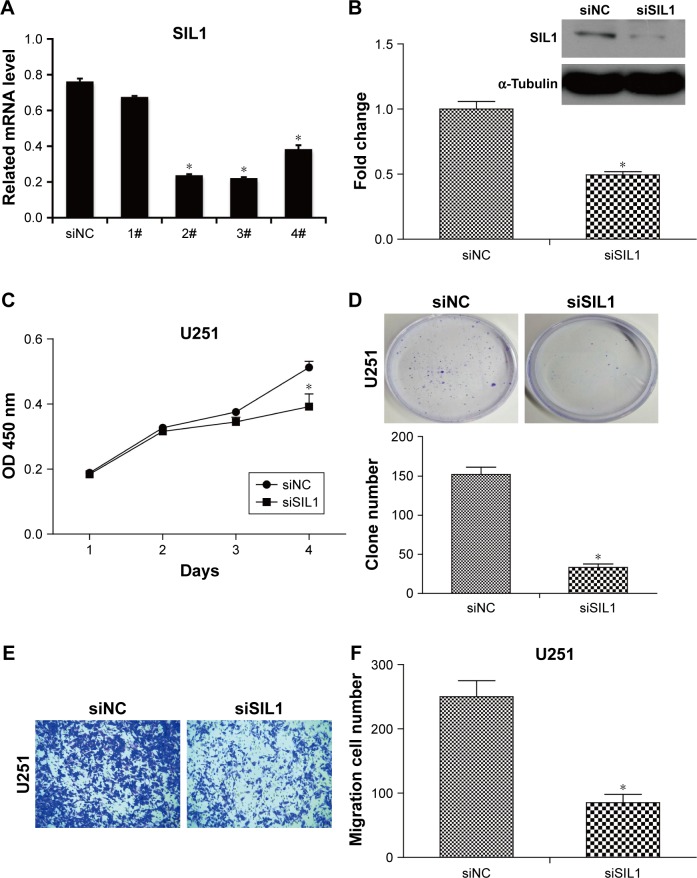
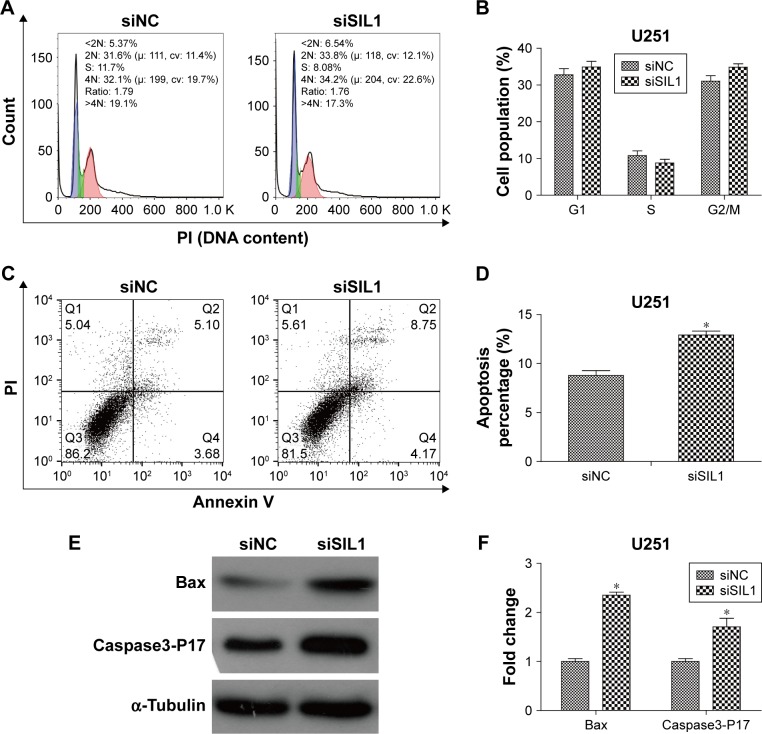
We found that the expression of SIL1 was increased by approximately 1.5-fold in GBM and 1.3-fold in LGG compared with normal controls (<0.05) and negatively correlated with patients' survival. IHC revealed that SIL1 expression was significantly higher in glioma tissues than that in paracancerous tissues (<0.05). Glioma patients with high SIL1 expression accounted for 65.79% (25/38) of total samples and SIL1 expression significantly increased in grade IV glioma compared to grades I-III (=0.026). Suppression of SIL1 expression led to significant inhibition of U251 cell proliferation. Transwell assay showed that cell migration of U251 was significantly inhibited by siSIL transfection, with an inhibitory rate reaching 69%. Flow cytometry detection showed that siSIL1 could induce apoptosis of U251 cells and upregulated the expression of the pro-apoptotic protein Bax and Caspase3-P17. However, siSIL1 transfection had no effect on the cell cycle. Mechanism studies demonstrated that siSIL1 transfection led to inactivation of AKT/mTOR signaling pathway, including decreased phosphorylation of AKT and mTOR without affecting protein expression, as well as decreased expression of the downstream effector p70S6K.
Downregulation of SIL1 inhibited the progression of glioma by suppressing the AKT/mTOR signaling pathway.
SIL1是一种广泛存在于内质网的蛋白质,作为BiP的辅助伴侣发挥作用。先前的研究表明,SIL1功能丧失常与神经疾病相关,如 Marinesco-Sjögren 综合征。然而,尚无研究探讨SIL1在肿瘤中的作用。本研究旨在揭示SIL1在胶质瘤中的功能及潜在机制。
首先,通过在基因表达谱交互式分析中搜索,我们检测了多形性胶质母细胞瘤(GBM)和低级别脑胶质瘤(LGG)中SIL1的表达及预后价值。还进行了免疫组织化学分析(IHC)以确定内源性SIL1水平。使用细胞计数试剂盒-8(CCK8)和克隆形成试验检测U251细胞的增殖。通过Transwell试验检测细胞迁移,通过流式细胞术检测细胞周期和凋亡。进行蛋白质印迹法以确定蛋白质表达。
我们发现,与正常对照相比,GBM中SIL1的表达增加了约1.5倍,LGG中增加了1.3倍(<0.05),且与患者生存率呈负相关。免疫组织化学显示,胶质瘤组织中SIL1的表达明显高于癌旁组织(<0.05)。SIL1高表达的胶质瘤患者占总样本的65.79%(25/38),与I-III级相比,IV级胶质瘤中SIL1表达显著增加(=0.026)。抑制SIL1表达导致U251细胞增殖受到显著抑制。Transwell试验表明,siSIL转染显著抑制了U251细胞的迁移,抑制率达到69%。流式细胞术检测显示,siSIL1可诱导U251细胞凋亡,并上调促凋亡蛋白Bax和Caspase3-P17的表达。然而,siSIL1转染对细胞周期无影响。机制研究表明,siSIL1转染导致AKT/mTOR信号通路失活,包括AKT和mTOR磷酸化降低,而不影响蛋白质表达,以及下游效应物p70S6K表达降低。
SIL1的下调通过抑制AKT/mTOR信号通路抑制胶质瘤的进展。