Bournaud Caroline, Gillet François-Xavier, Murad André M, Bresso Emmanuel, Albuquerque Erika V S, Grossi-de-Sá Maria F
Embrapa Genetic Resources and Biotechnology, Brasília, Brazil.
Université de Lorraine, Centre National de la Recherche Scientifique, Inria, Laboratoire Lorrain de Recherche en Informatique et ses Applications, Nancy, France.
Front Plant Sci. 2018 Jun 26;9:904. doi: 10.3389/fpls.2018.00904. eCollection 2018.
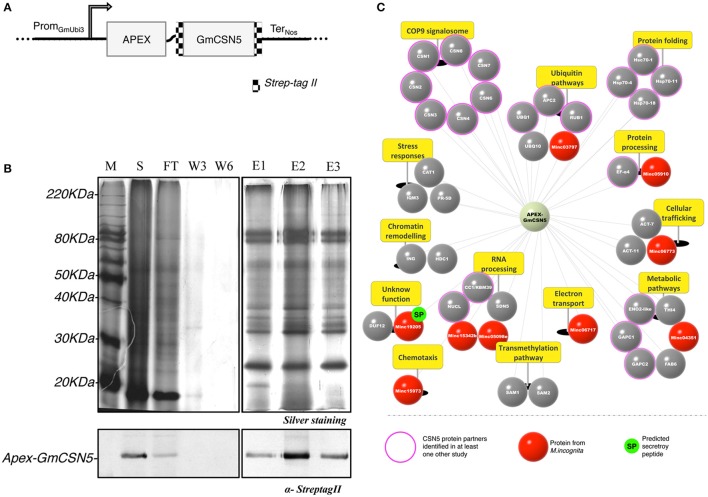
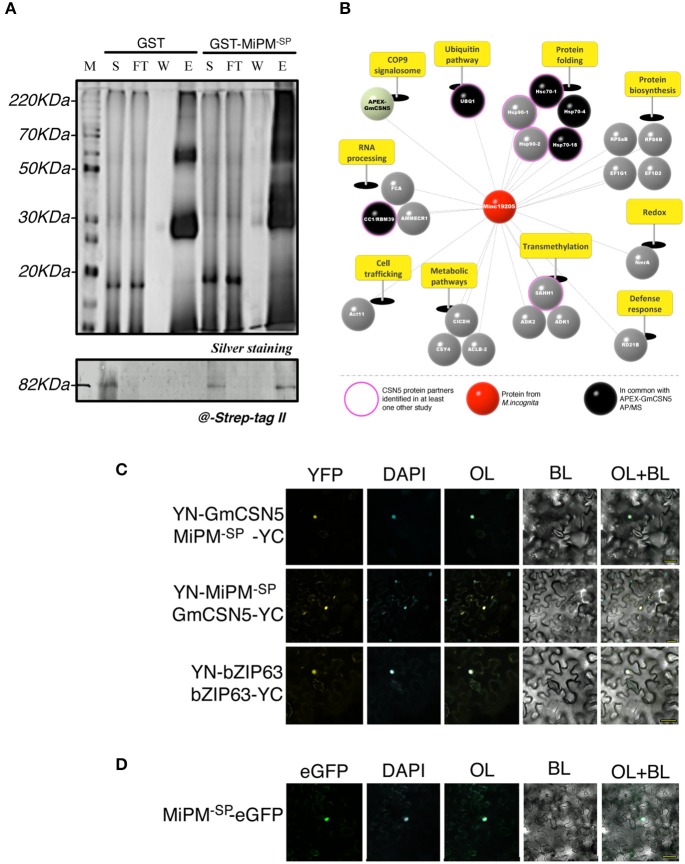
The pathogenicity of phytonematodes relies on secreted virulence factors to rewire host cellular pathways for the benefits of the nematode. In the root-knot nematode (RKN) , thousands of predicted secreted proteins have been identified and are expected to interact with host proteins at different developmental stages of the parasite. Identifying the host targets will provide compelling evidence about the biological significance and molecular function of the predicted proteins. Here, we have focused on the hub protein CSN5, the fifth subunit of the pleiotropic and eukaryotic conserved COP9 signalosome (CSN), which is a regulatory component of the ubiquitin/proteasome system. We used affinity purification-mass spectrometry (AP-MS) to generate the interaction network of CSN5 in -infected roots. We identified the complete CSN complex and other known CSN5 interaction partners in addition to unknown plant and proteins. Among these, we described PASSE-MURAILLE (MiPM), a small pioneer protein predicted to contain a secretory peptide that is up-regulated mostly in the J2 parasitic stage. We confirmed the CSN5-MiPM interaction, which occurs in the nucleus, by bimolecular fluorescence complementation (BiFC). Using MiPM as bait, a GST pull-down assay coupled with MS revealed some common protein partners between CSN5 and MiPM. We further showed by and microscopic analyses that the recombinant purified MiPM protein enters the cells of Arabidopsis root tips in a non-infectious context. In further detail, the supercharged N-terminal tail of MiPM (NTT-MiPM) triggers an unknown host endocytosis pathway to penetrate the cell. The functional meaning of the CSN5-MiPM interaction in the parasitism is discussed. Moreover, we propose that the cell-penetrating properties of some secreted proteins might be a non-negligible mechanism for cell uptake, especially during the steps preceding the sedentary parasitic phase.
植物线虫的致病性依赖于分泌的毒力因子来重塑宿主细胞通路,以利于线虫。在根结线虫(RKN)中,已鉴定出数千种预测的分泌蛋白,预计它们会在寄生虫的不同发育阶段与宿主蛋白相互作用。确定宿主靶点将为预测蛋白的生物学意义和分子功能提供有力证据。在这里,我们重点研究了枢纽蛋白CSN5,它是多效性且真核保守的COP9信号体(CSN)的第五个亚基,而CSN是泛素/蛋白酶体系统的一个调节成分。我们使用亲和纯化-质谱(AP-MS)来生成受感染根中CSN5的相互作用网络。除了未知的植物和蛋白外,我们还鉴定出了完整的CSN复合物以及其他已知的CSN5相互作用伙伴。其中,我们描述了PASSE-MURAILLE(MiPM),一种预测含有分泌肽的小先驱蛋白,其在J2寄生阶段大多上调。我们通过双分子荧光互补(BiFC)证实了CSN5与MiPM在细胞核中的相互作用。以MiPM为诱饵,结合质谱的GST下拉试验揭示了CSN5和MiPM之间的一些共同蛋白伙伴。我们通过进一步的和显微镜分析表明,重组纯化的MiPM蛋白在非感染情况下进入拟南芥根尖细胞。更详细地说,MiPM的带正电的N末端尾巴(NTT-MiPM)触发了一条未知的宿主内吞途径以穿透细胞。讨论了CSN5-MiPM相互作用在寄生中的功能意义。此外,我们提出一些线虫分泌蛋白的细胞穿透特性可能是细胞摄取的一个不可忽视的机制,尤其是在定居寄生阶段之前的步骤中。