Laboratoire de Reproduction et Développement des Plantes, Université de Lyon, ENS de Lyon, UCBL, INRA, CNRS, 46 Allée d'Italie, 69364, Lyon, Cedex 07, France.
BMC Biol. 2018 Feb 7;16(1):20. doi: 10.1186/s12915-018-0490-y.
In plants, the shoot apical meristem (SAM) has two main functions, involving the production of all aerial organs on the one hand and self-maintenance on the other, allowing the production of organs during the entire post-embryonic life of the plant. Transcription factors, microRNA, hormones, peptides and forces have been involved in meristem function. Whereas phosphatidylinositol phosphates (PIPs) have been involved in almost all biological functions, including stem cell maintenance and organogenesis in animals, the processes in meristem biology to which PIPs contribute still need to be delineated.
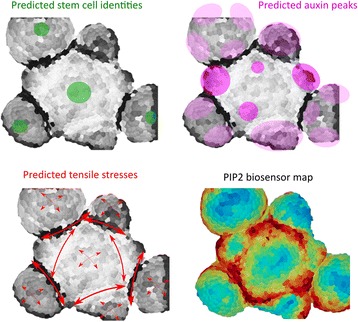
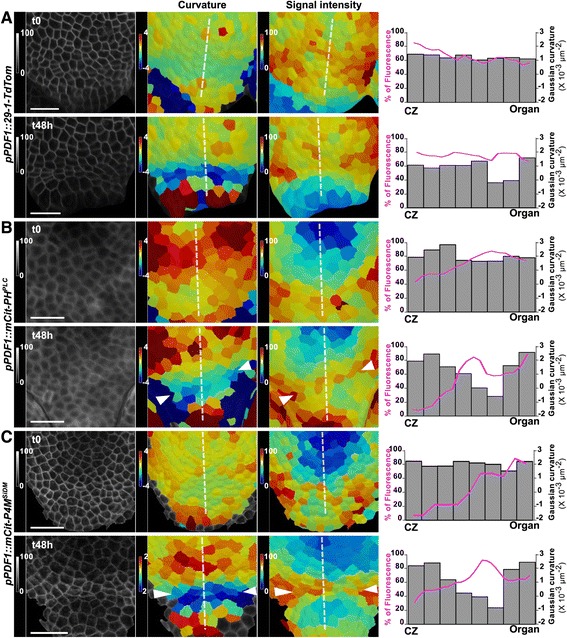
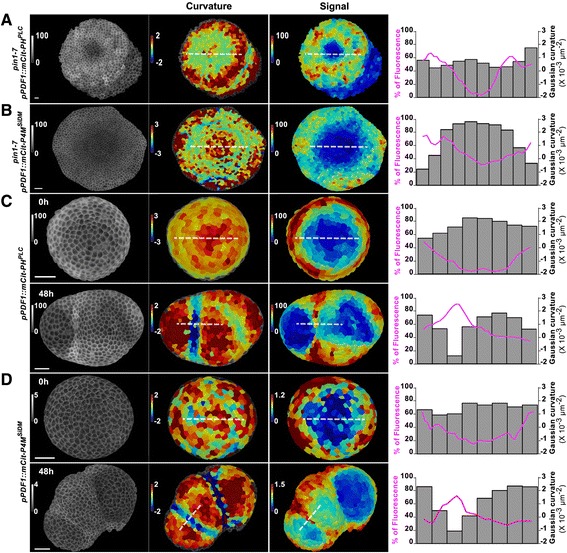
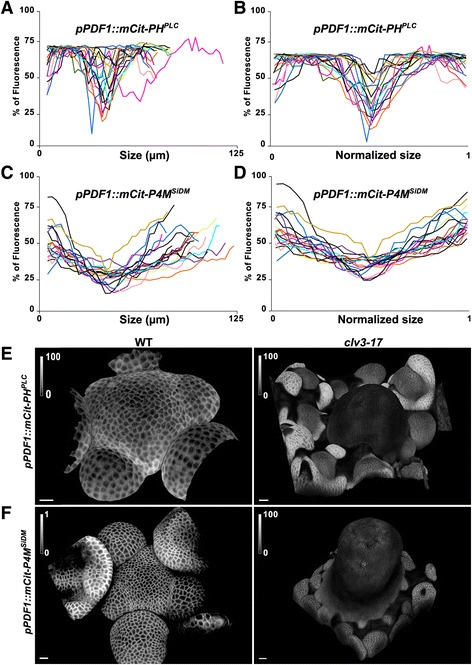
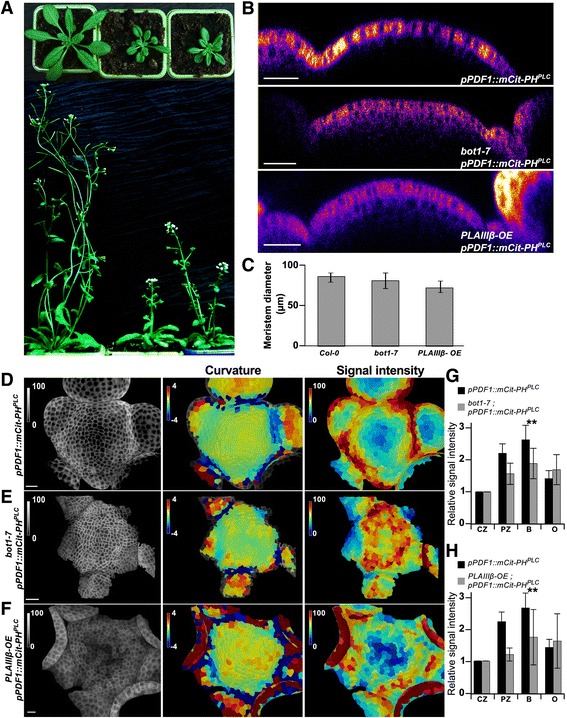
Using biosensors for PI4P and PI(4,5)P, the two most abundant PIPs at the plasma membrane, we reveal that meristem functions are associated with a stereotypical PIP tissue-scale pattern, with PI(4,5)P always displaying a more clear-cut pattern than PI4P. Using clavata3 and pin-formed1 mutants, we show that stem cell maintenance is associated with reduced levels of PIPs. In contrast, high PIP levels are signatures for organ-meristem boundaries. Interestingly, this pattern echoes that of cortical microtubules and stress anisotropy at the meristem. Using ablations and pharmacological approaches, we further show that PIP levels can be increased when the tensile stress pattern is altered. Conversely, we find that katanin mutant meristems, with increased isotropy of microtubule arrays and slower response to mechanical perturbations, exhibit reduced PIP gradients within the SAM. Comparable PIP pattern defects were observed in phospholipase A3β overexpressor lines, which largely phenocopy katanin mutants at the whole plant level.
Using phospholipid biosensors, we identified a stereotypical PIP accumulation pattern in the SAM that negatively correlates with stem cell maintenance and positively correlates with organ-boundary establishment. While other cues are very likely to contribute to the final PIP pattern, we provide evidence that the patterns of PIP, cortical microtubules and mechanical stress are positively correlated, suggesting that the PIP pattern, and its reproducibility, relies at least in part on the mechanical status of the SAM.
在植物中,茎尖分生组织(SAM)具有两个主要功能,一方面涉及产生所有气生器官,另一方面自我维持,允许在植物的整个胚胎后生命期间产生器官。转录因子、microRNA、激素、肽和力都参与了分生组织的功能。虽然磷脂酰肌醇磷酸(PIPs)几乎参与了包括动物干细胞维持和器官发生在内的所有生物学功能,但 PIPs 参与的分生组织生物学过程仍需加以描绘。
使用针对质膜中最丰富的两种 PIP(PI4P 和 PI(4,5)P)的生物传感器,我们揭示了分生组织功能与一种典型的 PIP 组织尺度模式相关,PI(4,5)P 的模式总是比 PI4P 更清晰。使用 clavata3 和 pin-formed1 突变体,我们表明干细胞维持与 PIP 水平的降低有关。相比之下,高 PIP 水平是器官-分生组织边界的特征。有趣的是,这种模式与皮层微管和分生组织的应力各向异性相呼应。使用消融和药理学方法,我们进一步表明,当拉伸应力模式发生变化时,PIP 水平可以增加。相反,我们发现katanin 突变体分生组织中微管阵列的各向异性增加且对机械扰动的反应较慢,SAM 内的 PIP 梯度降低。在磷脂酶 A3β过表达系中观察到类似的 PIP 图案缺陷,这些缺陷在整个植物水平上与 katanin 突变体非常相似。
使用磷脂生物传感器,我们在 SAM 中鉴定出一种典型的 PIP 积累模式,该模式与干细胞维持呈负相关,与器官边界建立呈正相关。虽然其他线索很可能有助于最终的 PIP 模式,但我们提供的证据表明 PIP、皮层微管和机械应力模式是正相关的,这表明 PIP 模式及其可重复性至少部分依赖于 SAM 的机械状态。