Zhu Yingdi, Qiao Liang, Prudent Michel, Bondarenko Alexandra, Gasilova Natalia, Möller Siham Beggah, Lion Niels, Pick Horst, Gong Tianqi, Chen Zhuoxin, Yang Pengyuan, Lovey Lysiane Tissières, Girault Hubert H
Laboratoire d'Electrochimie Physique et Analytique , École Polytechnique Fedérale de Lausanne , Rue de l'industrie 17 , CH-1951 Sion , Switzerland . Email:
Institute of Biomedical Sciences , Fudan University , Dong'an Road 131 , 200032 Shanghai , China.
Chem Sci. 2016 May 1;7(5):2987-2995. doi: 10.1039/c5sc04919a. Epub 2016 Jan 26.
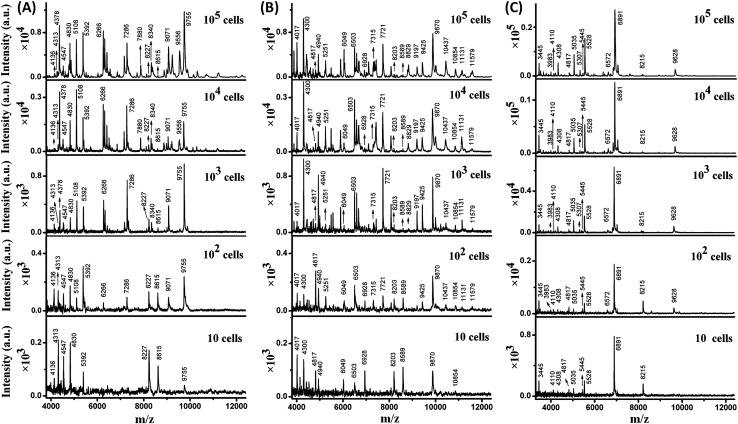
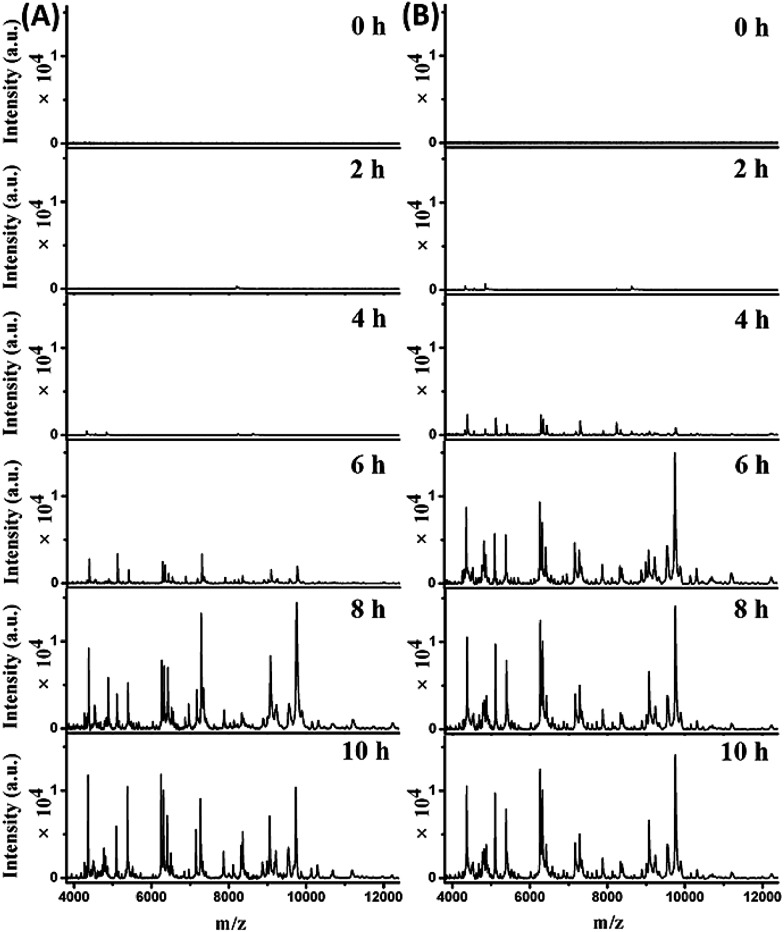
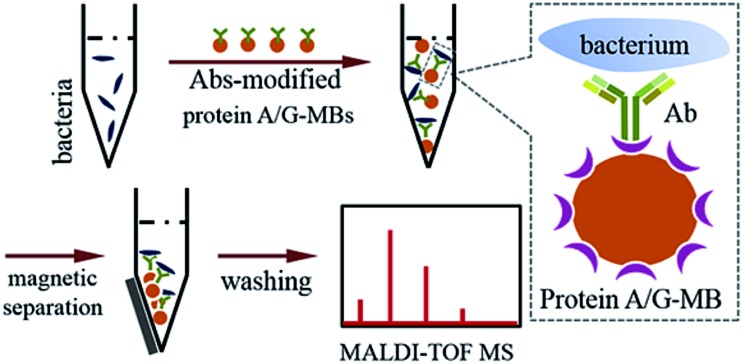
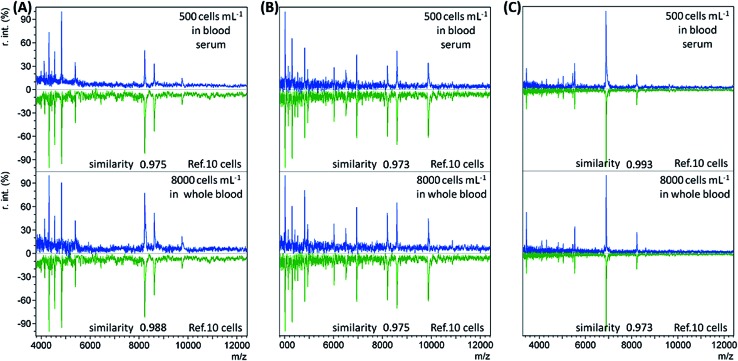
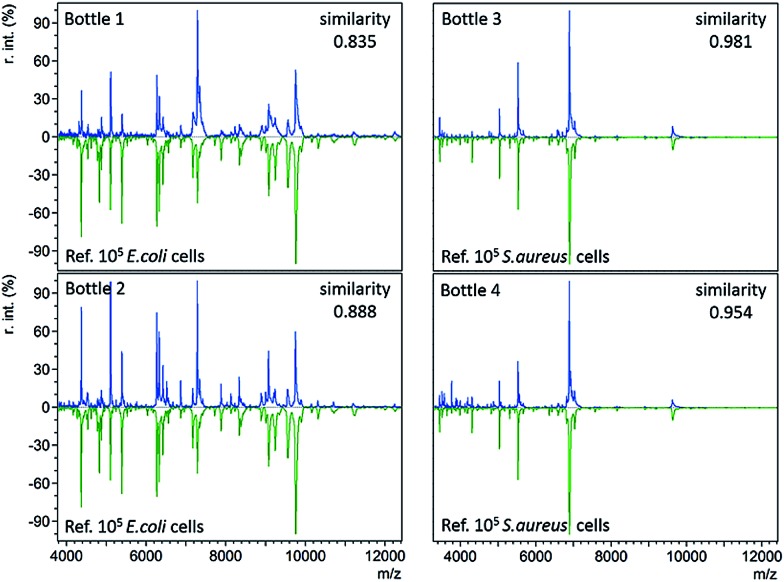
Bloodstream infections rank among the most serious causes of morbidity and mortality in hospitalized patients, partly due to the long period (up to one week) required for clinical diagnosis. In this work, we have developed a sensitive method to quickly and accurately identify bacteria in human blood samples by combining optimized matrix-assisted laser desorption/ionization time-of-flight mass spectrometry (MS) and efficient immunoaffinity enrichment/separation. A library of bacteria reference mass spectra at different cell numbers was firstly built. Due to a reduced sample spot size, the reference spectra could be obtained from as few as 10 to 10 intact bacterial cells. Bacteria in human blood samples were then extracted using antibodies-modified magnetic beads for MS fingerprinting. By comparing the sample spectra with the reference spectra based on a cosine correlation, bacteria with concentrations as low as 500 cells per mL in blood serum and 8000 cells per mL in whole blood were identified. The proposed method was further applied to positive clinical blood cultures (BCs) provided by a local hospital, where and were identified. Because of the method's high sensitivity, the BC time required for diagnosis can be greatly reduced. As a proof of concept, whole blood spiked with a low initial concentration (10 or 10 cells per mL) of bacteria was cultured in commercial BC bottles and analysed by the developed method after different BC times. Bacteria were successfully identified after 4 hours of BC. Therefore, an entire diagnostic process could be accurately accomplished within half a day using the newly developed method, which could facilitate the timely determination of appropriate anti-bacterial therapy and decrease the risk of mortality from bloodstream infections.
血流感染是住院患者发病和死亡的最严重原因之一,部分原因是临床诊断需要较长时间(长达一周)。在这项工作中,我们开发了一种灵敏的方法,通过结合优化的基质辅助激光解吸/电离飞行时间质谱(MS)和高效的免疫亲和富集/分离,快速准确地鉴定人血样本中的细菌。首先建立了不同细胞数量的细菌参考质谱库。由于样品点尺寸减小,参考光谱可从低至10到10个完整细菌细胞中获得。然后使用抗体修饰的磁珠提取人血样本中的细菌用于MS指纹分析。通过基于余弦相关性将样品光谱与参考光谱进行比较,鉴定出血清中浓度低至每毫升500个细胞和全血中每毫升8000个细胞的细菌。所提出的方法进一步应用于当地医院提供的阳性临床血培养(BC),其中鉴定出了[具体细菌名称1]和[具体细菌名称2]。由于该方法的高灵敏度,诊断所需的BC时间可以大大缩短。作为概念验证,在商业BC瓶中培养初始浓度较低(每毫升10或10个细胞)的加标全血,并在不同的BC时间后通过所开发的方法进行分析。BC 4小时后成功鉴定出细菌。因此,使用新开发的方法可以在半天内准确完成整个诊断过程,这有助于及时确定合适的抗菌治疗并降低血流感染导致的死亡风险。