Chantry Caroline J, Blanton Aubrey, Taché Véronique, Finta Laurel, Tancredi Daniel
1Department of Pediatrics, University of California Davis Medical Center, 2516 Stockton Blvd, Sacramento, CA 95817 USA.
2Obstetrics and Gynecology, University of California Davis Medical Center, Sacramento, CA USA.
Matern Health Neonatol Perinatol. 2018 Jul 4;4:16. doi: 10.1186/s40748-018-0083-3. eCollection 2018.
Delayed cord clamping (DCC) results in decreased iron deficiency in infancy. The American College of Obstetrics and Gynecology has called for research on the optimal time to clamp the cord during cesarean deliveries (CD). Our objective was to conduct a pilot trial examining the safety of delayed cord clamping (DCC) for maternal-infant dyads during elective cesarean delivery (CD).
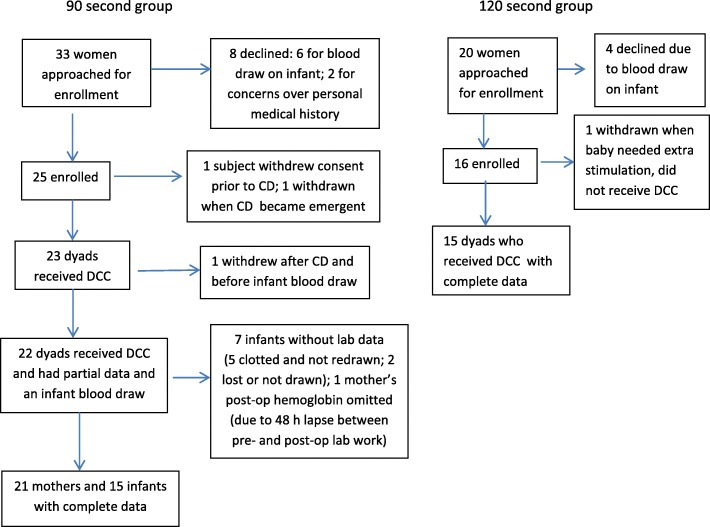
We enrolled 39 dyads [23 at 90 s, 16 at 120 s; (DCC Pilot)] between 10/2013 and 9/2014. We abstracted data from the electronic medical record (EMR) for historical controls (HC) birthing between 1/2012-6/2013 for whom DCC was not performed ( = 112).
Available data for 37 mothers and 30 infants compared to HC revealed 174 (95% CI: 61-286) mL lower mean estimated maternal blood loss [(EBL) mean (SD) mL]: DCC Pilot 691(218) vs. HC 864(442), = 0.003 and lower incidence of maternal transfusions, DCC Pilot 2.7% vs. HC 18.8%, = 0.016. There was no significant between group difference between DCC Pilot and HC in other a priori definitions of excess maternal blood loss: a) EBL > 800 ml, 21.6% vs. 38.8%, = 0.07 or b) post-op hgb/pre-op hgb < 80%, 16.7% vs. 20.6%, = 0.81. There were also no statistically significant between group differences in rates of NICU admission DCC Pilot 8.1% vs. HC 7.1%, = 1.0., but there was a higher rate of newborn cold stress or hypothermia ≤36.2 °C in study subjects, DCC Pilot 27.0% vs. HC 11.9%, = 0.038.Prevalence of newborn anemia was decreased [DCC pilot 3.3% (1 of 30) vs. HC 40.0% (4 of 10 infants with data), = 0.012. No infants were polycythemic.
These pilot data suggest cord clamping can be delayed to 120 s during elective CD without increased risk of excessive maternal blood loss. More aggressive prevention of infant heat loss may be warranted. A randomized trial to evaluate long-term maternal and infant outcomes is indicated.
Clinical trials.gov, NCT02229162; registered: 1 September, 2014.
延迟脐带结扎(DCC)可降低婴儿期缺铁的发生率。美国妇产科学院呼吁开展研究,以确定剖宫产(CD)时脐带结扎的最佳时机。我们的目标是进行一项试点试验,研究择期剖宫产(CD)期间延迟脐带结扎(DCC)对母婴二元组的安全性。
2013年10月至2014年9月期间,我们招募了39对母婴二元组[23对在90秒时结扎,16对在120秒时结扎;(DCC试点组)]。我们从电子病历(EMR)中提取了2012年1月至2013年6月期间分娩且未进行DCC的历史对照(HC)数据(n = 112)。
与HC组相比,37名母亲和30名婴儿的可用数据显示,估计平均母体失血量(EBL)低174(95%CI:61 - 286)mL[(EBL)均值(标准差)mL]:DCC试点组为691(218),而HC组为864(442),P = 0.003,且母体输血发生率较低,DCC试点组为2.7%,HC组为18.8%,P = 0.016。在其他预先定义的母体失血过多的定义中,DCC试点组和HC组之间无显著组间差异:a)EBL > 800 ml,分别为21.6%和38.8%,P = 0.07;或b)术后血红蛋白/术前血红蛋白 < 80%,分别为16.7%和20.6%,P = 0.81。两组间新生儿重症监护病房(NICU)入院率也无统计学显著差异,DCC试点组为8.1%,HC组为7.1%,P = 1.0,但研究对象中新生儿冷应激或体温过低(≤36.2°C)的发生率较高,DCC试点组为27.0%,HC组为11.9%,P = 0.038。新生儿贫血患病率降低[DCC试点组为3.3%(30例中的1例),HC组为40.0%(有数据的10例婴儿中的4例),P = 0.012。无婴儿发生红细胞增多症。
这些试点数据表明,择期剖宫产期间脐带结扎可延迟至120秒,而不会增加母体失血过多的风险。可能需要更积极地预防婴儿热量损失。有必要进行一项随机试验来评估母婴的长期结局。
ClinicalTrials.gov,NCT02229162;注册时间:2014年9月1日。