Department of Psychology.
Emotion. 2019 Apr;19(3):465-479. doi: 10.1037/emo0000436. Epub 2018 Jul 12.
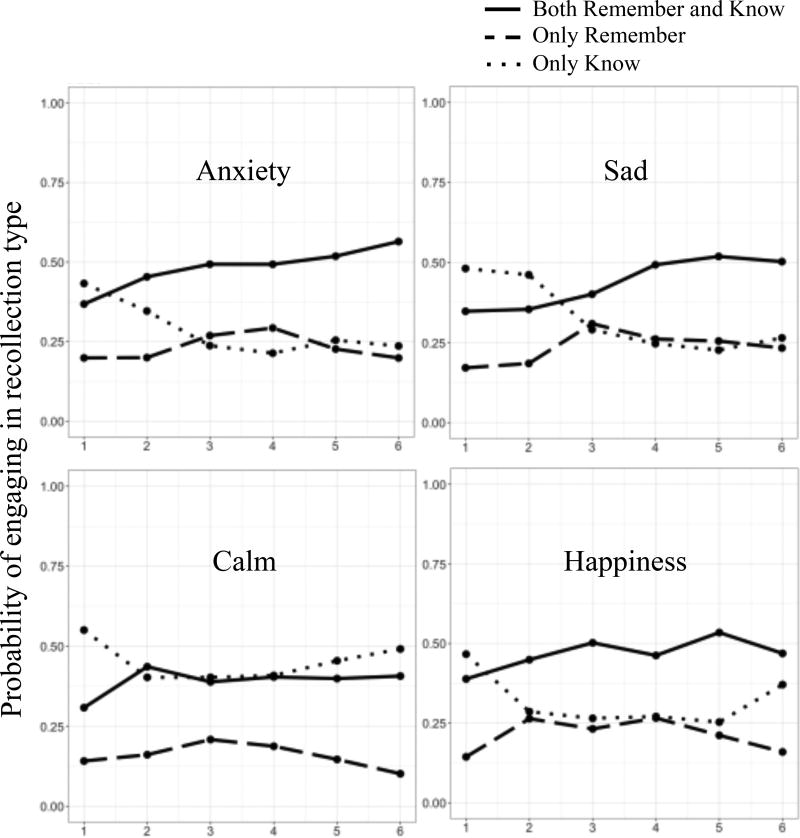
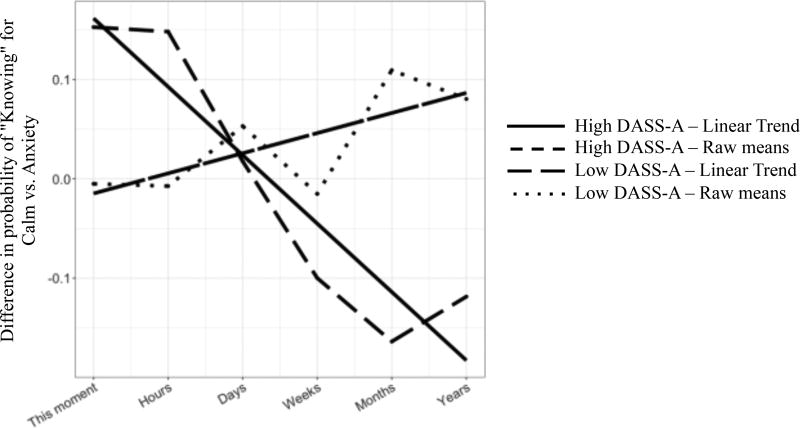
Researchers and clinicians routinely rely on patients' retrospective emotional self-reports to guide diagnosis and treatment, despite evidence of impaired autobiographical memory and retrieval of emotional information in depression and anxiety. To clarify the nature and specificity of these impairments, we conducted two large online data collections (Study 1, = 1,983; Study 2, = 900) examining whether depression and/or anxiety symptoms would uniquely predict the use of self-reported episodic (i.e., remembering) and/or semantic (i.e., knowing) retrieval when rating one's positive and negative emotional experiences over different time frames. Participants were randomly assigned to one of six time frames (ranging from to ) and were asked to rate how intensely they felt each of four emotions, anxious, sad, calm, and happy, over that period. Following each rating, they were asked several follow-up prompts assessing their perceived reliance on episodic and/or semantic information to rate how they felt, using procedures adapted from the traditional "remember/know" paradigm (Tulving, 1985). Across both studies, depression and anxiety symptoms each uniquely predicted increased likelihood of remembering across emotion types, and decreased likelihood of knowing how one felt when rating positive emotion types. Implications for the theory and treatment of emotion-related memory disturbances in depression and anxiety, and for dual-process theories of memory retrieval more generally, are discussed. (PsycINFO Database Record (c) 2019 APA, all rights reserved).
研究人员和临床医生通常依赖患者的回顾性情绪自我报告来指导诊断和治疗,尽管有证据表明抑郁和焦虑会损害自传体记忆和情绪信息的检索。为了阐明这些损伤的性质和特异性,我们进行了两项大型在线数据收集研究(研究 1,n=1983;研究 2,n=900),考察了抑郁和/或焦虑症状是否会独特地预测在不同时间框架内对积极和消极情绪体验进行自我报告的情节(即记忆)和/或语义(即知道)检索时的使用。参与者被随机分配到六个时间框架之一(范围从 到 ),并被要求在该时间段内对四种情绪(焦虑、悲伤、平静和快乐)的每个情绪的强度进行评分。在每次评分后,他们会被问到几个后续提示,评估他们对情节和/或语义信息的感知依赖程度,以评估他们如何评价自己的感受,使用的程序改编自传统的“记得/知道”范式(Tulving,1985)。在两项研究中,抑郁和焦虑症状都独特地预测了对不同情绪类型的记忆的可能性增加,而对积极情绪类型的自我感觉的了解可能性降低。这对抑郁和焦虑中与情绪相关的记忆障碍的理论和治疗以及更普遍的记忆检索双加工理论具有启示意义。(PsycINFO 数据库记录(c)2019 APA,保留所有权利)。