Benin Bogdan M, Dirin Dmitry N, Morad Viktoriia, Wörle Michael, Yakunin Sergii, Rainò Gabriele, Nazarenko Olga, Fischer Markus, Infante Ivan, Kovalenko Maksym V
Laboratory of Inorganic Chemistry, ETH Zürich, CH-8093, Zürich, Switzerland.
Laboratory for Thin Films and Photovoltaics, Empa-Swiss Federal Laboratories for Materials, CH-8600, Dübendorf, Switzerland.
Angew Chem Int Ed Engl. 2018 Aug 27;57(35):11329-11333. doi: 10.1002/anie.201806452. Epub 2018 Jul 30.
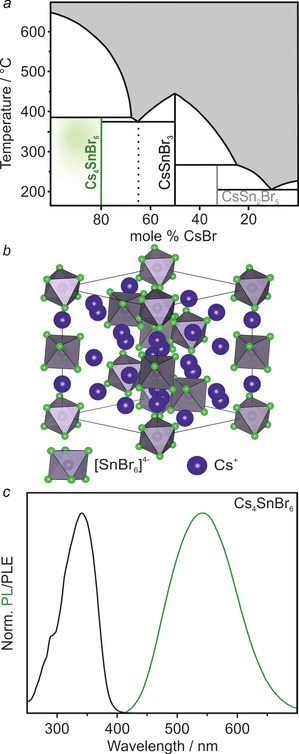
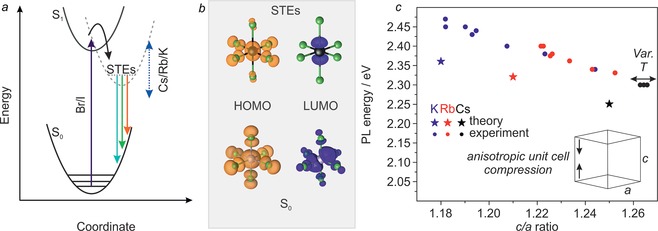
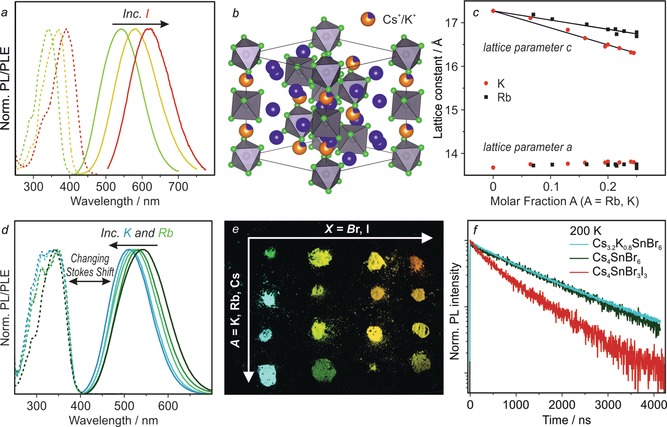
The spatial localization of charge carriers to promote the formation of bound excitons and concomitantly enhance radiative recombination has long been a goal for luminescent semiconductors. Zero-dimensional materials structurally impose carrier localization and result in the formation of localized Frenkel excitons. Now the fully inorganic, perovskite-derived zero-dimensional Sn material Cs SnBr is presented that exhibits room-temperature broad-band photoluminescence centered at 540 nm with a quantum yield (QY) of 15±5 %. A series of analogous compositions following the general formula Cs A Sn(Br I ) (A=Rb, K; x≤1, y≤1) can be prepared. The emission of these materials ranges from 500 nm to 620 nm with the possibility to compositionally tune the Stokes shift and the self-trapped exciton emission bands.
长期以来,电荷载流子的空间定位以促进束缚激子的形成并相应增强辐射复合一直是发光半导体的目标。零维材料在结构上会使载流子局部化,并导致形成局域化的弗伦克尔激子。现在展示了一种完全无机的、源自钙钛矿的零维Sn材料CsSnBr,它在室温下呈现出以540 nm为中心的宽带光致发光,量子产率(QY)为15±5 %。可以制备一系列遵循通式CsASn(BrI)(A = Rb、K;x≤1,y≤1)的类似组合物。这些材料的发射波长范围为500 nm至620 nm,有可能通过成分调节斯托克斯位移和自陷激子发射带。