Department of Pediatrics and Child Health, Addis Ababa University, P.O.Box 1768, Addis Ababa, Ethiopia.
Child and Adolescent Health, World Health Organization Country Office, Dar Es Salaam, Tanzania.
BMC Health Serv Res. 2018 Jul 13;18(1):547. doi: 10.1186/s12913-018-3336-y.
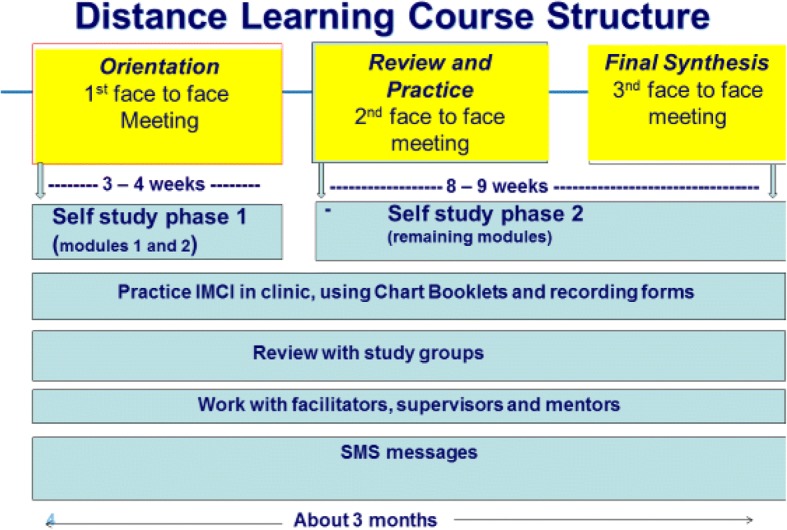
The standard 11-days IMCI (Integrated Management of Childhood Illness) training course (standard IMCI) has faced barriers such as high cost to scale up. Distance learning IMCI training program was developed as an alternative to the standard IMCI course. This article presents the evaluation results of the implementation of distance learning IMCI training program in Tanzania.
From December 2012 to end of June 2015, a total of 4806 health care providers (HCP) were trained on distance learning IMCI from 1427 health facilities {HF) in 68 districts in Tanzania. Clinical assessments were done at the end of each course and on follow up visits of health facilities 4 to 6 weeks after training. The results of those assessments are used to compare performance of health care providers trained in distance learning IMCI with those trained in the standard IMCI course. Statistical analysis is done by comparing proportions of those with appropriate performances using four WHO priority performance indicators as well as cost of conducting the courses. In addition, the perspectives of health care providers, IMCI course facilitators, policy makers and partners were gathered using either focussed group discussions or structured questionnaires.
Distance learning IMCI allowed clusters of training courses to take place in parallel, allowing rapid expansion of IMCI coverage. Health care providers trained in distance learning IMCI performed equally well as those trained in the standard IMCI course in assessing Main Symptoms, treating sick children and counselling caretakers appropriately. They performed better in assessing Danger Signs. Distance learning IMCI gave a 70% reduction in cost of conducting the training courses.
Distance learning IMCI is an alternative to scaling up IMCI as it provides an effective option with significant cost reduction in conducting training courses.
标准的 11 天儿童疾病综合管理(IMCI)培训课程(标准 IMCI)面临着诸如扩大规模成本高的障碍。远程学习 IMCI 培训计划是作为标准 IMCI 课程的替代方案而开发的。本文介绍了在坦桑尼亚实施远程学习 IMCI 培训计划的评估结果。
从 2012 年 12 月至 2015 年 6 月底,共有 4806 名医疗保健提供者(HCP)在坦桑尼亚 68 个地区的 1427 个卫生设施(HF)接受了远程学习 IMCI 培训。在每次课程结束时和培训后 4 至 6 周对卫生设施进行临床评估。这些评估的结果用于比较在远程学习 IMCI 中接受培训的医疗保健提供者与在标准 IMCI 课程中接受培训的医疗保健提供者的表现。统计分析是通过比较使用四个世界卫生组织优先绩效指标和课程开展成本来比较具有适当绩效的人员的比例来完成的。此外,还通过焦点小组讨论或结构化问卷收集了医疗保健提供者、IMCI 课程促进者、决策者和合作伙伴的观点。
远程学习 IMCI 允许培训课程集群同时进行,从而迅速扩大 IMCI 的覆盖范围。在评估主要症状、适当治疗患病儿童和咨询照顾者方面,接受远程学习 IMCI 培训的医疗保健提供者的表现与接受标准 IMCI 课程培训的医疗保健提供者一样好。他们在评估危险信号方面表现更好。远程学习 IMCI 将培训课程的成本降低了 70%。
远程学习 IMCI 是扩大 IMCI 规模的一种替代方案,因为它提供了一种有效的选择,在培训课程的开展成本方面具有显著的降低。