1Washington University School of Medicine, 660 South Euclid Avenue, Campus Box 8504, Saint Louis, MO USA.
2Autism Research Laboratory, Moscow State University of Psychology and Education (MSUPE), 2A Shelepihinskaya Quay, Moscow, 123390 Russia.
Mol Autism. 2018 Jul 5;9:41. doi: 10.1186/s13229-018-0220-x. eCollection 2018.
Inherited abnormalities of perception, recognition, and attention to faces have been implicated in the etiology of autism spectrum disorders (ASD) including abnormal components of event-related brain potentials (ERP) elicited by faces.
We examined familial aggregation of face processing ERP abnormalities previously implicated in ASD in 49 verbal individuals with ASD, 36 unaffected siblings (US), 18 unaffected fathers (UF), and 53 unrelated controls (UC). The ASD, US, and UC groups ranged in age from 12 to 21 years, the UF group ranged in age from 30 to 56 years. ERP responses to images of upright and inverted faces and houses were analyzed under disparate EEG reference schemes.
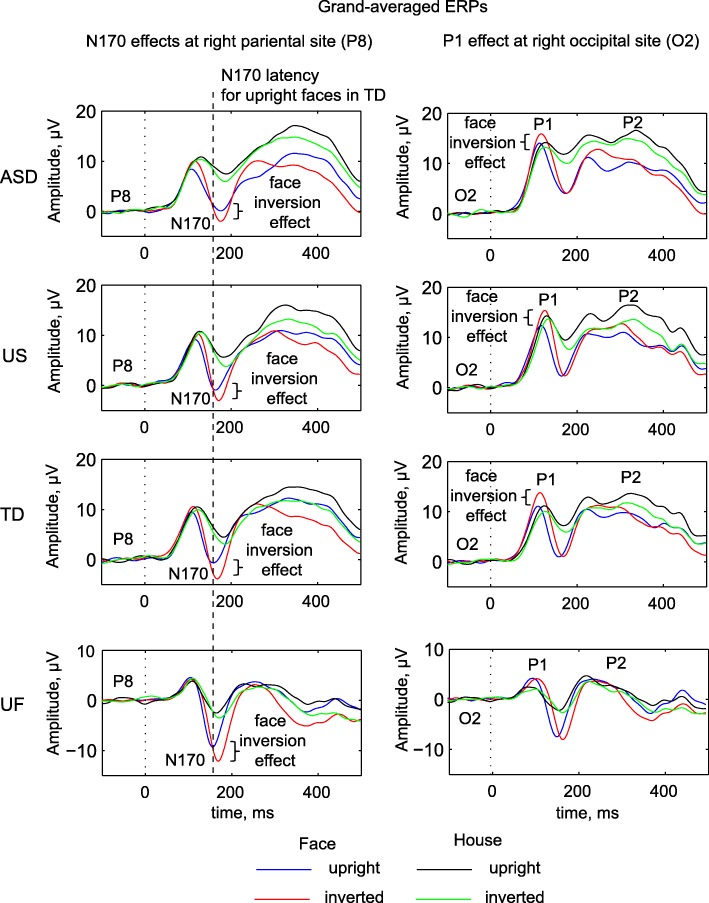
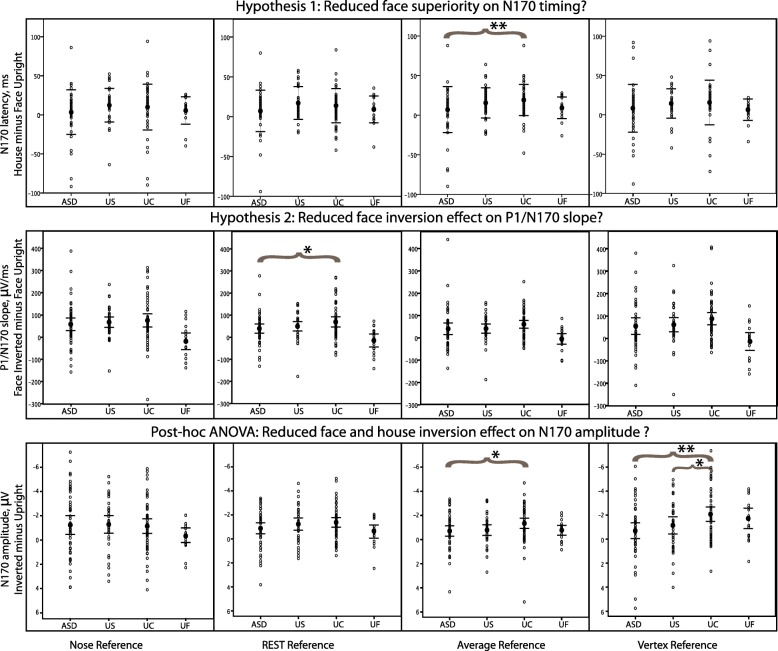
Face-sensitive features of N170 and P1 were readily observed in all groups. Differences between ASD and control groups depended upon the EEG reference scheme. Notably, the superiority of face over object for N170 latency was attenuated in ASD subjects, but not their relatives; this occurred exclusively with the average reference. The difference in N170 amplitude between inverted and upright faces was reduced in both ASD and US groups relative to UC, but this effect was significant only with the vertex reference. Furthermore, similar group differences were observed for both inverted faces and inverted houses, suggesting a lack of face specificity for the attenuation of the N170 inversion effect in ASD.
The present findings refine understanding of face processing ERPs in ASD. These data provide only modest evidence for highly-selective ASD-sensitive ERP features, and underscore the sensitivity of these biomarkers to ERP reference scheme. These schemes have varied across published studies and must be accounted for in future studies of the relationship between these commonly acquired ERP characteristics, genotype, and ASD.
在包括自闭症谱系障碍(ASD)在内的疾病中,人们已经发现感知、识别和注意面孔的遗传性异常与面孔诱发的事件相关脑电位(ERP)的异常成分有关。
我们研究了先前与 ASD 相关的面孔加工 ERP 异常的家族聚集性,研究对象包括 49 名患有 ASD 的言语个体、36 名无相关障碍的兄弟姐妹(US)、18 名无相关障碍的父亲(UF)和 53 名无关对照(UC)。ASD、US 和 UC 组的年龄在 12 至 21 岁之间,UF 组的年龄在 30 至 56 岁之间。根据不同的 EEG 参考方案,对面孔和房屋的图像进行 ERP 反应分析。
在所有组中,都可以轻松观察到 N170 和 P1 的面孔敏感特征。ASD 组和对照组之间的差异取决于 EEG 参考方案。值得注意的是,在 ASD 患者中,N170 潜伏期对面的优势减弱,但他们的亲属却没有;这种情况仅在平均参考中出现。与 UC 相比,ASD 和 US 组的 N170 振幅在倒置和正立面孔之间的差异减小,但这种效应仅在顶点参考时才显著。此外,倒置面孔和倒置房屋都观察到类似的组间差异,这表明在 ASD 中 N170 反转效应的衰减缺乏面孔特异性。
本研究结果细化了 ASD 患者面孔加工 ERP 的理解。这些数据仅为高度选择性的 ASD 敏感 ERP 特征提供了有限的证据,并强调了这些生物标志物对 ERP 参考方案的敏感性。这些方案在已发表的研究中有所不同,在未来研究这些常见获得的 ERP 特征、基因型与 ASD 之间的关系时,必须考虑到这些方案。