Pitombo Leonardo M, Ramos Juliana C, Quevedo Helio D, do Carmo Karina P, Paiva Jane M F, Pereira Elisabete A, do Carmo Janaina B
Federal University of São Carlos (UFSCar) - Department of Environmental Sciences, Rod. João Leme dos Santos Km 110, 18052-780, Sorocaba, SP, Brazil.
Federal University of São Carlos (UFSCar) - Graduate Program of Biotechnology and Environmental Monitoring, Rod. João Leme dos Santos Km 110, 18052-780, Sorocaba, SP, Brazil.
MethodsX. 2018 Jun 19;5:656-668. doi: 10.1016/j.mex.2018.06.008. eCollection 2018.
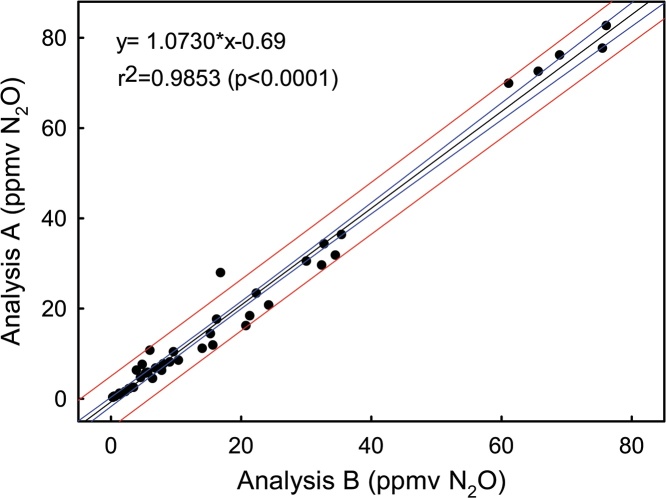
This methodology is proposed to measure the fluxes of trace gases among microcosms and the atmosphere. As microcosm respiration we include both aerobic and anaerobic respiration, which may results in CO, CH, NO, NO, N, HS and H fluxes. Its applicability includes the assessment of products biodegradability and toxicity, the effect of treatments and products on greenhouse gases fluxes, and the mineralization of organic fertilizers. A step by step procedure; the complementary parameters and good practices that might be taken into account to perform a microcosm experiment; and the tools nowadays available that could be useful in this respirometric methodology are presented. We included a spreadsheet with calculus examples. Samples were taken at 1; 30; 60 and 90 min after closing the microcosms to determine the gases fluxes. The dilution effect was negligible, as we present. Besides CO, we have successfully quantified the fluxes of CH and NO from the microcosms in a broad range of concentrations. This method is useful in technical and scientific studies, for instances to test new products and improve the understanding of microbial processes, respectively. •Simple materials are required to set up the microcosm.•Examples of (pre) treatments are given regarding water availability, fertilizer doses, pH adjustment and nutrients amendments.•The method was suitable to directly measure multiple trace gases fluxes, either produced or consumed during microcosm respiration.
本方法旨在测量微观世界与大气之间痕量气体的通量。作为微观世界呼吸作用,我们将有氧呼吸和无氧呼吸都包括在内,这可能会导致一氧化碳、甲烷、一氧化氮、二氧化氮、氮气、硫化氢和氢气通量的产生。其适用性包括评估产品的生物降解性和毒性、处理和产品对温室气体通量的影响以及有机肥料的矿化作用。介绍了一个逐步程序、进行微观世界实验时可能需要考虑的补充参数和良好做法,以及目前可用于这种呼吸测定方法的工具。我们提供了一个带有计算示例的电子表格。在封闭微观世界后的1、30、60和90分钟采集样本,以确定气体通量。如我们所示,稀释效应可忽略不计。除了一氧化碳,我们还成功地在很宽的浓度范围内量化了微观世界中甲烷和一氧化氮的通量。该方法在技术和科学研究中很有用,例如分别用于测试新产品和增进对微生物过程的理解。•设置微观世界需要简单的材料。•给出了关于水分有效性、肥料用量、pH调节和养分添加的(预)处理示例。•该方法适用于直接测量微观世界呼吸作用过程中产生或消耗的多种痕量气体通量。