National Laboratory of Pattern Recognition (NLPR), Institute of Automation, Chinese Academy of Sciences, Beijing 100190, China.
School of Artificial Intelligence, University of Chinese Academy of Sciences, Beijing 100049, China.
Sensors (Basel). 2018 Jul 2;18(7):2118. doi: 10.3390/s18072118.
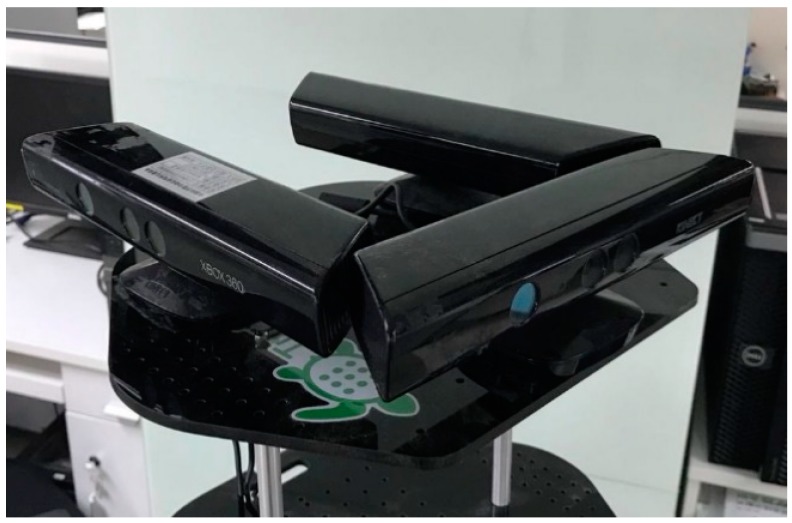
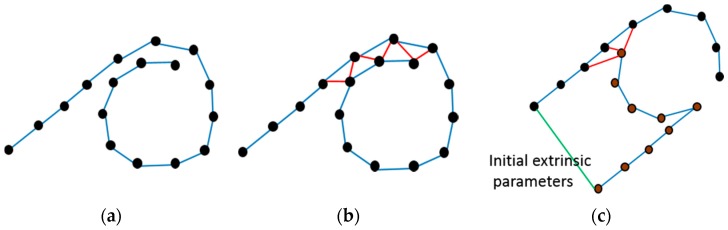
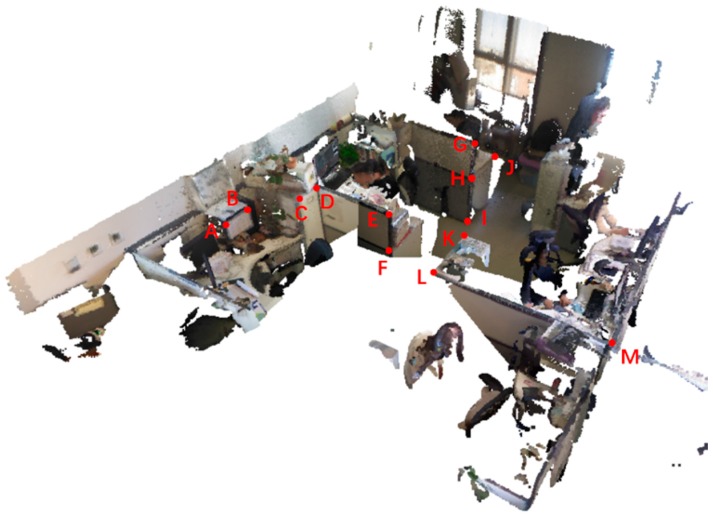
A multi-camera dense RGB-D SLAM (simultaneous localization and mapping) system has the potential both to speed up scene reconstruction and to improve localization accuracy, thanks to multiple mounted sensors and an enlarged effective field of view. To effectively tap the potential of the system, two issues must be understood: first, how to calibrate the system where sensors usually shares small or no common field of view to maximally increase the effective field of view; second, how to fuse the location information from different sensors. In this work, a three-Kinect system is reported. For system calibration, two kinds of calibration methods are proposed, one is suitable for system with inertial measurement unit (IMU) using an improved hand⁻eye calibration method, the other for pure visual SLAM without any other auxiliary sensors. In the RGB-D SLAM stage, we extend and improve a state-of-art single RGB-D SLAM method to multi-camera system. We track the multiple cameras' poses independently and select the one with the pose minimal-error as the reference pose at each moment to correct other cameras' poses. To optimize the initial estimated pose, we improve the deformation graph by adding an attribute of device number to distinguish surfels built by different cameras and do deformations according to the device number. We verify the accuracy of our extrinsic calibration methods in the experiment section and show the satisfactory reconstructed models by our multi-camera dense RGB-D SLAM. The RMSE (root-mean-square error) of the lengths measured in our reconstructed mode is 1.55 cm (similar to the state-of-art single camera RGB-D SLAM systems).
多相机密集 RGB-D SLAM(同时定位与建图)系统具有加快场景重建和提高定位精度的潜力,这要归功于多个安装的传感器和扩大的有效视野。为了有效地利用系统的潜力,必须理解两个问题:首先,如何在传感器通常共享小或没有共同视场的情况下对系统进行校准,以最大限度地增加有效视场;其次,如何融合来自不同传感器的位置信息。在这项工作中,报告了一个三 Kinect 系统。对于系统校准,提出了两种校准方法,一种适用于带有惯性测量单元(IMU)的系统,使用改进的手眼校准方法,另一种适用于没有任何其他辅助传感器的纯视觉 SLAM。在 RGB-D SLAM 阶段,我们扩展和改进了一种最先进的单 RGB-D SLAM 方法,使其适用于多相机系统。我们独立跟踪多个相机的姿势,并选择每个时刻具有最小姿势误差的相机作为参考姿势,以校正其他相机的姿势。为了优化初始估计姿势,我们通过添加设备号属性来改进变形图,以区分由不同相机构建的 surfels,并根据设备号进行变形。我们在实验部分验证了外部校准方法的准确性,并展示了我们的多相机密集 RGB-D SLAM 的令人满意的重建模型。我们重建模式下测量的长度的 RMSE(均方根误差)为 1.55 厘米(与最先进的单相机 RGB-D SLAM 系统相似)。