Department of Urology, RWTH Aachen University Hospital, Pauwelsstraße 30, 52074, Aachen, Germany.
Philips Chair for Medical Information Technology (MedIT), RWTH Aachen University, Aachen, Germany.
Biomed Eng Online. 2018 Jul 13;17(1):95. doi: 10.1186/s12938-018-0526-0.
Continuous non-invasive urinary bladder volume measurement (cystovolumetry) would allow better management of urinary tract disease. Electrical impedance tomography (EIT) represents a promising method to overcome the limitations of non-continuous ultrasound measurements. The aim of this study was to compare the measurement accuracy of EIT to standard ultrasound in healthy volunteers.
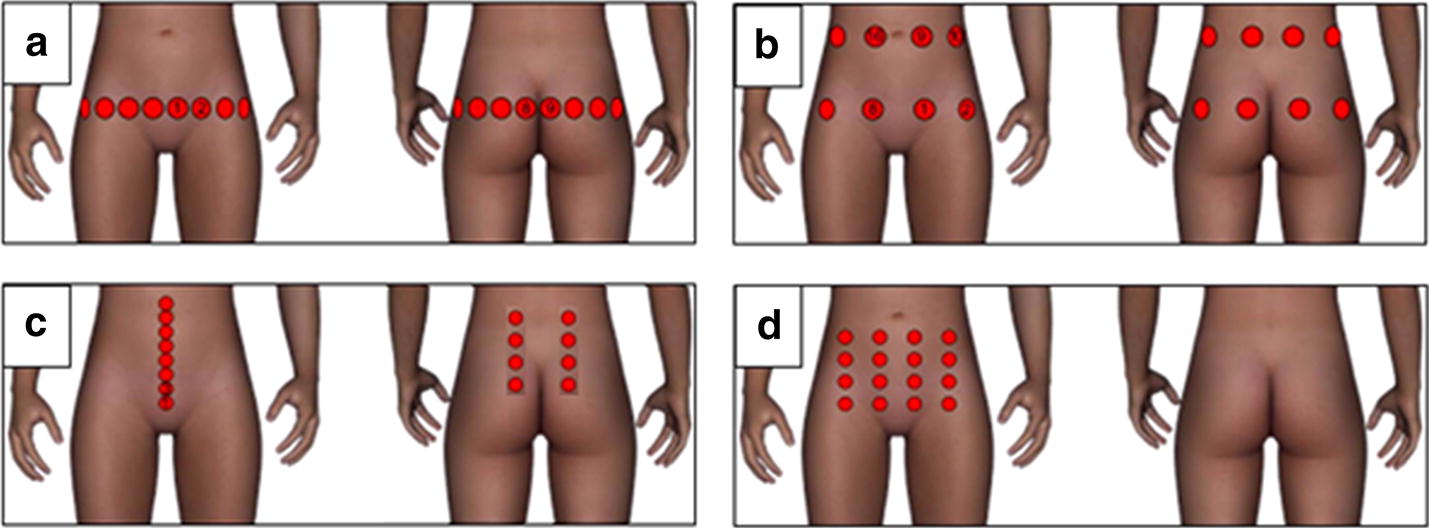
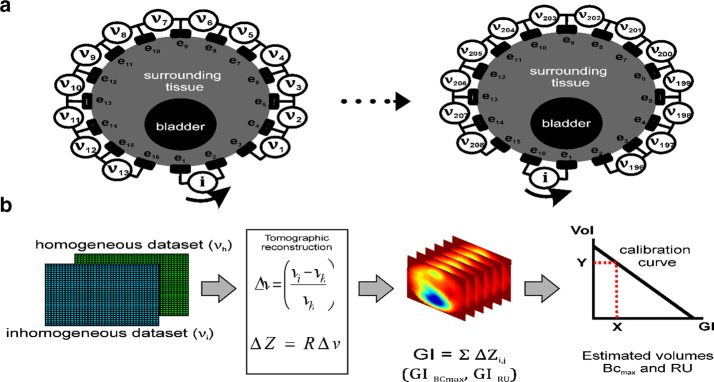
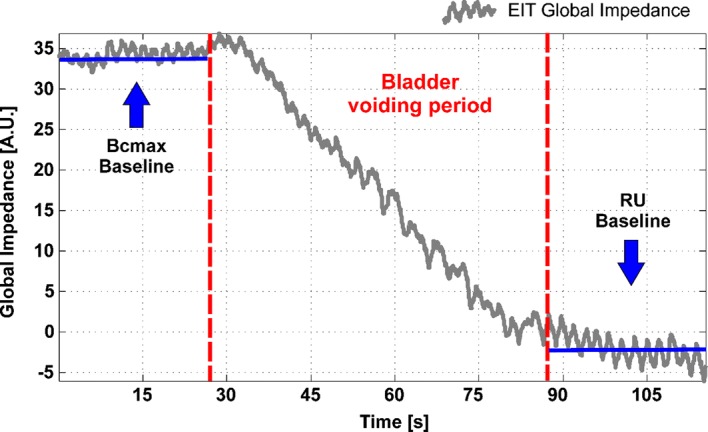
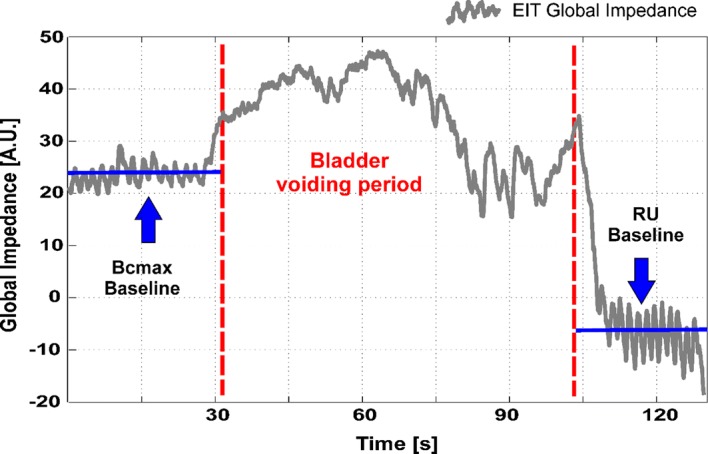
For EIT of the bladder a commercial device (Goe MF II) was used with 4 different configurations of 16 standard ECG electrodes attached to the lower abdomen of healthy participants. To estimate maximum bladder capacity (BCmax) and residual urine (RU) two ultrasound methods (US-Ellipsoid and US-L × W × H) and a bedside bladder scanner (BS), were performed at the point of urgency and after voiding. For volume reference, BCmax and RU were validated by urine collection in a weight measuring pitcher. The global impedance method was used offline to estimate BCmax and RU from EIT.
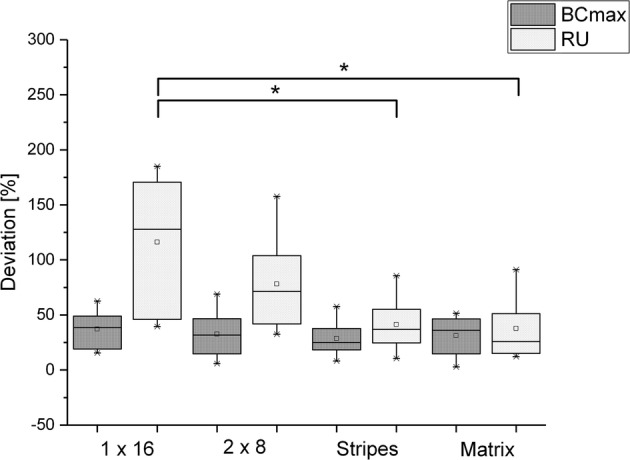
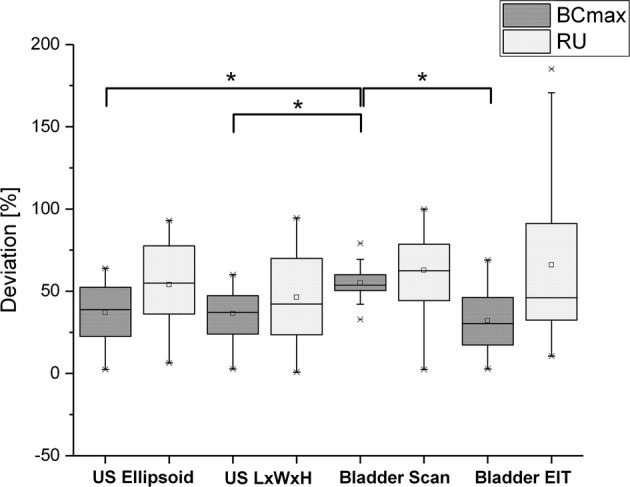
The mean error of US-Ellipsoid (37 ± 17%) and US-L × W × H (36 ± 15%) and EIT (32 ± 18%) showed no significant differences in the estimation of BCmax (mean 743 ± 200 ml) normalized to pitcher volumetry. BS showed significantly worse accuracy (55 ± 9%). Volumetry of RU (mean 152.1 ± 64 ml) revealed comparable higher errors for both EIT (72 ± 58%) and BS (63 ± 24%) compared to US-Ellipsoid (54 ± 25%). In case of RU, EIT accuracy is dependent on electrode configuration, as the Stripes (41 ± 25%) and Matrix (38 ± 27%) configurations revealed significantly superior accuracy to the 1 × 16 (116 ± 62%) configuration.
EIT-cystovolumetry compares well with ultrasound techniques. For estimation of RU, the selection of the EIT electrode configuration is important. Also, the development of an algorithm should consider the impact of movement artefacts. Finally, the accuracy of non-invasive ultrasound accepted as gold standard of cystovolumetry should be reconsidered.
连续无创膀胱容量测量(cystovolumetry)将允许更好地管理尿路疾病。电阻抗断层成像(EIT)代表了一种克服非连续超声测量局限性的有前途的方法。本研究的目的是比较 EIT 与健康志愿者的标准超声测量的准确性。
对于膀胱的 EIT,使用商业设备(Goe MF II),将 16 个标准心电图电极的 4 种不同配置附着在健康参与者的下腹部。为了估计最大膀胱容量(BCmax)和残余尿量(RU),在紧急情况下和排尿后,使用两种超声方法(US-Ellipsoid 和 US-L × W × H)和床边膀胱扫描仪(BS)进行测量。为了进行体积验证,BCmax 和 RU 通过在称重量杯中收集尿液进行验证。离线使用全局阻抗法从 EIT 估计 BCmax 和 RU。
US-Ellipsoid(37 ± 17%)和 US-L × W × H(36 ± 15%)和 EIT(32 ± 18%)的平均误差在估计 BCmax 时没有显著差异(平均 743 ± 200 ml),归一化为 pitcher 体积测量法。BS 显示出明显更差的准确性(55 ± 9%)。RU 容积(平均 152.1 ± 64 ml)显示,EIT(72 ± 58%)和 BS(63 ± 24%)与 US-Ellipsoid(54 ± 25%)相比,误差更高。在 RU 的情况下,EIT 的准确性取决于电极配置,因为 Stripes(41 ± 25%)和 Matrix(38 ± 27%)配置比 1 × 16(116 ± 62%)配置显示出明显更高的准确性。
EIT-cystovolumetry 与超声技术相比表现良好。对于 RU 的估计,EIT 电极配置的选择很重要。此外,算法的开发应考虑运动伪影的影响。最后,应该重新考虑被接受为 cystovolumetry 金标准的无创超声的准确性。