Wang Zuojun, Yan Jinsheng, Zou Tingqian, Gao Hui
Department of Stomatology, Stomatological Hospital of Jingmen City, Jingmen, Hubei 448000, P.R. China.
School of Traditional Chinese Medicine, Jinan University, Guangzhou, Guangdong 510632, P.R. China.
Oncol Lett. 2018 Aug;16(2):2243-2250. doi: 10.3892/ol.2018.8967. Epub 2018 Jun 13.
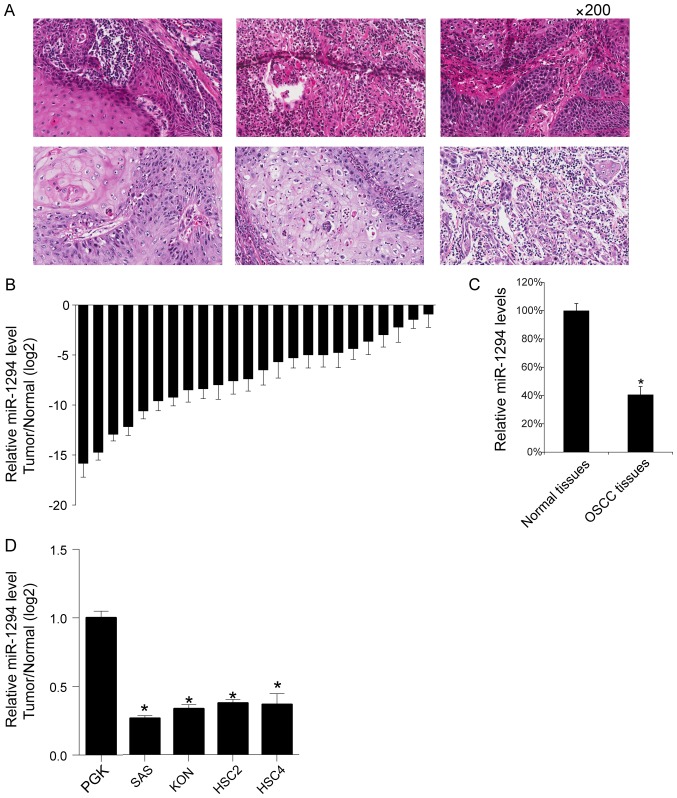
Oral squamous cell carcinoma (OSCC) is the predominant histological type of oral cancer. The 5-year survival rate of OSCC is only ~50%. c-Myc is a known oncogene and target gene in various cancer types, including OSCC. The presnet study revealed that c-Myc is one of the target genes of miR-1294. Results indicated lower levels of miR-1294 in OSCC tissues samples collected from 24 patients with OSCC. Notably, overexpression of miR-1294 inhibited proliferation and migration in OSCC cell lines and inhibition of miR-1294 promoted cell growth and migration in OSCC cell lines. Moreover, miR-1294 can target the 3'UTR of c-Myc, as we identified a negative correlation between c-Myc mRNA expression and miR-1294 expression in 24 OSCC tissues. In conclusion, the data demonstrate the tumor suppressive role of miR-1294 in OSCC.
口腔鳞状细胞癌(OSCC)是口腔癌的主要组织学类型。OSCC的5年生存率仅约为50%。c-Myc是包括OSCC在内的多种癌症类型中已知的癌基因和靶基因。目前的研究表明,c-Myc是miR-1294的靶基因之一。结果显示,从24例OSCC患者收集的OSCC组织样本中miR-1294水平较低。值得注意的是,miR-1294的过表达抑制了OSCC细胞系的增殖和迁移,而抑制miR-1294则促进了OSCC细胞系的生长和迁移。此外,miR-1294可以靶向c-Myc的3'UTR,因为我们在24例OSCC组织中发现c-Myc mRNA表达与miR-1294表达之间呈负相关。总之,数据证明了miR-1294在OSCC中的肿瘤抑制作用。