Yoon Yeogyeong, Ryu Jia, Kim Hyunjoo, Kang Chung Won, Jung-Choi Kyunghee
1Department of Occupational and Environmental Medicine, Ewha Womans University, School of Medicine, 1071, Anyangcheon-ro, Yangcheon-gu, Seoul, 07985 South Korea.
2Department of Occupational and Environmental Medicine, Ewha Womans University Medical Center, 1071, Anyangcheon-ro, Yangcheon-gu, Seoul, 07985 South Korea.
Ann Occup Environ Med. 2018 Jul 13;30:46. doi: 10.1186/s40557-018-0257-5. eCollection 2018.
South Korea is one of the countries with the longest working hours in the OECD countries. The aim of this study was to evaluate the effect of working hours on depressive symptoms and the role of job stress factors between the two variables among employees in South Korea.
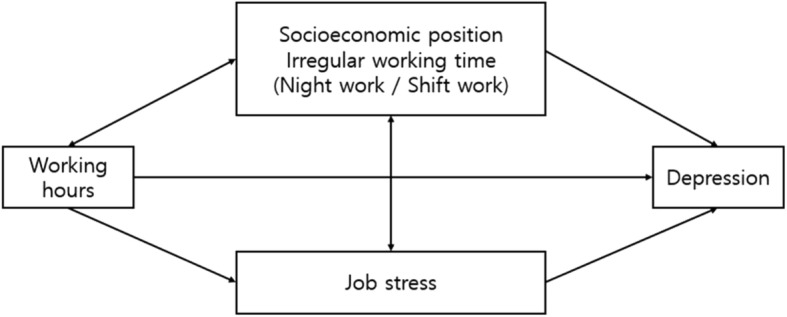
This study used data from the Korea Working Conditions Survey in 2014. Study subjects included 23,197 employees aged 19 years or older who work more than 35 h per week. Working hours were categorized into 35-39, 40, 41-52, 53-68, and more than 68 h per week. Depressive symptoms were assessed using the WHO's Well-Being Index with a cut-off score of 13. We calculated prevalence ratios of depressive symptoms according to working hours using log-binomial regression. Through the percentage change in prevalence ratios, we identified the extent of the role of job stress factors that explain depressive symptoms.
The risks of depressive symptoms were significantly higher in people who worked 35-39 h per week (PR: 1.09, CI: 1.01-1.18), 53-68 h/week (PR: 1.21, CI: 1.16-1.25), and more than 68 h/week (PR: 1.14, CI: 1.07-1.21) than 40 h/week, after adjusting for confounding variables. Job stress explained the effects of long working hours on depressive symptoms in about 20-40% of the groups working more than 40 h/week. Among the factors of job stress, social support was 10-30%, which showed the highest explanatory power in all working hours. Reward explained 15-30% in the more than 52 h working group, and reward was the most important factor in the working group that exceeded 68 h.
We showed the working hours could be an independent risk factor for depressive symptoms in employees. To improve workers' mental health, it is important to strengthen social support in the workplace, to provide adequate rewards as they work, and ultimately to regulate the appropriate amount of working hours.
韩国是经合组织国家中工作时长最长的国家之一。本研究旨在评估工作时长对抑郁症状的影响,以及韩国员工中工作压力因素在这两个变量之间所起的作用。
本研究使用了2014年韩国工作条件调查的数据。研究对象包括23197名年龄在19岁及以上、每周工作超过35小时的员工。工作时长分为每周35 - 39小时、40小时、41 - 52小时、53 - 68小时以及超过68小时。使用世界卫生组织的幸福指数评估抑郁症状,临界值为13。我们使用对数二项回归计算了不同工作时长下抑郁症状的患病率比。通过患病率比的百分比变化,我们确定了解释抑郁症状的工作压力因素的作用程度。
在调整混杂变量后,每周工作35 - 39小时(PR:1.09,CI:1.01 - 1.18)、53 - 68小时/周(PR:1.21,CI:1.16 - 1.25)以及超过68小时/周(PR:1.14,CI:1.07 - 1.21)的人群中,抑郁症状的风险显著高于每周工作40小时的人群。工作压力解释了每周工作超过40小时的人群中约20% - 40%的长时间工作对抑郁症状的影响。在工作压力因素中,社会支持占10% - 30%,在所有工作时长中解释力最高。奖励在每周工作超过52小时的组中占15% - 30%,在工作时长超过68小时的组中,奖励是最重要的因素。
我们表明工作时长可能是员工抑郁症状的一个独立风险因素。为改善员工心理健康,加强工作场所的社会支持、在员工工作时提供适当奖励并最终规范合适的工作时长很重要。