• 文献检索
  • 文档翻译
  • 深度研究
  • 学术资讯
  • Suppr Zotero 插件Zotero 插件
  • 邀请有礼
  • 套餐&价格
  • 历史记录
应用&插件
Suppr Zotero 插件Zotero 插件浏览器插件Mac 客户端Windows 客户端微信小程序
定价
高级版会员购买积分包购买API积分包
服务
文献检索文档翻译深度研究API 文档MCP 服务
关于我们
关于 Suppr公司介绍联系我们用户协议隐私条款
关注我们

Suppr 超能文献

核心技术专利:CN118964589B侵权必究
粤ICP备2023148730 号-1Suppr @ 2026

文献检索

告别复杂PubMed语法,用中文像聊天一样搜索,搜遍4000万医学文献。AI智能推荐,让科研检索更轻松。

立即免费搜索

文件翻译

保留排版,准确专业,支持PDF/Word/PPT等文件格式,支持 12+语言互译。

免费翻译文档

深度研究

AI帮你快速写综述,25分钟生成高质量综述,智能提取关键信息,辅助科研写作。

立即免费体验

复杂动态的变分编码。

Variational encoding of complex dynamics.

机构信息

Biophysics Program, Stanford University, Stanford, California, USA.

Chemistry Department, Stanford University, Stanford, California, USA.

出版信息

Phys Rev E. 2018 Jun;97(6-1):062412. doi: 10.1103/PhysRevE.97.062412.

DOI:10.1103/PhysRevE.97.062412
PMID:30011547
原文链接:https://pmc.ncbi.nlm.nih.gov/articles/PMC7398762/
Abstract

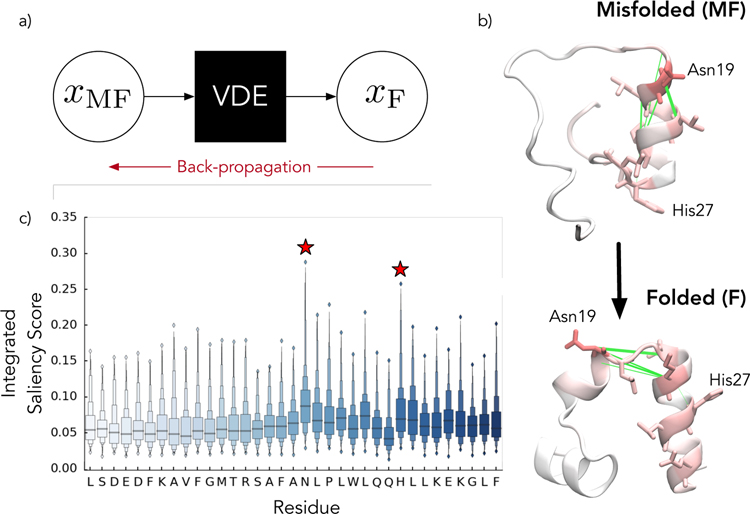
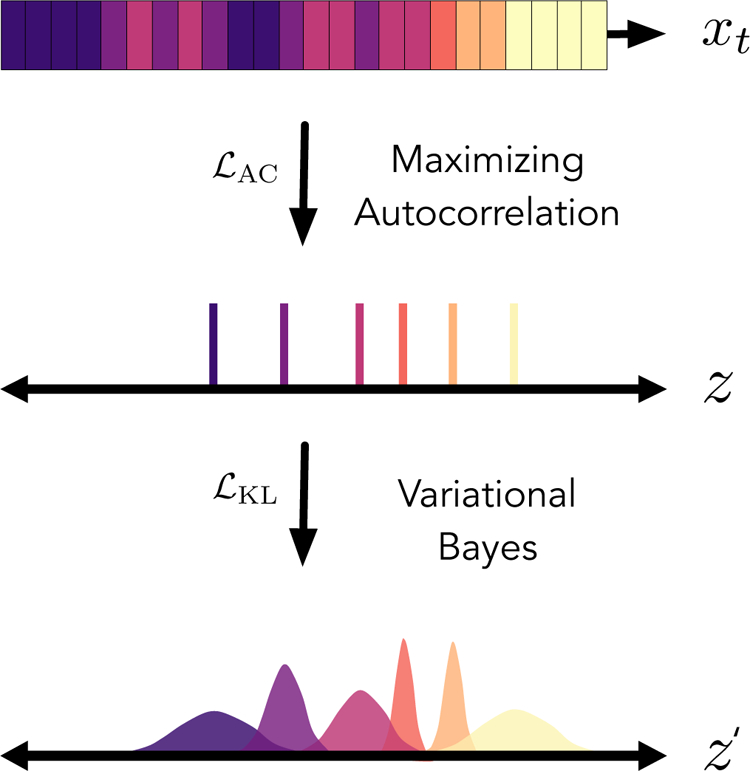
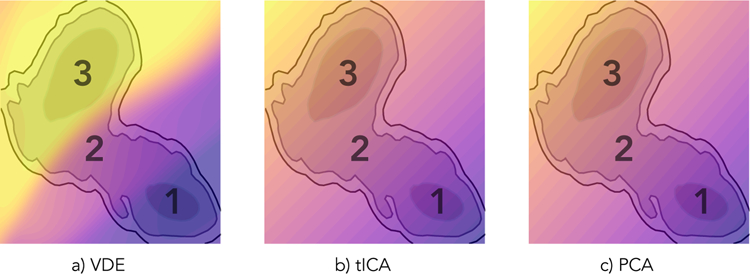
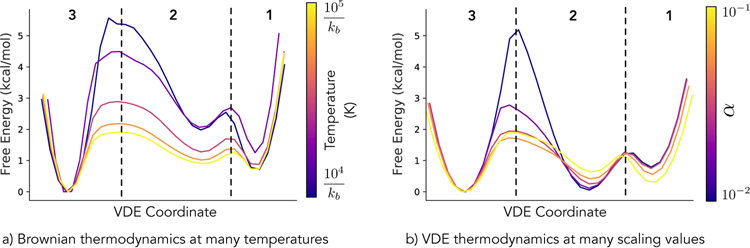
Often the analysis of time-dependent chemical and biophysical systems produces high-dimensional time-series data for which it can be difficult to interpret which individual features are most salient. While recent work from our group and others has demonstrated the utility of time-lagged covariate models to study such systems, linearity assumptions can limit the compression of inherently nonlinear dynamics into just a few characteristic components. Recent work in the field of deep learning has led to the development of the variational autoencoder (VAE), which is able to compress complex datasets into simpler manifolds. We present the use of a time-lagged VAE, or variational dynamics encoder (VDE), to reduce complex, nonlinear processes to a single embedding with high fidelity to the underlying dynamics. We demonstrate how the VDE is able to capture nontrivial dynamics in a variety of examples, including Brownian dynamics and atomistic protein folding. Additionally, we demonstrate a method for analyzing the VDE model, inspired by saliency mapping, to determine what features are selected by the VDE model to describe dynamics. The VDE presents an important step in applying techniques from deep learning to more accurately model and interpret complex biophysics.

摘要

通常,对时变化学和生物物理系统的分析会产生高维时间序列数据,对于这些数据,很难解释哪些单个特征最为显著。虽然我们小组和其他小组最近的工作已经证明了时滞协变量模型在研究此类系统中的效用,但线性假设可能会限制将固有的非线性动力学压缩为仅几个特征分量。深度学习领域的最新工作导致了变分自动编码器(VAE)的发展,该方法能够将复杂数据集压缩为更简单的流形。我们提出使用时滞 VAE 或变分动力学编码器(VDE)将复杂的非线性过程简化为单个嵌入,以高度保真度来描述基础动力学。我们展示了 VDE 如何在各种示例中捕获重要的动力学,包括布朗动力学和原子蛋白折叠。此外,我们还展示了一种基于显着性映射的分析 VDE 模型的方法,以确定 VDE 模型选择哪些特征来描述动力学。VDE 是将深度学习技术应用于更准确地建模和解释复杂生物物理学的重要步骤。

https://cdn.ncbi.nlm.nih.gov/pmc/blobs/050e/7398762/e77123bcf98d/nihms-1600101-f0007.jpg
https://cdn.ncbi.nlm.nih.gov/pmc/blobs/050e/7398762/8dd5fec5a7e2/nihms-1600101-f0001.jpg
https://cdn.ncbi.nlm.nih.gov/pmc/blobs/050e/7398762/4ea873b5db09/nihms-1600101-f0002.jpg
https://cdn.ncbi.nlm.nih.gov/pmc/blobs/050e/7398762/f374e2702c34/nihms-1600101-f0003.jpg
https://cdn.ncbi.nlm.nih.gov/pmc/blobs/050e/7398762/688140dd2225/nihms-1600101-f0004.jpg
https://cdn.ncbi.nlm.nih.gov/pmc/blobs/050e/7398762/7269f14c0545/nihms-1600101-f0005.jpg
https://cdn.ncbi.nlm.nih.gov/pmc/blobs/050e/7398762/cc5cf9ff7b2e/nihms-1600101-f0006.jpg
https://cdn.ncbi.nlm.nih.gov/pmc/blobs/050e/7398762/e77123bcf98d/nihms-1600101-f0007.jpg
https://cdn.ncbi.nlm.nih.gov/pmc/blobs/050e/7398762/8dd5fec5a7e2/nihms-1600101-f0001.jpg
https://cdn.ncbi.nlm.nih.gov/pmc/blobs/050e/7398762/4ea873b5db09/nihms-1600101-f0002.jpg
https://cdn.ncbi.nlm.nih.gov/pmc/blobs/050e/7398762/f374e2702c34/nihms-1600101-f0003.jpg
https://cdn.ncbi.nlm.nih.gov/pmc/blobs/050e/7398762/688140dd2225/nihms-1600101-f0004.jpg
https://cdn.ncbi.nlm.nih.gov/pmc/blobs/050e/7398762/7269f14c0545/nihms-1600101-f0005.jpg
https://cdn.ncbi.nlm.nih.gov/pmc/blobs/050e/7398762/cc5cf9ff7b2e/nihms-1600101-f0006.jpg
https://cdn.ncbi.nlm.nih.gov/pmc/blobs/050e/7398762/e77123bcf98d/nihms-1600101-f0007.jpg

相似文献

1
Variational encoding of complex dynamics.复杂动态的变分编码。
Phys Rev E. 2018 Jun;97(6-1):062412. doi: 10.1103/PhysRevE.97.062412.
2
Note: Variational encoding of protein dynamics benefits from maximizing latent autocorrelation.注意:蛋白质动力学的变分编码受益于最大化潜在自相关。
J Chem Phys. 2018 Dec 7;149(21):216101. doi: 10.1063/1.5043303.
3
Similarity-assisted variational autoencoder for nonlinear dimension reduction with application to single-cell RNA sequencing data.基于相似性辅助变分自动编码器的非线性降维方法及其在单细胞 RNA 测序数据分析中的应用。
BMC Bioinformatics. 2023 Nov 14;24(1):432. doi: 10.1186/s12859-023-05552-1.
4
Predicting chemotherapy response using a variational autoencoder approach.使用变分自动编码器方法预测化疗反应。
BMC Bioinformatics. 2021 Sep 22;22(1):453. doi: 10.1186/s12859-021-04339-6.
5
Deep clustering of protein folding simulations.蛋白质折叠模拟的深度聚类。
BMC Bioinformatics. 2018 Dec 21;19(Suppl 18):484. doi: 10.1186/s12859-018-2507-5.
6
Nonlinear quality-related fault detection using combined deep variational information bottleneck and variational autoencoder.基于深度变分信息瓶颈与变分自编码器相结合的非线性质量相关故障检测
ISA Trans. 2021 Aug;114:444-454. doi: 10.1016/j.isatra.2021.01.002. Epub 2021 Jan 11.
7
VAE: a stochastic process prior for Bayesian deep learning with MCMC.变分自编码器:用于贝叶斯深度学习和马尔可夫链蒙特卡罗的随机过程先验。
Stat Comput. 2022;32(6):96. doi: 10.1007/s11222-022-10151-w. Epub 2022 Oct 17.
8
Transferable Neural Networks for Enhanced Sampling of Protein Dynamics.可迁移神经网络增强蛋白质动力学采样。
J Chem Theory Comput. 2018 Apr 10;14(4):1887-1894. doi: 10.1021/acs.jctc.8b00025. Epub 2018 Mar 19.
9
Optimizing Variational Graph Autoencoder for Community Detection with Dual Optimization.通过双重优化优化变分图自动编码器以进行社区检测
Entropy (Basel). 2020 Feb 7;22(2):197. doi: 10.3390/e22020197.
10
Deep Learning and Infrared Spectroscopy: Representation Learning with a β-Variational Autoencoder.深度学习与红外光谱学:基于β变分自编码器的表示学习。
J Phys Chem Lett. 2022 Jun 30;13(25):5787-5793. doi: 10.1021/acs.jpclett.2c01328. Epub 2022 Jun 21.

引用本文的文献

1
A beginner's approach to deep learning applied to VS and MD techniques.深度学习应用于VS和MD技术的初学者方法。
J Cheminform. 2025 Apr 8;17(1):47. doi: 10.1186/s13321-025-00985-7.
2
Using pretrained graph neural networks with token mixers as geometric featurizers for conformational dynamics.使用带有令牌混合器的预训练图神经网络作为构象动力学的几何特征提取器。
J Chem Phys. 2025 Jan 28;162(4). doi: 10.1063/5.0244453.
3
Using pretrained graph neural networks with token mixers as geometric featurizers for conformational dynamics.使用带有标记混合器的预训练图神经网络作为构象动力学的几何特征提取器。

本文引用的文献

1
Note: Variational encoding of protein dynamics benefits from maximizing latent autocorrelation.注意:蛋白质动力学的变分编码受益于最大化潜在自相关。
J Chem Phys. 2018 Dec 7;149(21):216101. doi: 10.1063/1.5043303.
2
Time-lagged autoencoders: Deep learning of slow collective variables for molecular kinetics.时滞自编码器:分子动力学中慢集体变量的深度学习。
J Chem Phys. 2018 Jun 28;148(24):241703. doi: 10.1063/1.5011399.
3
Markov State Models: From an Art to a Science.马尔可夫状态模型:从一门艺术到一门科学。
ArXiv. 2024 Dec 31:arXiv:2409.19838v2.
4
An Information Bottleneck Approach for Markov Model Construction.一种用于马尔可夫模型构建的信息瓶颈方法。
ArXiv. 2024 Jun 10:arXiv:2404.02856v2.
5
Information Bottleneck Approach for Markov Model Construction.信息瓶颈方法在马尔可夫模型构建中的应用。
J Chem Theory Comput. 2024 Jun 25;20(12):5352-5367. doi: 10.1021/acs.jctc.4c00449. Epub 2024 Jun 10.
6
Tutorial on how to build non-Markovian dynamic models from molecular dynamics simulations for studying protein conformational changes.从分子动力学模拟构建非马尔可夫动态模型以研究蛋白质构象变化的教程。
J Chem Phys. 2024 Mar 28;160(12). doi: 10.1063/5.0189429.
7
Enhanced Sampling with Machine Learning.利用机器学习的增强采样
Annu Rev Phys Chem. 2024 Jun;75(1):347-370. doi: 10.1146/annurev-physchem-083122-125941. Epub 2024 Jun 14.
8
Markov State Models: To Optimize or Not to Optimize.马尔可夫状态模型:优化还是不优化。
J Chem Theory Comput. 2024 Jan 23;20(2):977-988. doi: 10.1021/acs.jctc.3c01134. Epub 2024 Jan 1.
9
Chasing collective variables using temporal data-driven strategies.使用时间数据驱动策略追踪集体变量。
QRB Discov. 2023 Jan 6;4:e2. doi: 10.1017/qrd.2022.23. eCollection 2023.
10
Uncertainties in Markov State Models of Small Proteins.小蛋白的马尔可夫状态模型中的不确定性。
J Chem Theory Comput. 2023 Aug 22;19(16):5516-5524. doi: 10.1021/acs.jctc.3c00372. Epub 2023 Aug 4.
J Am Chem Soc. 2018 Feb 21;140(7):2386-2396. doi: 10.1021/jacs.7b12191. Epub 2018 Feb 2.
4
VAMPnets for deep learning of molecular kinetics.用于分子动力学深度学习的VAMP网络。
Nat Commun. 2018 Jan 2;9(1):5. doi: 10.1038/s41467-017-02388-1.
5
Note: MSM lag time cannot be used for variational model selection.注:MSM 滞后时间不能用于变分模型选择。
J Chem Phys. 2017 Nov 7;147(17):176101. doi: 10.1063/1.5002086.
6
Deep reconstruction model for dynamic PET images.动态PET图像的深度重建模型
PLoS One. 2017 Sep 21;12(9):e0184667. doi: 10.1371/journal.pone.0184667. eCollection 2017.
7
A deep learning framework for financial time series using stacked autoencoders and long-short term memory.一种使用堆叠自编码器和长短时记忆的金融时间序列深度学习框架。
PLoS One. 2017 Jul 14;12(7):e0180944. doi: 10.1371/journal.pone.0180944. eCollection 2017.
8
Variational Koopman models: Slow collective variables and molecular kinetics from short off-equilibrium simulations.变分 Koopman 模型:从短非平衡模拟中提取慢集体变量和分子动力学。
J Chem Phys. 2017 Apr 21;146(15):154104. doi: 10.1063/1.4979344.
9
Identification of simple reaction coordinates from complex dynamics.从复杂动力学中识别简单反应坐标。
J Chem Phys. 2017 Jan 28;146(4):044109. doi: 10.1063/1.4974306.
10
MSMBuilder: Statistical Models for Biomolecular Dynamics.MSMBuilder:生物分子动力学的统计模型。
Biophys J. 2017 Jan 10;112(1):10-15. doi: 10.1016/j.bpj.2016.10.042.