Ding Xiaosheng, Li Li, Tang CHuanhao, Meng Chao, Xu Weiran, Wei Xing, Guo Ziwei, Zhang Tingting, Fu Yali, Zhang Lingling, Wang Xiangyi, Lin Li, Liang Jun
Department of Oncology, Peking University International Hospital, Beijing 102206, P.R. China.
Oncol Lett. 2018 Aug;16(2):2382-2390. doi: 10.3892/ol.2018.8936. Epub 2018 Jun 8.
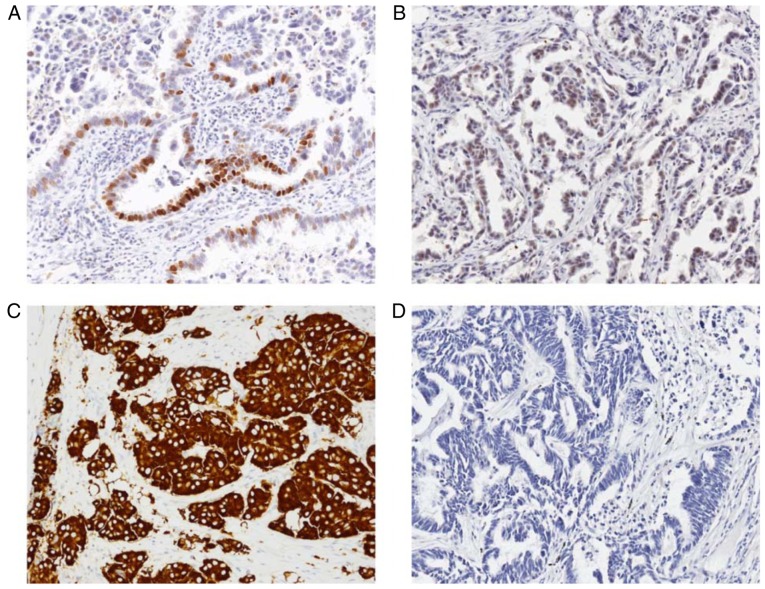
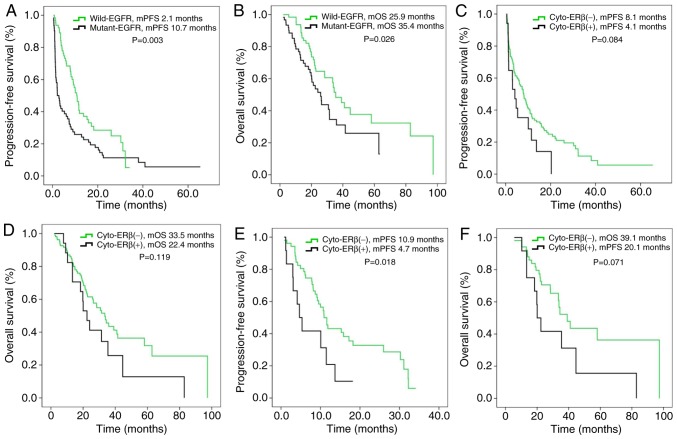
There is growing evidence that estrogen receptors (ER) are expressed in lung cancer cells, and are able to interact with the epidermal growth factor receptor (EGFR) signaling pathway. However, data on the association between cytoplasmic ER expression and the response to EGFR-tyrosine kinase inhibitors (TKI) treatment are limited. The aim of the present study was to investigate the associations between ERα/ERβ expression and EGFR mutational status and response to TKI treatment in metastatic lung adenocarcinoma. A retrospective study of 126 consecutive patients with lung adenocarcinoma who were diagnosed with stage IV disease and had received EGFR-TKI treatment was conducted. ER expression was detected by immunohistochemistry. EGFR and GTPase KRas (KRAS) mutational statuses were evaluated by denaturing high performance liquid chromatography and PCR-restriction fragment length polymorphism, respectively. In the overall cohort of 126 lung adenocarcinoma samples analyzed, ERα expression in the nucleus of tumor cells was identified in 17 (18.9%) patients, whereas ERβ expression was identified in the nucleus (22/126, 17.5%) and cytoplasm (17/126, 13.5%). The nuclear expression of ERβ was positively associated with the degree of tumor differentiation (P=0.010). EGFR-sensitizing mutations were significantly associated with improved objective response rates (ORR), disease control rates (DCR), median progression-free survival (mPFS) and median overall survival (mOS) (P<0.001; P<0.001; P=0.003; and P=0.026, respectively). Patients with cytoplasmic ERβ expression exhibited non-significant poorer ORR, DCR, mPFS and mOS compared with patients without cytoplasmic ERβ expression (P=0.082; P=0.106; P=0.084; and P=0.119, respectively). However, the significant decrease of ORR, DCR and mPFS was observed in patients with coexisting cytoplasmic ERβ expression and EGFR-sensitizing mutations (P=0.030; P=0.009; and P=0.018, respectively) in comparison with the subgroup with EGFR sensitizing mutations but negative expression of cytoplasmic ERβ. A trend towards shorter mOS was also observed in patients with coexisting cytoplasmic ERβ expression and EGFR-sensitizing mutations (P=0.071). No KRAS mutations were identified in patients with cytoplasmic ERβ expression. Subsequent to adjusting for sex, smoking status and EGFR mutation status, the Cox repression analysis indicated that cytoplasmic expression of ERβ was a negative independent predictor for mPFS in the whole patient cohort (HR=1.870; 95% confidence interval 1.058-3.305; P=0.031). Cytoplasmic ERβ expression was negatively correlated with the efficacy of EGFR-TKI treatment for metastatic lung adenocarcinoma, particularly for patients with coexisting cytoplasmic ERβ expression and EGFR-sensitizing mutations. Cytoplasmic ERβ may be a promising marker to predict the outcome of EGFR-TKI treatment.
越来越多的证据表明,雌激素受体(ER)在肺癌细胞中表达,并能够与表皮生长因子受体(EGFR)信号通路相互作用。然而,关于细胞质ER表达与EGFR酪氨酸激酶抑制剂(TKI)治疗反应之间关联的数据有限。本研究的目的是探讨ERα/ERβ表达与EGFR突变状态以及转移性肺腺癌对TKI治疗反应之间的关联。对126例连续诊断为IV期疾病并接受EGFR-TKI治疗的肺腺癌患者进行了回顾性研究。通过免疫组织化学检测ER表达。分别通过变性高效液相色谱法和PCR-限制性片段长度多态性评估EGFR和GTP酶KRas(KRAS)的突变状态。在分析的126例肺腺癌样本的总体队列中,17例(18.9%)患者的肿瘤细胞核中检测到ERα表达,而22例(17.5%)患者的细胞核和17例(13.5%)患者的细胞质中检测到ERβ表达。ERβ的核表达与肿瘤分化程度呈正相关(P=0.010)。EGFR敏感突变与客观缓解率(ORR)、疾病控制率(DCR)、中位无进展生存期(mPFS)和中位总生存期(mOS)显著改善相关(分别为P<0.001;P<0.001;P=0.003;P=0.026)。与无细胞质ERβ表达的患者相比,有细胞质ERβ表达的患者的ORR、DCR、mPFS和mOS无显著降低(分别为P=0.082;P=0.106;P=0.084;P=0.119)。然而,与具有EGFR敏感突变但细胞质ERβ表达阴性的亚组相比,同时存在细胞质ERβ表达和EGFR敏感突变的患者的ORR、DCR和mPFS显著降低(分别为P=0.030;P=0.009;P=0.018)。同时存在细胞质ERβ表达和EGFR敏感突变的患者也观察到mOS缩短的趋势(P=0.071)。在有细胞质ERβ表达的患者中未发现KRAS突变。在调整性别、吸烟状态和EGFR突变状态后,Cox回归分析表明,ERβ的细胞质表达是整个患者队列中mPFS的负独立预测因子(HR=1.870;95%置信区间1.058-3.305;P=0.031)。细胞质ERβ表达与EGFR-TKI治疗转移性肺腺癌的疗效呈负相关,特别是对于同时存在细胞质ERβ表达和EGFR敏感突变的患者。细胞质ERβ可能是预测EGFR-TKI治疗结果的一个有前景的标志物。