Harper Lucy, Bold Justine
Freelance Nutritional Therapist, UK.
Allied Health and Social Sciences, University of Worcester, Worcester, WR2 6AJ, UK.
Gastroenterol Hepatol Bed Bench. 2018 Summer;11(3):259-268.
To explore the motivation for gluten avoidance in the absence of coeliac disease (CD) and ascertain what symptoms are triggered by gluten and what beliefs/reasons influence this decision.
Links between physical/psychological symptoms and gluten in CD are well known but less is known about those who self-select a gluten-free diet (GFD) in the absence of CD.
An empirical study using responses to an anonymous on-line questionnaire. Closed questions were used as a screening tool to exclude participants who had CD, wheat allergy or were following a low FODMAP diet. Data from participants using a GFD in the absence of a medical diagnosis was then analysed using thematic analysis.
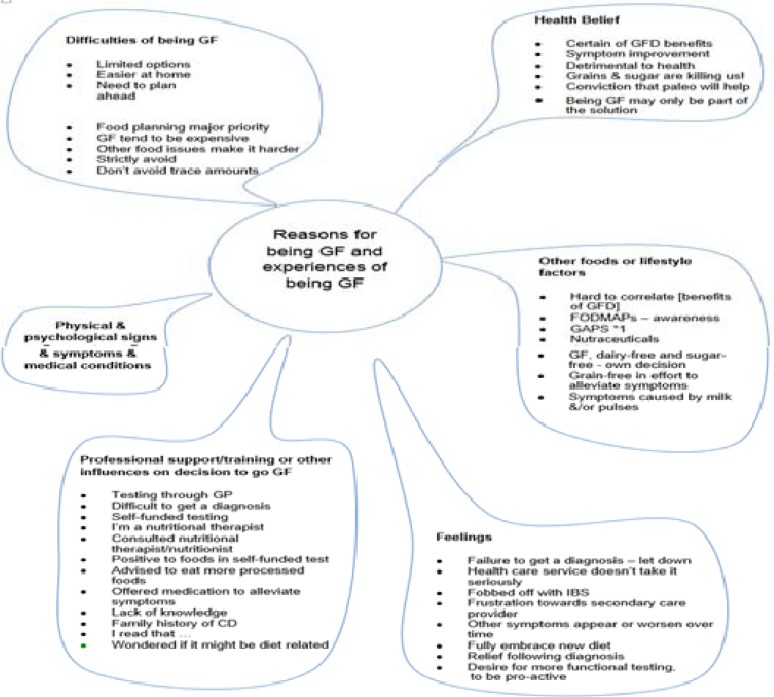
120 initial responses, 87 were completed in full. 23 respondents fulfilled the inclusion criteria for thematic analysis. 7 different themes emerged, including one for signs/symptoms. Other themes identified included difficulties of a GFD, health beliefs, feelings and influence on decision to follow a GFD. Responses indicate that the reasons for gluten avoidance are in the most part reasoned and logical and were based around participants' self-management of symptoms.
Symptoms included those typical of irritable bowel syndrome (IBS), but also infertility, low mood/energy, immune function and weight management and visual and auditory hallucinations. It appears the majority of responses analysed thematically could fit into the spectrum of non-coeliac gluten sensitivity (NCGS). Findings also suggest more support at all levels of medical care may help patients establish if it is gluten, rather than wheat or FODMAPs particularly fructans that are contributing to signs/symptoms.
探讨在无乳糜泻(CD)情况下避免食用麸质的动机,确定麸质会引发哪些症状以及哪些信念/原因影响了这一决定。
乳糜泻中身体/心理症状与麸质之间的联系已为人熟知,但对于那些在无乳糜泻情况下自行选择无麸质饮食(GFD)的人了解较少。
一项实证研究,采用对匿名在线问卷的回复。封闭式问题用作筛选工具,以排除患有乳糜泻、小麦过敏或遵循低FODMAP饮食的参与者。然后使用主题分析法对无医学诊断情况下采用无麸质饮食的参与者的数据进行分析。
最初有120份回复,其中87份完整填写。23名受访者符合主题分析的纳入标准。出现了7个不同主题,包括一个关于体征/症状的主题。确定的其他主题包括无麸质饮食的困难、健康信念、感受以及对选择无麸质饮食决定的影响。回复表明,避免食用麸质的原因大多是合理且合乎逻辑的,并且基于参与者对症状的自我管理。
症状包括肠易激综合征(IBS)的典型症状,还有不孕、情绪低落/精力不足、免疫功能、体重管理以及视觉和听觉幻觉。看来,经主题分析的大多数回复可能符合非乳糜泻性麸质敏感(NCGS)的范畴。研究结果还表明,各级医疗保健提供更多支持可能有助于患者确定是麸质,而非小麦或FODMAPs(特别是果聚糖)导致了体征/症状。