Ernst Strüngmann Institute (ESI) for Neuroscience in Cooperation with the Max Planck Society, Deutschordenstraße 46, 60528 Frankfurt a.M., Germany; Epilepsy Center Frankfurt Rhine-Main, Center of Neurology and Neurosurgery, Goethe University, Schleusenweg 2-16, 60528 Frankfurt a.M., Germany; Institute of Neuroscience, Newcastle University, Framlington Place, Newcastle upon Tyne NE2 4HH, UK.
Ernst Strüngmann Institute (ESI) for Neuroscience in Cooperation with the Max Planck Society, Deutschordenstraße 46, 60528 Frankfurt a.M., Germany.
Curr Biol. 2018 Aug 6;28(15):2377-2387.e5. doi: 10.1016/j.cub.2018.05.086. Epub 2018 Jul 12.
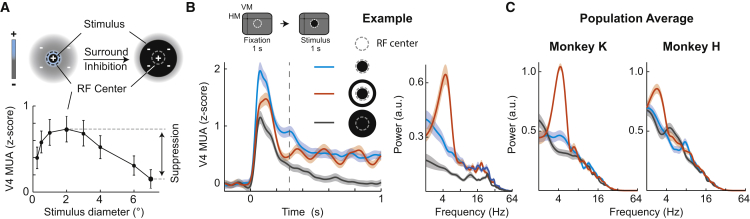
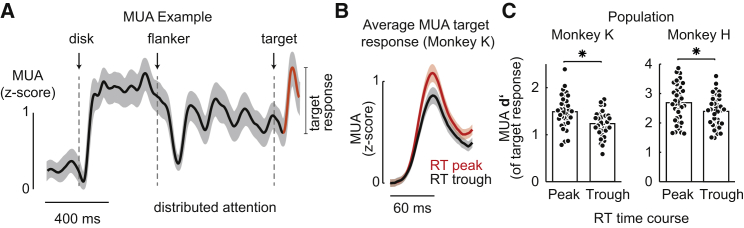
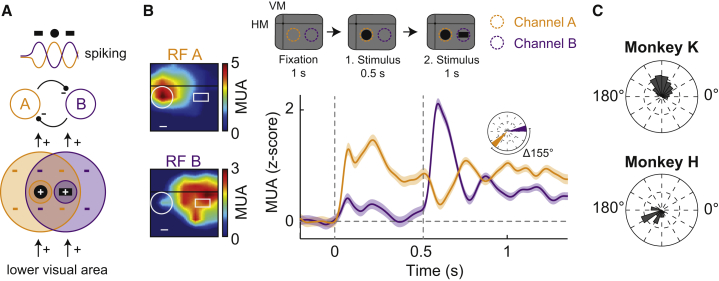
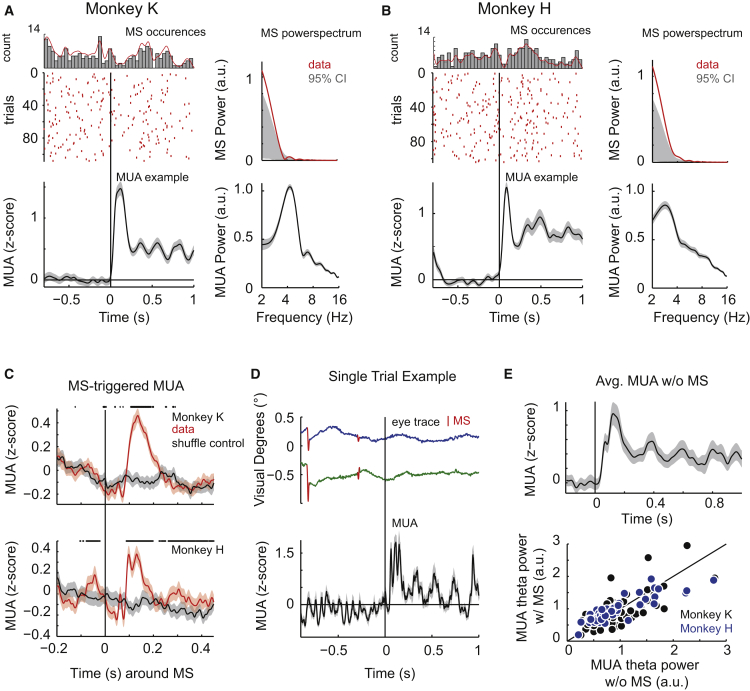
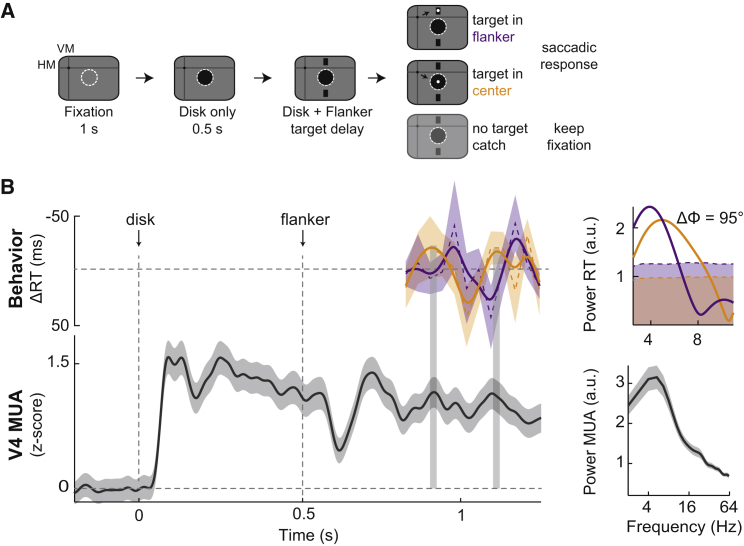
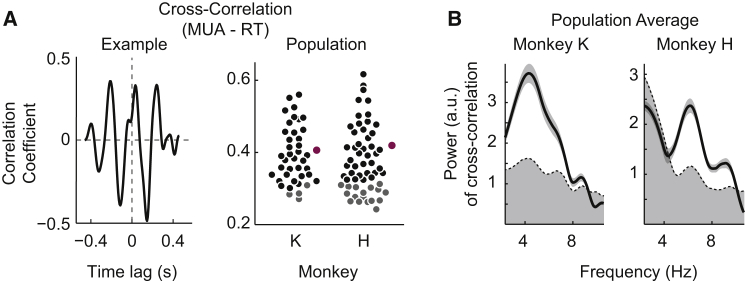
Growing evidence suggests that distributed spatial attention may invoke theta (3-9 Hz) rhythmic sampling processes. The neuronal basis of such attentional sampling is, however, not fully understood. Here we show using array recordings in visual cortical area V4 of two awake macaques that presenting separate visual stimuli to the excitatory center and suppressive surround of neuronal receptive fields (RFs) elicits rhythmic multi-unit activity (MUA) at 3-6 Hz. This neuronal rhythm did not depend on small fixational eye movements. In the context of a distributed spatial attention task, during which the monkeys detected a spatially and temporally uncertain target, reaction times (RTs) exhibited similar rhythmic fluctuations. RTs were fast or slow depending on the target occurrence during high or low MUA, resulting in rhythmic MUA-RT cross-correlations at theta frequencies. These findings show that theta rhythmic neuronal activity can arise from competitive RF interactions and that this rhythm may result in rhythmic RTs potentially subserving attentional sampling.
越来越多的证据表明,分布式空间注意力可能会引发θ(3-9Hz)节律采样过程。然而,这种注意力采样的神经元基础尚未完全理解。在这里,我们使用两只清醒猕猴的视觉皮层 V4 的阵列记录表明,向神经元感受野(RF)的兴奋中心和抑制外围呈现单独的视觉刺激,会在 3-6Hz 产生节律性多单位活动(MUA)。这种神经元节律并不依赖于小的注视眼动。在分布式空间注意任务的背景下,当猴子检测到空间和时间不确定的目标时,反应时间(RT)表现出类似的节律波动。RT 取决于高或低 MUA 期间目标的出现,从而导致在θ频率下出现 MUA-RT 交叉相关的快或慢 RT,这表明θ节律神经元活动可能源于竞争 RF 相互作用,并且这种节律可能导致潜在的注意力采样的节律 RT。