Guglielmino Grazzia, Moraes Bruno Teixeira de, Villanova Luiz Celso, Padovani Marina, Biase Noemi Grigoletto De
Departamento de Otorrinolaringologia e Cirurgia de Cabeca e Pescoco, Universidade Federal de Sao Paulo, Sao Paulo, SP, BR.
Departamento de Cirurgia, Universidade Federal de Pernambuco, Recife, PE, BR.
Clinics (Sao Paulo). 2018 Jul 16;73:e87. doi: 10.6061/clinics/2018/e87.
Vocal tremors, which cause social difficulties for patients, may be classified as resting or action tremors. Of the vocal action tremors, essential and dystonic tremors are the most common. Botulinum toxin and oral medications have been used to treat vocal tremors, but no comparative clinical trials have been performed. The aim of this study was to compare the effects of botulinum toxin injection and the oral administration of propranolol in the treatment of essential and dystonic vocal tremors.
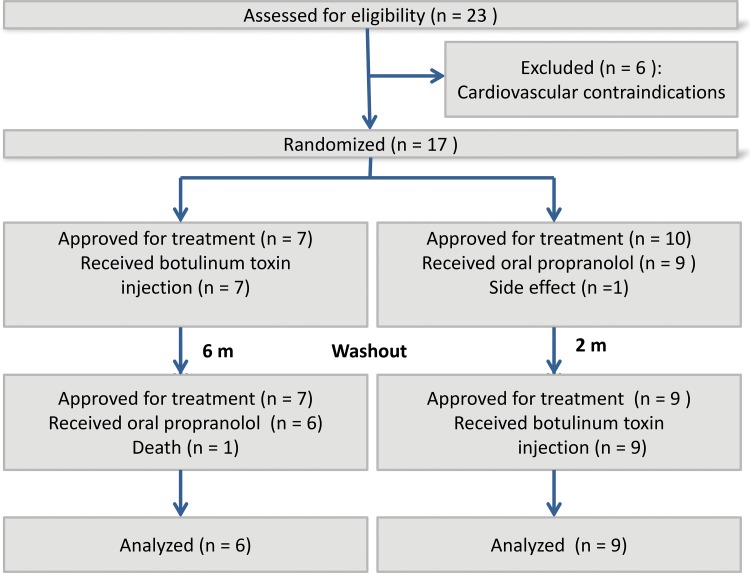
This clinical trial recruited 15 patients, divided into essential and dystonic vocal tremor groups. Patients in both groups received successive treatment with botulinum toxin and propranolol. The treatments were administered at different times; the order of treatment was randomly selected. Patients were assessed with flexible nasofibrolaryngoscopy and with perceptual and acoustic voice evaluations. A statistical significance level of 0.05 (5%) was used.
Botulinum toxin produced statistically significant improvements in perceptual measures of vocal instability in patients with dystonic vocal tremors compared with baseline values and treatment with propranolol. The acoustic measure of variability in the fundamental frequency was significantly lower in patients with dystonic vocal tremors after treatment with botulinum toxin.
Essential and dystonic vocal tremors responded differently to treatment. Dystonic vocal tremors responded significantly to treatment with botulinum toxin but not oral propranolol. Essential vocal tremors did not respond significantly to either treatment, perhaps due to the small number of patients, which is a limitation of this research.
导致患者社交困难的声音震颤可分为静止性或动作性震颤。在动作性声音震颤中,特发性震颤和肌张力障碍性震颤最为常见。肉毒杆菌毒素和口服药物已被用于治疗声音震颤,但尚未进行比较性临床试验。本研究的目的是比较肉毒杆菌毒素注射和口服普萘洛尔治疗特发性和肌张力障碍性声音震颤的效果。
这项临床试验招募了15名患者,分为特发性和肌张力障碍性声音震颤组。两组患者均先后接受肉毒杆菌毒素和普萘洛尔治疗。治疗在不同时间进行;治疗顺序随机选择。通过软性鼻纤维喉镜检查以及感知和声学语音评估对患者进行评估。使用的统计学显著性水平为0.05(5%)。
与基线值和普萘洛尔治疗相比,肉毒杆菌毒素在肌张力障碍性声音震颤患者的声音不稳定性感知测量方面产生了具有统计学显著性的改善。肉毒杆菌毒素治疗后,肌张力障碍性声音震颤患者的基频变异性声学测量值显著降低。
特发性和肌张力障碍性声音震颤对治疗的反应不同。肌张力障碍性声音震颤对肉毒杆菌毒素治疗有显著反应,但对口服普萘洛尔无反应。特发性声音震颤对两种治疗均无显著反应,可能是由于患者数量较少,这是本研究的一个局限性。