Akaiwa Michinori, Martin Tioga, Mendelsohn Brian A
Agensys Inc. an Affiliate of Astellas Pharma Inc., 1800 Stewart Street, Santa Monica, California 90404, United States.
ACS Omega. 2018 May 31;3(5):5212-5221. doi: 10.1021/acsomega.8b00093. Epub 2018 May 15.
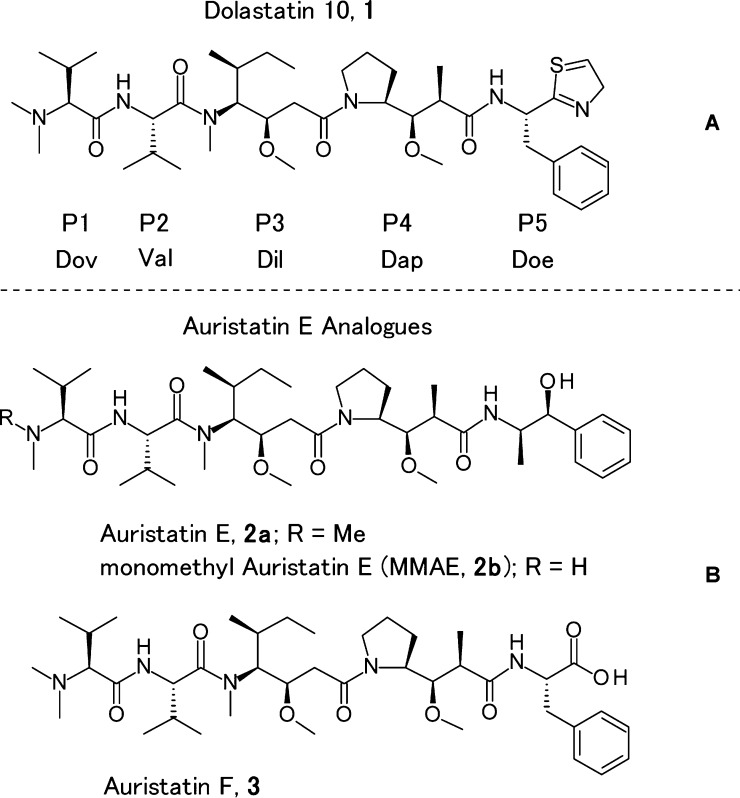
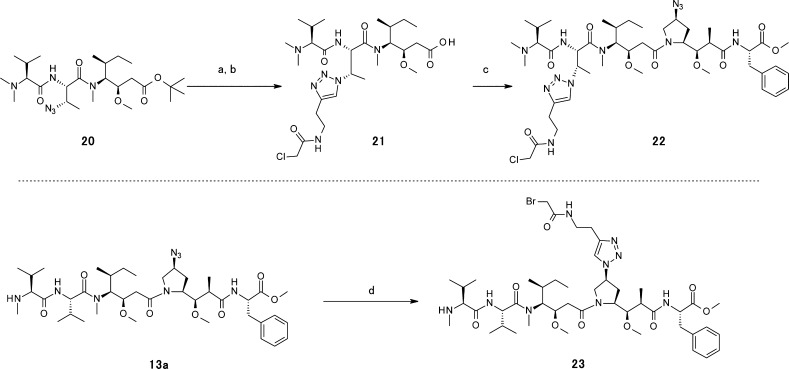
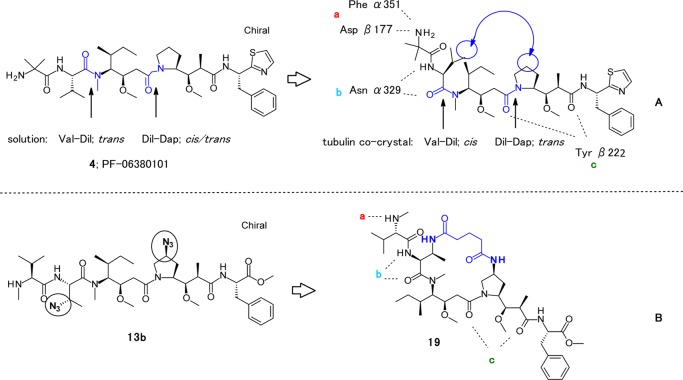
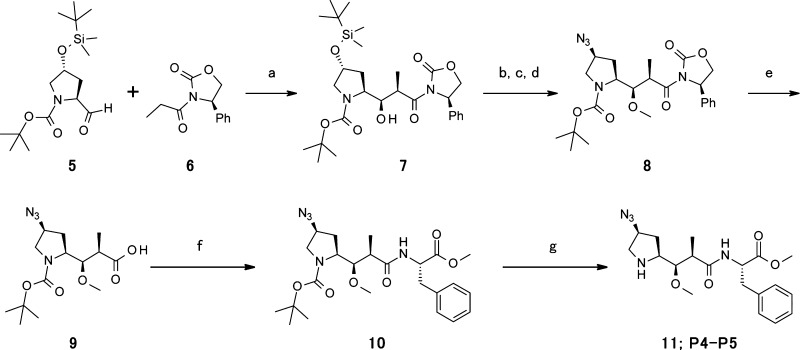
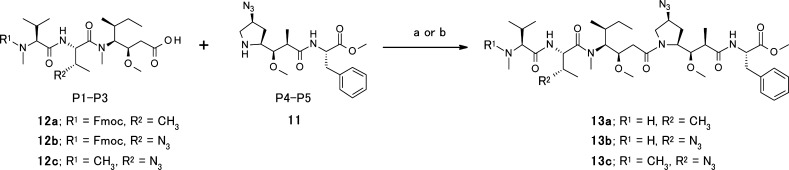
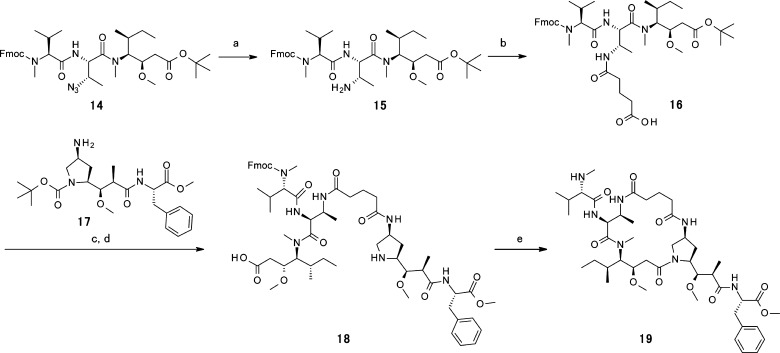
Because of their potent cytotoxic activity, members of the auristatin family (synthetic analogues of the naturally occurring dolastatin 10) have remained a target of significant research, most notably in the context of antibody drug conjugate payloads. Typically, modifications of the backbone scaffold of dolastatin 10 have focused on variations of the N-terminal (P1) and C-terminal (P5) subunits. Scant attention has been paid thus far to the P4 subunit in the scientific literature. In this paper, we introduce an azide functional group at the P4 subunit, resulting in potent cytotoxic activity seen in vitro. Another highly active compound in this study contained azide functional groups in both the P2 and P4 subunits and required dolavaline as the P1 subunit and a phenylalanine as the P5 subunit. Furthermore, these two azide groups served not only as modifiers of cytotoxicity but also as handles for linker attachment or as a tether for use in the synthesis of a macrocyclic analogue.
由于其强大的细胞毒性活性,奥瑞他汀家族成员(天然多拉司他汀10的合成类似物)一直是大量研究的目标,尤其在抗体药物偶联物有效载荷的背景下。通常,多拉司他汀10主链支架的修饰主要集中在N端(P1)和C端(P5)亚基的变化上。迄今为止,科学文献中对P4亚基的关注甚少。在本文中,我们在P4亚基处引入了一个叠氮官能团,从而在体外观察到了强大的细胞毒性活性。本研究中的另一种高活性化合物在P2和P4亚基中均含有叠氮官能团,并且需要多拉缬氨酸作为P1亚基,苯丙氨酸作为P5亚基。此外,这两个叠氮基团不仅作为细胞毒性的修饰基团,还作为连接子连接的手柄或用于合成大环类似物的系链。