Department of Clinical Immunology, Xijing Hospital, Fourth Military Medical University, Xi'an, China.
Department of Hematology and Rheumatology, Hanzhong 3201 Hospital, Hanzhong, China.
PLoS One. 2018 Jul 19;13(7):e0201021. doi: 10.1371/journal.pone.0201021. eCollection 2018.
Pain management is a huge challenge in the treatment of rheumatoid arthritis (RA), and central sensitization is reportedly involved in the development of pain. The current study was undertaken to explore the possible role of N-methyl-D-aspartate receptors (NMDARs) in the spinal mechanism of central sensitization in RA using a collagen-induced arthritis (CIA) model.
Mechanical hypersensitivity was assessed in C57BL/6 mice, before and after the induction of CIA via administration of chick type II collagen. Analgesic drugs, receptor antagonist, and kinase inhibitor were administrated intrathecally in the spinal cord. Protein expression and phosphorylation changes were detected via immunoblotting.
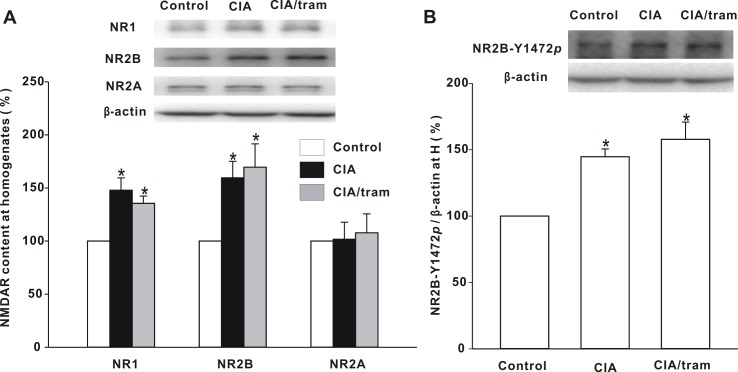
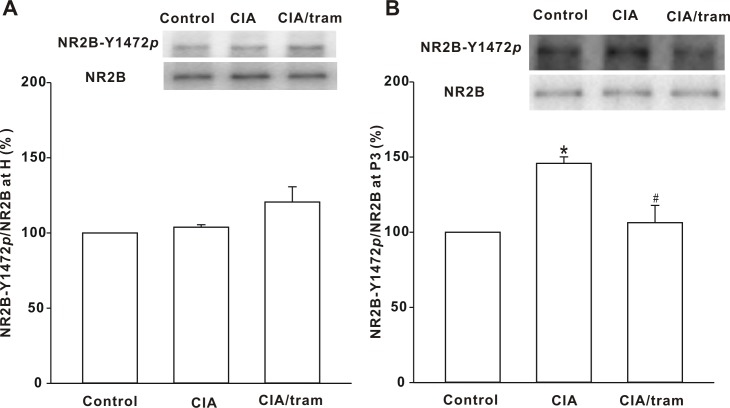
CIA mice developed significant mechanical hypersensitivity, and spinal administration of the NMDAR antagonist D-2-amino-5-phosphonovaleric acid (D-APV) effectively attenuated peripheral pain hypersensitivity. There was specific enhancement of synaptic NR2B-containing NMDAR (NR2BR) expression in the spinal dorsal horns of the mice. Both the increased total protein expression of NR2B subunit and the enhanced total phosphorylation level of NR2B subunit at 1472 tyrosine promoted the synaptic expression of NMDAR in the mice. Intrathecal injection of tramadol suppressed synaptic NMDAR expression mainly by changing the synaptic phosphorylation state of NR2B subunit at Tyr1472. Extracellular signal-regulated protein kinases 2 (ERK2) activity synchronized with the synaptic expression of NR2BR, which was downregulated by the action of tramadol.
Specific enhancement of NR2BR in the spinal dorsal horn may be vital for central sensitization in the CIA model of RA. The NR2BR/ERK2 pathway may be a promising target for pain management in RA patients.
疼痛管理是类风湿关节炎(RA)治疗中的一大挑战,据报道,中枢敏化参与了疼痛的发展。本研究旨在通过胶原诱导性关节炎(CIA)模型探索 N-甲基-D-天冬氨酸受体(NMDAR)在 RA 脊髓中枢敏化机制中的可能作用。
通过给予鸡Ⅱ型胶原诱导 CIA,在 CIA 诱导前后评估 C57BL/6 小鼠的机械性痛敏。鞘内给予镇痛药物、受体拮抗剂和激酶抑制剂。通过免疫印迹检测蛋白表达和磷酸化变化。
CIA 小鼠出现明显的机械性痛敏,脊髓给予 NMDAR 拮抗剂 D-2-氨基-5-磷戊酸(D-APV)可有效减轻外周痛敏。小鼠脊髓背角突触 NR2B 含有 NMDAR(NR2BR)表达特异性增强。NR2B 亚基总蛋白表达增加和 1472 酪氨酸位 NR2B 亚基总磷酸化水平增强均促进了小鼠脊髓 NMDAR 的突触表达。鞘内注射曲马多主要通过改变 NR2B 亚基 Tyr1472 的突触磷酸化状态抑制突触 NMDAR 表达。细胞外信号调节蛋白激酶 2(ERK2)活性与 NR2BR 的突触表达同步,而曲马多的作用则下调了 ERK2 活性。
脊髓背角 NR2BR 的特异性增强可能对 RA CIA 模型中的中枢敏化至关重要。NR2BR/ERK2 通路可能是 RA 患者疼痛管理的有希望的靶点。