Department of Molecular Biology and Princeton Neuroscience Institute, Princeton University, Princeton, New Jersey, United States of America.
Department of Microbiology and Immunology, Thomas Jefferson University, Philadelphia, Pennsylvania, United States of America.
PLoS Pathog. 2018 Jul 20;14(7):e1007188. doi: 10.1371/journal.ppat.1007188. eCollection 2018 Jul.
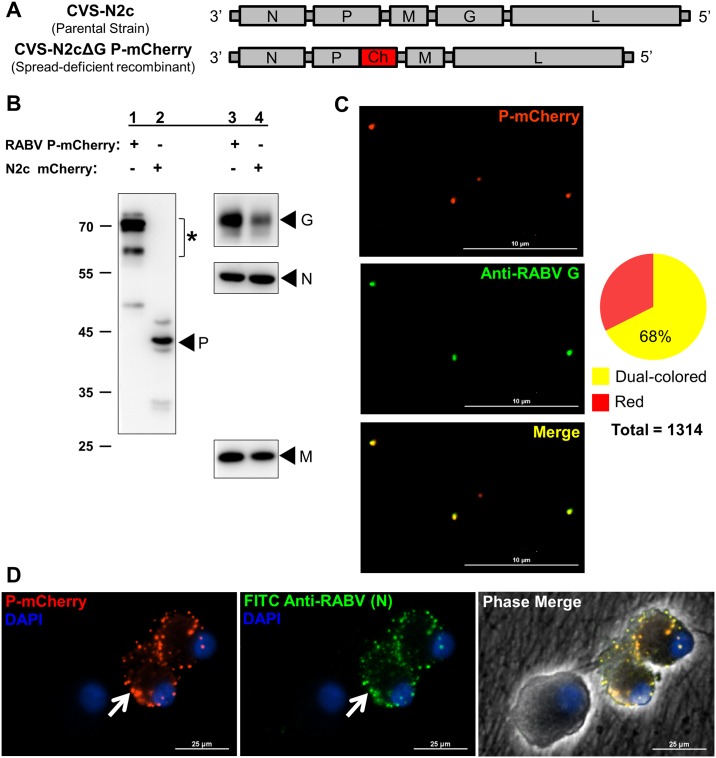
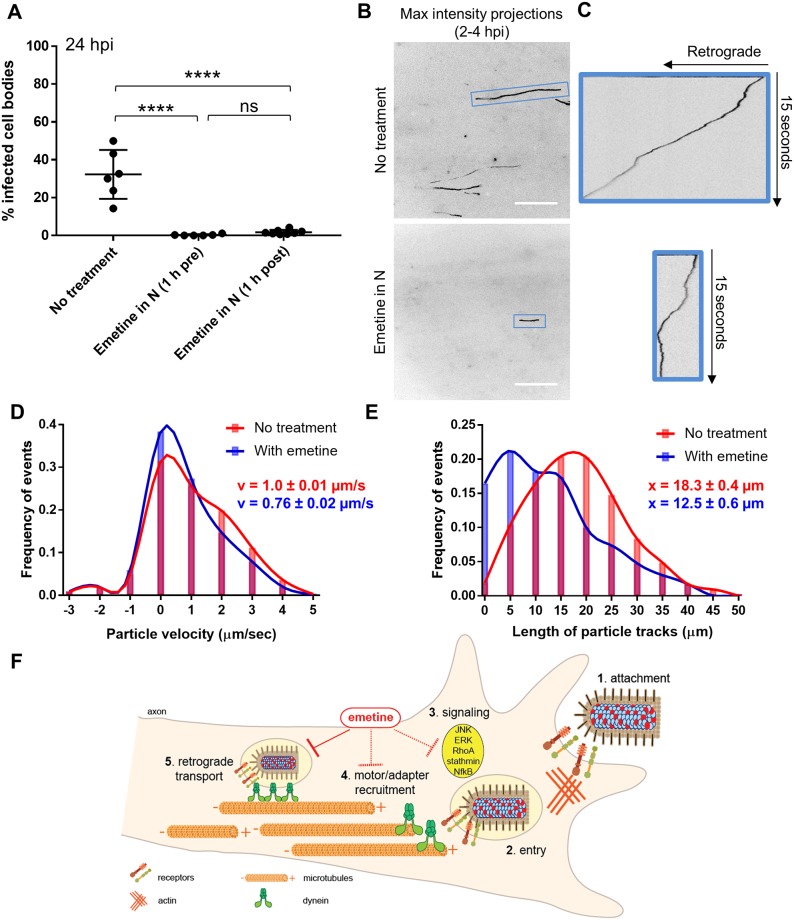
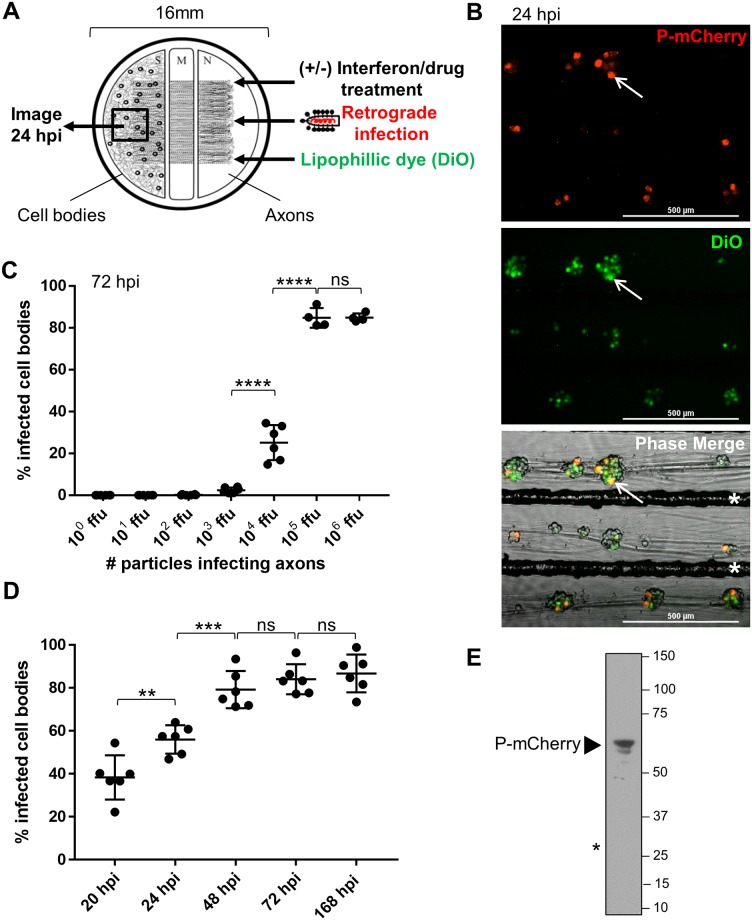
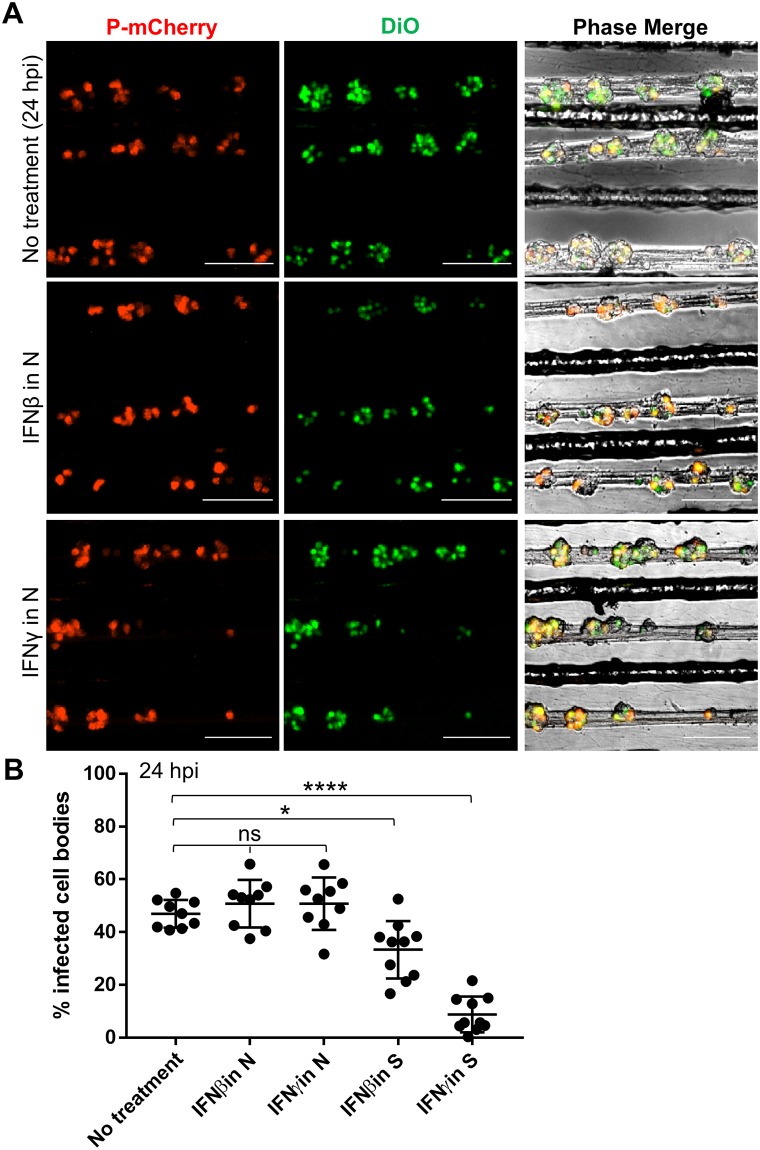
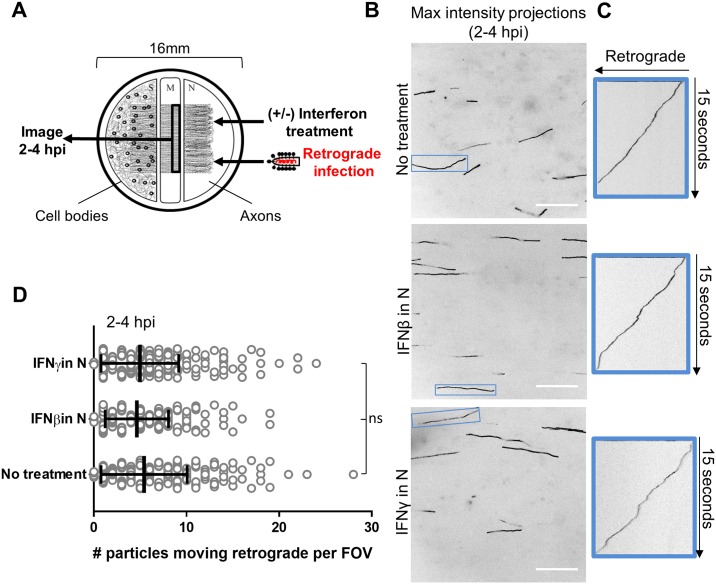
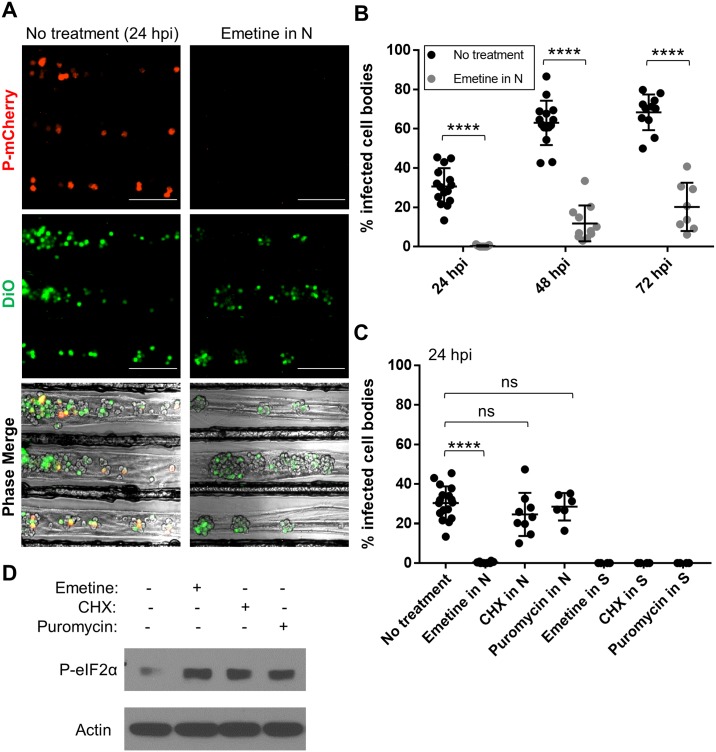
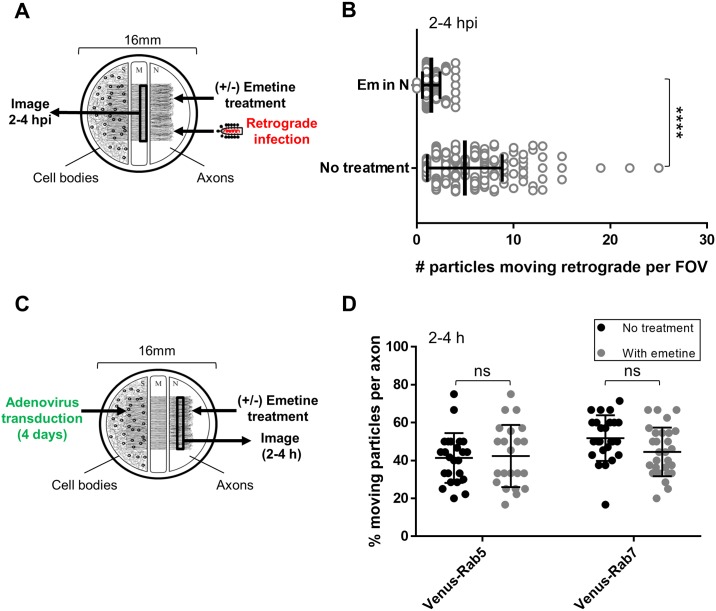
Neuroinvasive viruses, such as alpha herpesviruses (αHV) and rabies virus (RABV), initially infect peripheral tissues, followed by invasion of the innervating axon termini. Virus particles must undergo long distance retrograde axonal transport to reach the neuron cell bodies in the peripheral or central nervous system (PNS/CNS). How virus particles hijack the axonal transport machinery and how PNS axons respond to and regulate infection are questions of significant interest. To track individual virus particles, we constructed a recombinant RABV expressing a P-mCherry fusion protein, derived from the virulent CVS-N2c strain. We studied retrograde RABV transport in the presence or absence of interferons (IFN) or protein synthesis inhibitors, both of which were reported previously to restrict axonal transport of αHV particles. Using neurons from rodent superior cervical ganglia grown in tri-chambers, we showed that axonal exposure to type I or type II IFN did not alter retrograde axonal transport of RABV. However, exposure of axons to emetine, a translation elongation inhibitor, blocked axonal RABV transport by a mechanism that was not dependent on protein synthesis inhibition. The minority of RABV particles that still moved retrograde in axons in the presence of emetine, moved with slower velocities and traveled shorter distances. Emetine's effect was specific to RABV, as transport of cellular vesicles was unchanged. These findings extend our understanding of how neuroinvasion is regulated in axons and point toward a role for emetine as an inhibitory modulator of RABV axonal transport.
神经侵入性病毒,如α疱疹病毒(αHV)和狂犬病病毒(RABV),最初感染外周组织,然后侵入支配的轴突末梢。病毒颗粒必须经历长距离逆行轴突运输才能到达周围或中枢神经系统(PNS/CNS)中的神经元细胞体。病毒颗粒如何劫持轴突运输机制以及周围神经轴突如何对感染做出反应和进行调节,这些都是非常重要的问题。为了追踪单个病毒颗粒,我们构建了一种表达 P-mCherry 融合蛋白的重组 RABV,该蛋白源自强毒 CVS-N2c 株。我们研究了在存在或不存在干扰素(IFN)或蛋白质合成抑制剂的情况下 RABV 的逆行运输,这两种抑制剂先前都被报道限制了αHV 颗粒的轴突运输。使用在三腔室中生长的啮齿动物颈上神经节神经元,我们表明,轴突暴露于 I 型或 II 型 IFN 不会改变 RABV 的逆行轴突运输。然而,轴突暴露于抑制延伸的翻译抑制剂 emetine 会通过不依赖于蛋白质合成抑制的机制阻断轴突 RABV 运输。在 emetine 存在的情况下仍能逆行运输的少数 RABV 颗粒,其移动速度较慢,移动距离较短。Emetine 的作用是特异性的,因为细胞囊泡的运输没有改变。这些发现扩展了我们对轴突中神经入侵是如何被调节的理解,并表明 emetine 可能作为 RABV 轴突运输的抑制性调节剂发挥作用。